
Calories Burned By Walking 10000 Steps vs. 11 Exercises
Calories Burned By Walking 10000 Steps: Quick Answer
The StairMaster, incline walking, and burpees were among the fastest ways to match the calories burned by walking 10000 steps, but the winner differed between participants. Burpees burned calories fastest for me, while the StairMaster led for Melody and Dennis. These were calorie-burn comparisons, rather than measurements of long-term fat loss, and the exercise we would actually choose wasn’t always the one with the highest number.
Key Takeaways
- Walking 10000 steps took each of us 91 minutes and burned between 342 and 438 calories.
- StairMaster was the fastest calorie burner for Melody and Dennis. Before afterburn, Melody could match her walk in approximately 29 minutes.
- Burpees were my fastest calorie burner, even compared to the calories burned by walking 10000 steps, but not a session I’d realistically do regularly.
- At 3 miles per hour and a 9% incline, incline walking burned calories about 1.7–2.6 times as fast as our regular walks.
- Japanese interval walking saved Melody significant time, but offered little time advantage for Dennis and me.
- Dennis’s incomplete squats burned calories more slowly than the calories burned by walking 10000 steps, and the vibration plate burned only a few calories above standing.
- You don’t need 10000 steps every day, but walking still counts. The best exercise is the one you actually stick to.
Walking 10000 steps a day is one of the simplest approaches I’ve used to help myself and the people I coach lose fat. But it comes with one obvious challenge: time.
To find out whether we could match that calorie burn more efficiently, Melody, Dennis, and I tested 11 exercises using a calorie-measuring mask.

We included three people because different body types, fitness levels, and approaches to an exercise might produce very different results.
First, we needed a walking baseline.
Calories Burned By Walking 10000 Steps
Walking 10,000 steps took each of us 91 minutes and burned between 342 and 438 calories. Even though we finished in the same amount of time, the calories burned by walking 10000 steps differed between us.
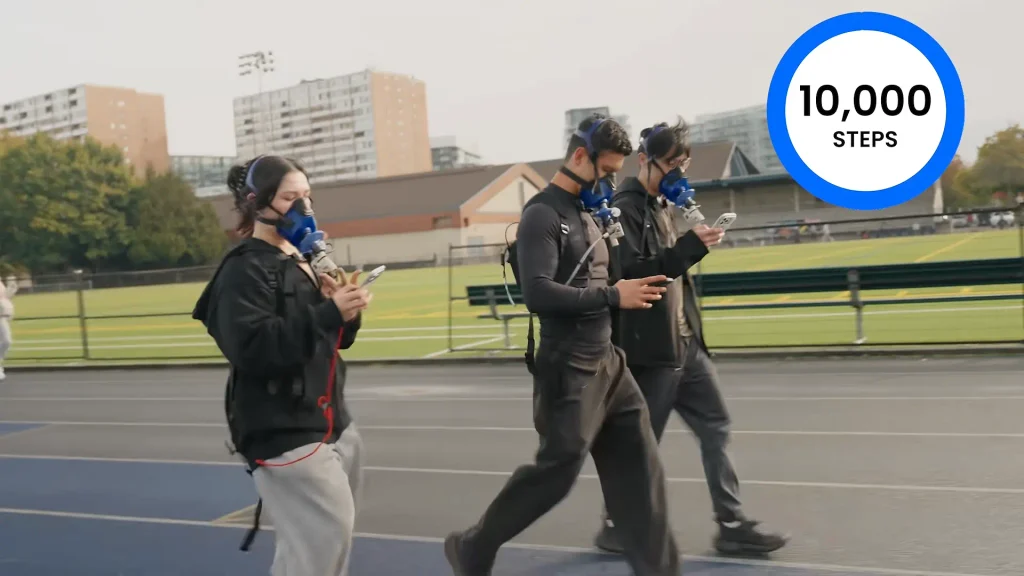
Dennis is naturally a fast walker. Melody and I tend to walk more slowly, and after about 30 minutes Dennis’s pace began to drop.
Eventually, all three of us reached exactly the same finish time.
| Participant | Time To Walk 10000 Steps | Calories Burned By Walking 10000 Steps |
| Jeremy | 91 minutes | 418 |
| Melody | 91 minutes | 438 |
| Dennis | 91 minutes | 342 |
Melody weighs close to what I do, and our calorie totals were similar. Dennis weighs about 30 pounds less than both of us and burned fewer calories.
Based on these results, multiplying body weight in pounds by 2.7 gave a rough estimate of the calories burned by walking 10000 steps. Treat that as a rough guide from this test, rather than an exact prediction. To work out how many calories you need to eat for your own goals, you can use our body recomposition calculator.
Normally, you wouldn’t need to complete all 10000 steps in one continuous session. We did it that way to establish a baseline: how long would each alternative take to match our own walking calorie burn?
And despite the time involved, walking had an obvious advantage. It was easy, accessible, and manageable.
Does Japanese Walking Burn Calories Faster Than Regular Walking?
Japanese interval walking alternates three minutes of slower walking with three minutes of faster walking. We repeated those intervals for 30 minutes to see whether changing pace could save time.
The method attracted attention because of a five-month study of middle-aged and older adults. The interval group completed at least five rounds of three minutes of slower walking followed by three minutes of faster walking, four or more days a week. A comparison group walked continuously at a moderate intensity, aiming for at least 8,000 steps a day on four or more days a week.
The interval group achieved greater improvements in leg strength, aerobic capacity, and resting systolic blood pressure, including roughly a 9% increase in peak aerobic capacity for walking.
Those results supported fitness benefits, but they didn’t answer our calorie-burn question.
For Dennis and me, the fast intervals weren’t as challenging as expected.
In the study, the fast intervals were prescribed at above 70% of each participant’s peak aerobic capacity for walking. In our test, I aimed for about 130 beats per minute, although that heart-rate target wasn’t the same measure of intensity.
Even with exaggerated arm movements, I struggled to reach it. Whenever my heart rate did rise, it dropped quickly during the slower intervals. Dennis had a similar experience.
Melody’s response was different. Her heart rate climbed higher and remained relatively elevated during the slower portions, suggesting that the workout was more challenging for her.
| Participant | Calories Burned In 30 Minutes |
| Jeremy | 152 |
| Melody | 249 |
| Dennis | 114 |
For Dennis and me, interval walking offered little meaningful time advantage over our regular walks.
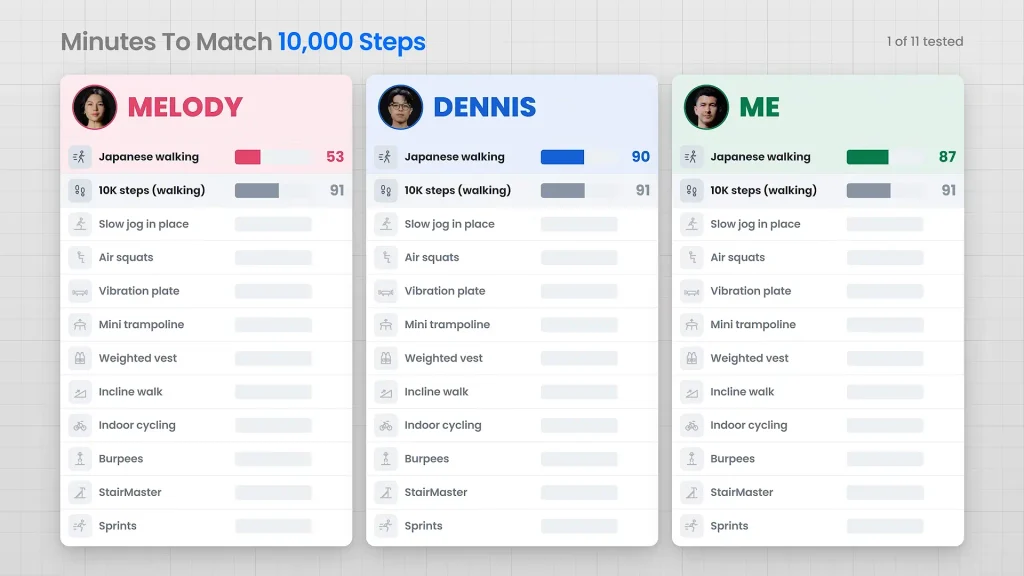
For Melody, it was a legitimate time-saver. At her measured rate, she could match the calories burned by walking 10000 steps in approximately 53 minutes instead of 91.
That matters because Melody is working with me to try to lose 20 pounds of fat before starting a family. Walking has helped her so far, but a busy work schedule and cold weather have made it harder to maintain.
Still, a higher calorie burn doesn’t automatically make a workout more appealing. Before seeing her results, Melody said she would rather do her usual 10000 steps.
Can Slow Jogging At Home Replace Walking?
Slow jogging to a beat is an indoor alternative that produced a calorie burn broadly similar to the calories burned by walking 10000 steps. It offered only a slight advantage for Melody, but its convenience made it worth considering.
The version we tested involved three simple cues:
- Follow a 180 BPM rhythm. Take one light step with each beat.
- Stay light on your toes. Avoid landing on your heels.
- Stay relaxed and upright.
Before long, my living room had turned into something resembling a fat-loss nightclub.
The beat helped keep everyone’s pace consistent. Unlike a self-paced exercise, it was harder to accidentally speed up or slow down.
None of us felt particularly out of breath, yet our heart rates were roughly 10 beats per minute higher than during regular walking. We rated the effort at around 3–3.5 out of 10.
Overall, it was close to a one-for-one swap with walking: roughly 10 minutes equated to the calorie burn of about 1,000 steps. So a 100 minutes equals the calories burned by walking 10000 steps.
That makes it a useful option when you’re indoors, watching TV, or trying to fit movement around cold weather. It doesn’t need to dramatically outperform walking to solve a practical problem.
Do Air Squats Burn More Calories Than Walking?
Air squats burned calories almost twice as fast as the calories burned by walking 10000 steps for me, but the benefit depended heavily on how we performed them. Dennis’s results were very different.
We used a metronome set to 30 beats per minute, aiming for one squat per beat.
Squats involve substantial lower-body muscle activity. How many calories an exercise burns depends partly on how much muscle is working and how hard those muscles work.
But that advantage depends on actually doing the movement.
Dennis began struggling early, and his repetitions became increasingly incomplete. The workout felt difficult to him, but his calorie burn didn’t reflect the same amount of work as ours.
| Participant | Calories Burned In 10 Minutes |
| Jeremy | 81 |
| Melody | 78 |
| Dennis | 29 |
Dennis’s 29 calories meant he actually burned calories more slowly than the calories burned by walking 10000 steps. His experience showed why an exercise feeling difficult doesn’t necessarily mean it produces a high calorie burn, especially when the repetitions become incomplete.
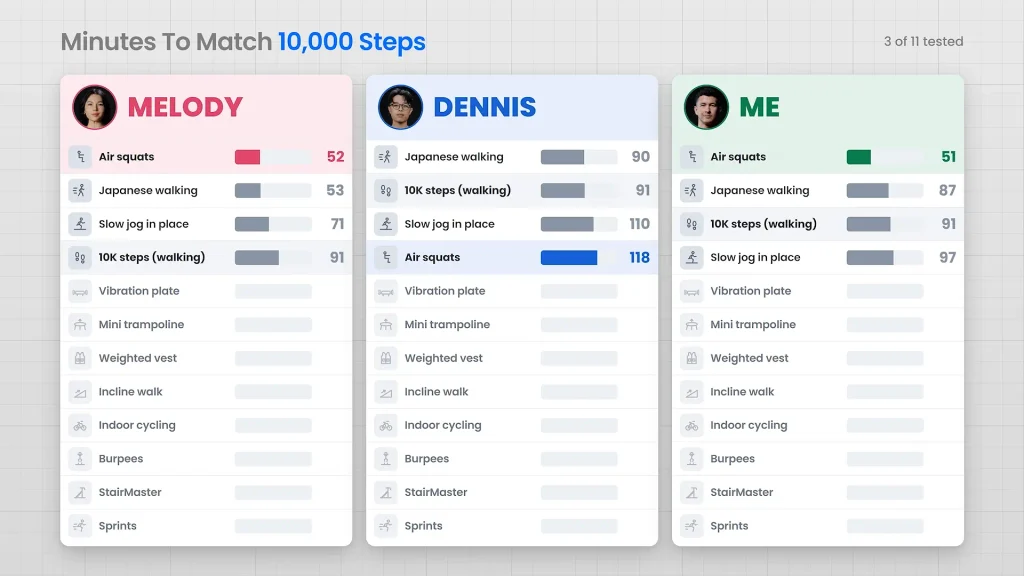
For me, squats were surprisingly effective. The metronome also helped keep me accountable.
Still, I couldn’t see myself doing approximately 52 minutes of continuous squats just to replace the calories burned by walking 10000 steps.
Breaking up sitting may offer a separate benefit. In a study of young men with overweight or obesity, three-minute squatting breaks every 45 minutes improved post-meal blood glucose control more than one continuous 30-minute walk during prolonged sitting. Short walking breaks also outperformed the single walk. The squat breaks and walking breaks produced similar results.
The intermittent activity conditions were matched to the continuous walk for total activity time and energy expenditure. One possible explanation is that repeatedly working the leg muscles helps them take up glucose from the blood and use it for energy.
That’s a different outcome from burning the most calories, but it gives those short movement breaks another purpose.
Do Vibration Plates Burn Many Calories?
Standing on a vibration plate burned only a small number of calories in our test. It was easy, but it wasn’t an efficient replacement for the calories burned by walking 10000 steps.
We bought a $100 vibration plate and used its highest setting.
When Dennis first suggested including it, I was skeptical. But there is some research behind whole-body vibration training.
In one 10-week study, women with obesity completed twice-weekly sessions that included 14 minutes of vibration while performing static leg and arm exercises. Compared with a non-exercising control group, the training group finished with greater leg strength and lower total and trunk fat after accounting for baseline differences.
That doesn’t mean the training group lost a large amount of fat: its average total fat mass changed little, while the control group gained fat. The study also received partial funding from the device manufacturer. Because there was no comparison group performing the same exercises without vibration, it couldn’t isolate the contribution of the vibration itself.
Our own calorie results were modest.
| Participant | Calories Burned In 10 Minutes |
| Jeremy | 28 |
| Melody | 33 |
| Dennis | 22 |
We all rated the effort at 1 out of 10. I felt more relaxed afterward than when I started.
But these totals were only a few calories above simply standing. Matching the calories burned by walking 10000 steps would require hours on the plate.
Does Rebounding Burn More Calories Than Walking?
Rebounding means bouncing and moving on a mini trampoline, often to music. It beat the calories burned by walking 10000 steps for all three of us, although it fell well below the online calorie claims we wanted to test.
You’ll see claims that rebounding burns 500–800 calories an hour, putting it in the territory of running.
Our experience didn’t match those numbers, but the workout challenged our coordination and brought out everyone’s inner kid.
| Participant | Calories Burned In 10 Minutes |
| Jeremy | 62 |
| Melody | 66 |
| Dennis | 41 |
Rebounding became Dennis’s best result at that point in the experiment. Squats remained ahead for me, while Japanese interval walking still led for Melody.
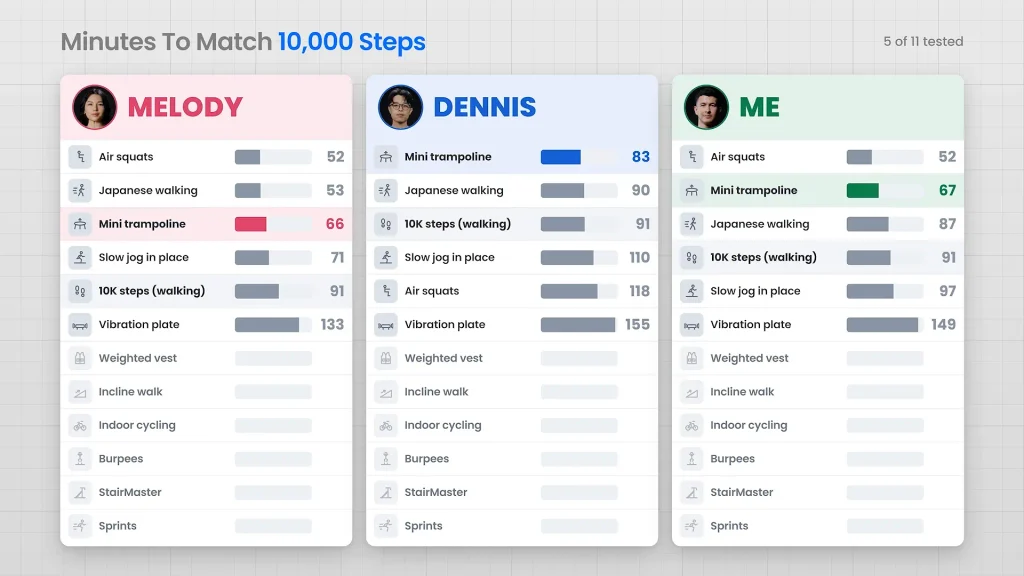
It also had something a calorie table doesn’t capture particularly well: we were having fun.
How Much Does A Weighted Backpack Increase Calorie Burn?
Rucking is walking with added weight, such as a loaded backpack or weighted vest. With a 20-pound backpack, we burned calories approximately 20–30% faster than the calories burned by walking 10000 steps.
Each of us completed a 20-minute walk carrying the same added weight.
The extra load made walking feel noticeably harder. The calorie increase was useful, although less dramatic than the effort might suggest.
| Participant | Calories Burned In 20 Minutes |
| Jeremy | 108 |
| Melody | 128 |
| Dennis | 91 |
Over a full 10,000 steps, that increase could amount to roughly another 100 calories.
That’s a meaningful difference over the calories burned by walking 10000 steps, but the next form of walking produced a much bigger change in our test.
Is Incline Walking More Efficient Than Flat Walking?
Incline walking substantially increased calorie burn for all three of us. We walked at 3 miles per hour on a 9% incline for 20 minutes.
We also set one rule: no holding onto the treadmill and leaning backward to make the incline easier.
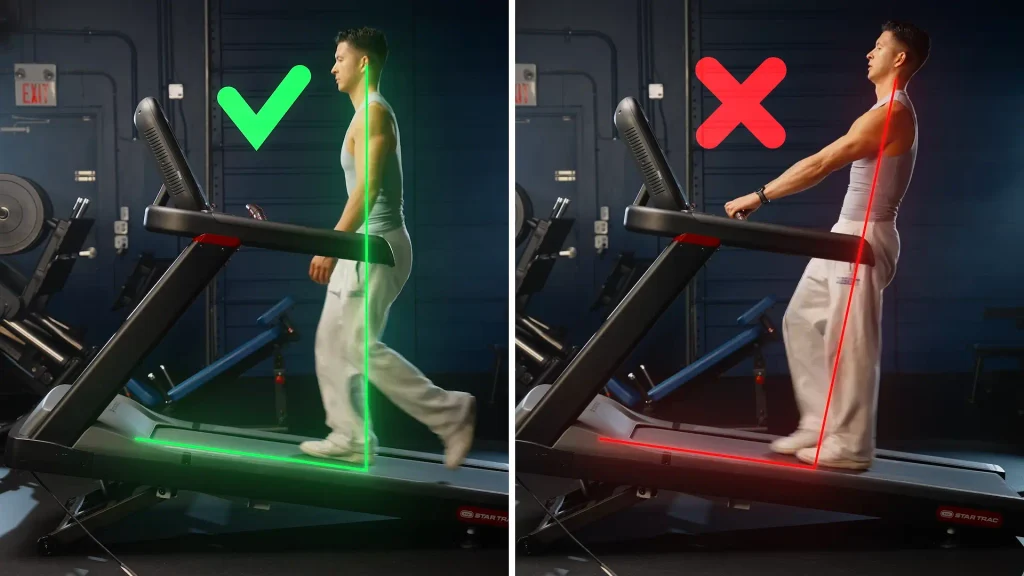
The point was to make our legs do the work. Walking uphill makes large lower-body muscles, including the quads and glutes, work harder.
Our measured results showed a substantial increase:
| Participant | Calories Burned In 20 Minutes |
| Jeremy | 166 |
| Melody | 252 |
| Dennis | 124 |
Compared with the calories burned by walking 10000 steps, incline walking burned calories about 1.8 times as fast for me, 1.7 times as fast for Dennis, and 2.6 times as fast for Melody.
At those measured rates, matching our 10,000-step walks would take approximately 50 minutes for me, 55 minutes for Dennis, and 35 minutes for Melody, assuming we maintained the same pace.
At this point in the experiment, incline walking had become the fastest option we’d tested for all three of us.
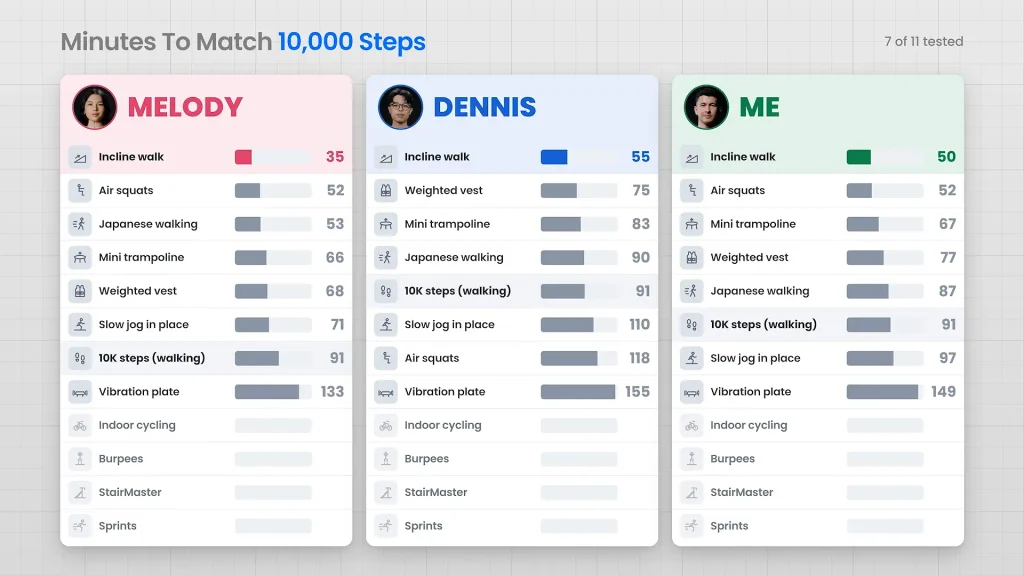
Melody carries much of her muscle in her lower body, which might help explain her particularly high result, alongside differences in fitness. That remains a possible explanation rather than something this experiment established.
It’s also why my work with Melody involves more than cardio. We combine it with challenging weight training and a proper diet.
If you want a personalized plan that adjusts based on how your body responds, you can try two weeks free of the Built With Science app.
How Does Cycling Compare With Walking?
Comfortably paced cycling gave each of us an advantage over regular walking, but the size of that advantage depended on effort.
Unlike incline walking, we didn’t standardize a resistance or speed. Everyone was told to choose a comfortable pace.
I pushed a little harder, which may explain why cycling was one of the few exercises where my calorie burn exceeded Melody’s.
| Participant | Calories Burned In 20 Minutes |
| Jeremy | 130 |
| Melody | 119 |
| Dennis | 88 |
These results illustrate an important distinction: the name of an exercise doesn’t determine its calorie burn by itself.
With a self-paced activity, how hard you choose to work matters.
Are Burpees The Fastest Calorie Burner?
Burpees were my fastest calorie burner in the experiment, but their demanding nature made them a less appealing everyday choice.
We set a 10-minute timer with a target of 100 burpees each.
Everyone started well. Then Dennis’s push-ups became shallower, and his jumps became increasingly difficult to describe.
Melody kept working hard and passed 50 repetitions. I finished with 100.
For Melody and me, our heart rates climbed higher than during any of the exercises we had tested up to that point.
| Participant | Calories Burned During 10 Minutes Of Burpees |
| Jeremy | 128 |
| Melody | 95 |
| Dennis | 45 |
My result worked out to roughly 1.3 calories per burpee in that session.
We also measured the “afterburn effect”: additional calories burned during recovery after the workout.
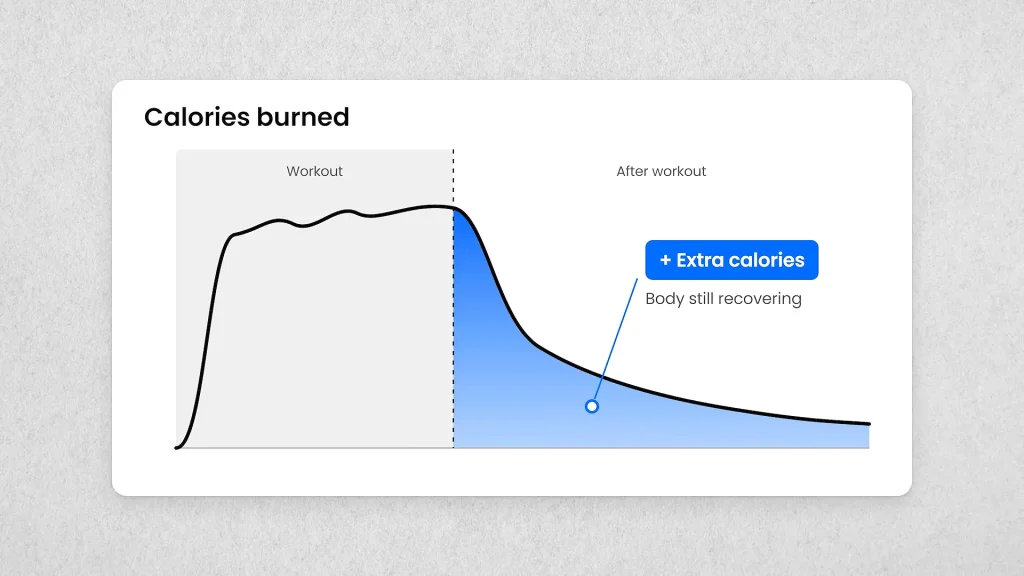
We kept our masks on for approximately 10–20 minutes afterward, until our heart rates returned to baseline. That recovery period added roughly 10% to each person’s exercise calorie total.
That was a useful extra contribution, but it required additional time beyond the 10-minute workout.
Burpees moved into first place for me and were a strong result for Melody compared to the calories burned by walking 10000 steps. Dennis’s lower effort and shortened repetitions produced a much less impressive return.
How Does The StairMaster Compare With Walking?
The StairMaster was the fastest calorie burner for Melody and Dennis and my second-fastest option. We used speed level 7 for 20 minutes.
Each step requires you to lift your body weight using large lower-body muscles. Setting the machine’s pace also makes it harder to gradually slow down.
At least, that was the idea.
Dennis found another way to reduce the challenge: leaning more and more of his weight onto the machine.
Meanwhile, Melody’s heart rate climbed to 175 beats per minute, higher than it had reached during burpees.
I regularly use the StairMaster after workouts, so my heart rate didn’t climb quite as high. It still felt like a solid session.
| Participant | Calories Burned During 20 Minutes |
| Jeremy | 224 |
| Melody | 300 |
| Dennis | 136 |
There was also some additional recovery calorie burn, particularly for Melody.
Even with Dennis leaning on the machine, the StairMaster produced his highest calorie-burn rate of the experiment.
For Melody, the exercise-only totals imply approximately 29 minutes to match the calories burned by walking 10000 steps, assuming she maintained the same rate. That estimate excludes the extra recovery calories.
Do Sprints Burn More Calories Than Other Exercises?
Our sprint session was demanding, but it didn’t beat the leading exercises for total calories burned. Much of the session was spent recovering between sprints.
For 10 minutes, we alternated all-out sprints with short recovery walks.
Dennis surprised me with his speed and effort. After finding ways to make several earlier exercises easier, he pushed hard here.
But working harder during each burst didn’t automatically produce the highest total.
Including the measured afterburn, the results were:
| Participant | Calories Burned, Including Afterburn |
| Jeremy | 95 |
| Melody | 96 |
| Dennis | 61 |
The recovery walks help explain the result. A sprint is intense, but the full session includes time when you aren’t sprinting.
How Long Would Each Exercise Take To Match Calories Burned By Walking 10000 Steps?
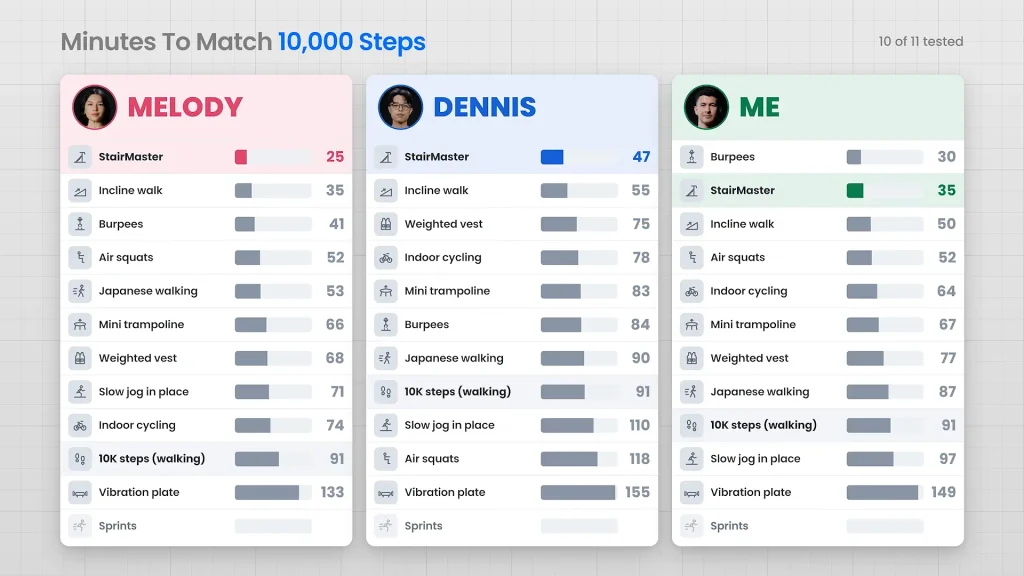
These estimates show how long each exercise would take to match the calories burned by walking 10000 steps, assuming the measured rate continued. The 91-minute walk was measured directly; the other numerical durations are extrapolations.
| Exercise | Jeremy: Minutes | Melody: Minutes | Dennis: Minutes |
| Walking 10,000 steps | 91 | 91 | 91 |
| Japanese interval walking | 83 | 53 | 90 |
| Slow jogging to a beat | Broadly similar to walking | Slightly less than walking | Broadly similar to walking |
| Air squats | 52 | 56 | 118 |
| Vibration plate | 149 | 133 | 155 |
| Rebounding | 67 | 66 | 83 |
| Walking with a 20-pound backpack | 77 | 68 | 75 |
| Incline walking | 50 | 35 | 55 |
| Cycling | 64 | 74 | 78 |
| Burpees | 33 | 46 | 76 |
| StairMaster | 37 | 29 | 50 |
| Sprint intervals | Not calculable on the same basis | Not calculable on the same basis | Not calculable on the same basis |
Estimates are rounded to the nearest minute and exclude afterburn. The reported sprint totals include afterburn without a separate exercise-only figure, so comparable estimates cannot be calculated. These projections do not mean participants can sustain each activity for the full estimated duration.
Which Exercise Would I Recommend For Each Of Us?
None of this means cutting out walking. We should still get some steps in, but it doesn’t have to be 10000 every day. That’s where these other exercises can help.
The highest calorie-burn rate also wasn’t always the best practical choice. My recommendations depended on what each person could realistically keep doing.
Dennis: Incline Walking
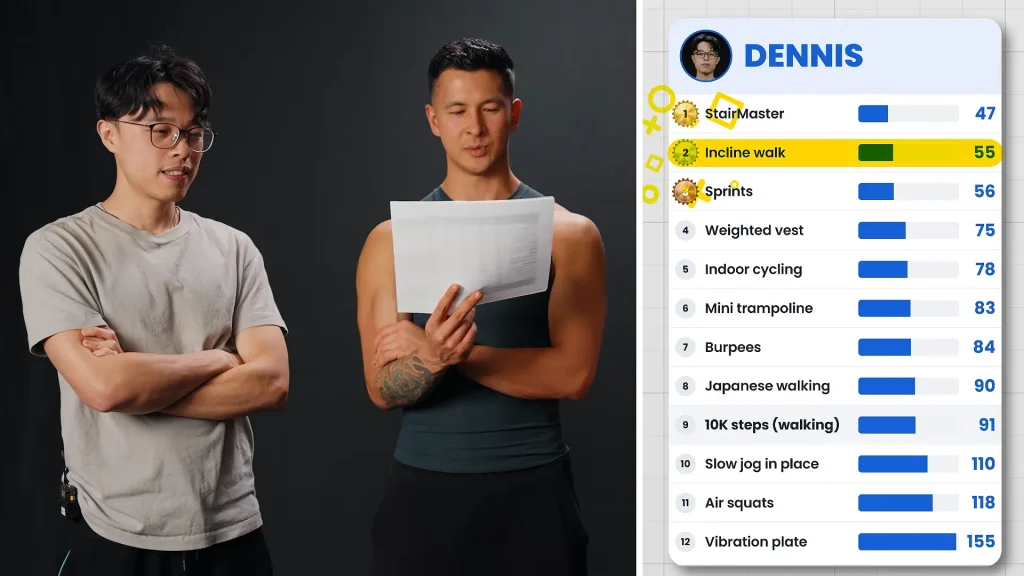
The StairMaster was Dennis’s fastest calorie burner, despite how much weight he rested on the machine.
But I would recommend incline walking for him. It burned almost as many calories per minute as the calories burned by walking 10000 steps, and he got through it with much less complaining.
That makes it a more realistic choice for him.
Jeremy: StairMaster
Burpees won on calorie-burn rate for me.
But I can’t honestly see myself regularly doing that session outside a video.
The StairMaster was my second-highest burner and would be my pick. I already use it regularly — there’s a reason I have one in my garage.
Melody: The StairMaster Led On Calorie Burn

The StairMaster was Melody’s clear calorie-burn winner. Before counting afterburn, it burned calories about three times as fast as the calories burned by walking 10000 steps.
At her measured exercise rate, she would match her 438-calorie walking total in approximately 29 minutes, assuming she maintained the same pace.
But the final choice should still be hers. Rebounding, incline walking, and the StairMaster offered different combinations of effort, convenience, and enjoyment. The calorie results help inform that choice without making it for her.
Her results also showed why it’s worth considering alternatives. Japanese interval walking worked much better for her than it did for Dennis or me, while jogging around the living room offered a practical indoor substitute.
Whether it’s the StairMaster, living-room jogging, plain walking, or a few minutes of air squats, it all counts.
The best exercise is rarely just the one that burns the most calories. It’s the one you actually stick to.
If you want a more personalized plan, you can try two weeks free of the Built With Science app.
Frequently Asked Questions
How Many Calories Does Walking 10,000 Steps Burn?
In our test, the calories burned by walking 10000 steps ranged from 342 to 438, and the walk took each of us 91 minutes. Melody and I, who weigh about the same, burned similar amounts, while Dennis, about 30 pounds lighter, burned the least. Multiplying body weight in pounds by 2.7 gave a rough estimate for our walks.
Do You Need To Walk 10,000 Steps Every Day?
No — you don’t have to walk 10,000 steps every day. Walking still counts, and other exercises can contribute alongside it.
Does Japanese Walking Work Equally Well For Everyone?
Its calorie-burn advantage differed substantially between participants in our test. It offered little time savings for Dennis and me, while Melody could match her walking baseline in approximately 53 minutes instead of 91.
What Can You Do Instead Of Walking Outside?
Slow jogging to a beat was a practical indoor alternative in our test, with roughly 10 minutes matching the calorie burn of about 1,000 steps. Rebounding also beat our walking calorie-burn rates, while incline walking and the StairMaster offered larger time savings.
Does The Afterburn Effect Make A Big Difference?
After burpees, the recovery calories added roughly 10% to our exercise totals. We measured those extra calories over approximately 10–20 additional minutes, so they weren’t all burned during the workout itself.