
Best Ab Exercises: 30 Tested and Ranked for Building Abs
Quick Answer: What Are The Best Ab Exercises?
We tested 30 popular ab exercises with EMG, scoring each against three criteria: how easily you can progressively overload it, whether it loads the abs in a deep stretch, and how much it works the abs relative to the hip flexors. A handful of cable-crunch and pelvis-curl variations came out on top, while planks, butterfly kicks, and mountain climbers landed at the bottom. Here’s the full best-to-worst ranking, plus the best ab exercises for beginners and advanced lifters.
Key Takeaways
- The best ab exercises share three traits: they’re easy to progressively overload, they load the abs in a deep stretch, and they work the abs more than the hip flexors.
- Top picks by experience level — beginners: the face-away lat pulldown cable crunch (upper abs) and the reverse crunch with an ab mat (lower abs); advanced lifters: the same upper-ab pick, with Garhammer raises for the lower abs.
- Least effective for building abs (F-tier): the standard plank, butterfly kicks, and mountain climbers.
- Your abs are one continuous muscle; you can bias the upper versus lower region, but you can’t truly isolate them, and whether that changes regional growth hasn’t been shown.
- EMG measured muscle activation, not growth: high activation alone doesn’t make an exercise best; the dragon flag produced the most activation yet ranks only B-tier.
- Even well-developed abs won’t show without a low enough body-fat level, so pair your training with your diet.
What works best for an advanced lifter might not work best for a beginner. So Dennis, our beginner test subject, did every exercise with me while we compared how each movement performed based on three criteria, along with EMG measurements from the upper abs, lower abs, and hip flexors.
At the other end of the ranking, the standard plank, butterfly kicks, and mountain climbers all landed in F-tier for building your abs.
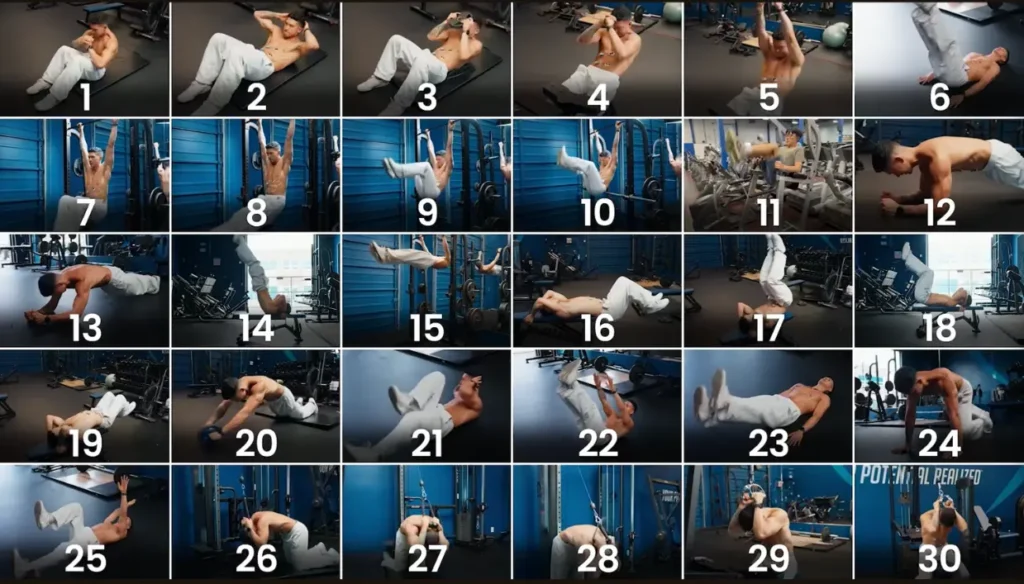
Here’s how all 30 stacked up, and which came out as the best ab exercises for building abs.
What Makes The Best Ab Exercises Effective?
The best ab exercises all tick three boxes: they’re easy to progressively overload, they put your abs under tension in a deep stretch, and they produce high ab activation relative to your hip flexors.
Can You Progressively Overload It?
Your abs respond and grow just like any other muscle does, so you should train them the same way.
That means an exercise should give you a practical way to make it harder as you get stronger, such as adding weight or increasing the difficulty of the movement.
Does It Stretch Your Abs?
A great ab exercise should also give your abs a deep stretch with tension in that stretched position.
That tension in the stretched position creates a powerful signal for your muscles to grow.
If an exercise prevents your abs from reaching that position, you’re limiting part of the movement — similar to performing only the top half of a biceps curl.
Do Your Abs Work More Than Your Hip Flexors?
Finally, I want high ab activation relative to the hip flexors.
To compare this, we used EMG sensors placed on the upper abs, lower abs, and hip flexors throughout the testing.
With those three criteria established, let’s start with one of the most common ab exercises.
Are Sit-Ups And Crunches Good For Building Abs?
Sit-ups and basic floor crunches are often thought to be among the best ab exercises, but both have limitations for building your abs. Crunches improve on sit-ups by reducing hip-flexor involvement, but the floor still prevents your abs from reaching a deep stretch.
Neither cracks our list of the best ab exercises, but a few small modifications make a major difference.
Sit-Ups — D-Tier
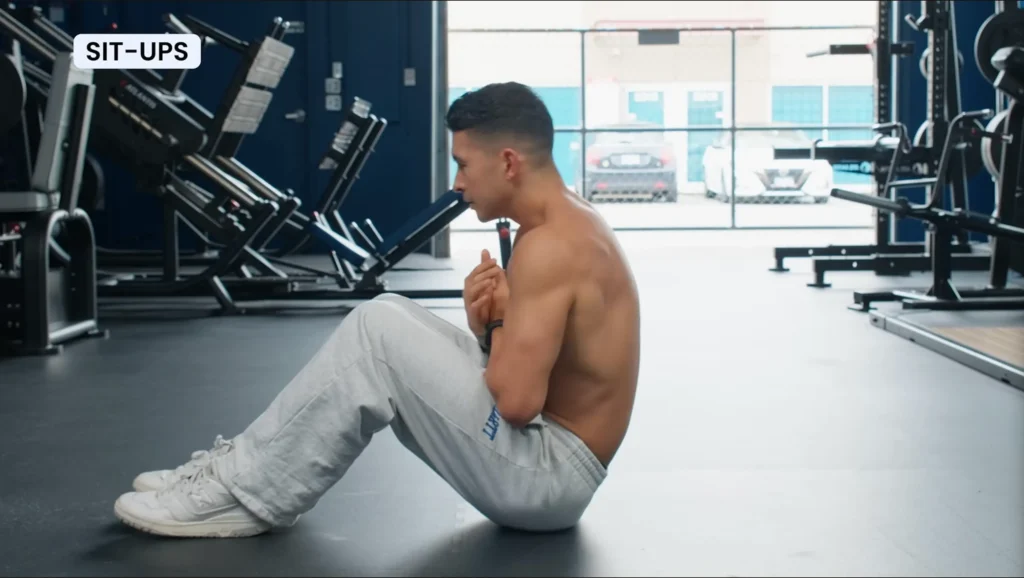
Sit-ups are actually not very good for building your abs.
They score well for progressive overload because you can simply hold a weight as you get stronger.
The problem is the other two criteria needed for the best ab exercises.
First, doing sit-ups on the floor limits how deeply your abs can stretch. Second, while our EMG showed high upper-ab activation during the first half of the movement, the hip flexors increasingly took over during the latter half to pull the upper body up.
Because of those limitations, sit-ups go into D-tier on our list of the best ab exercises.
Crunches — C-Tier
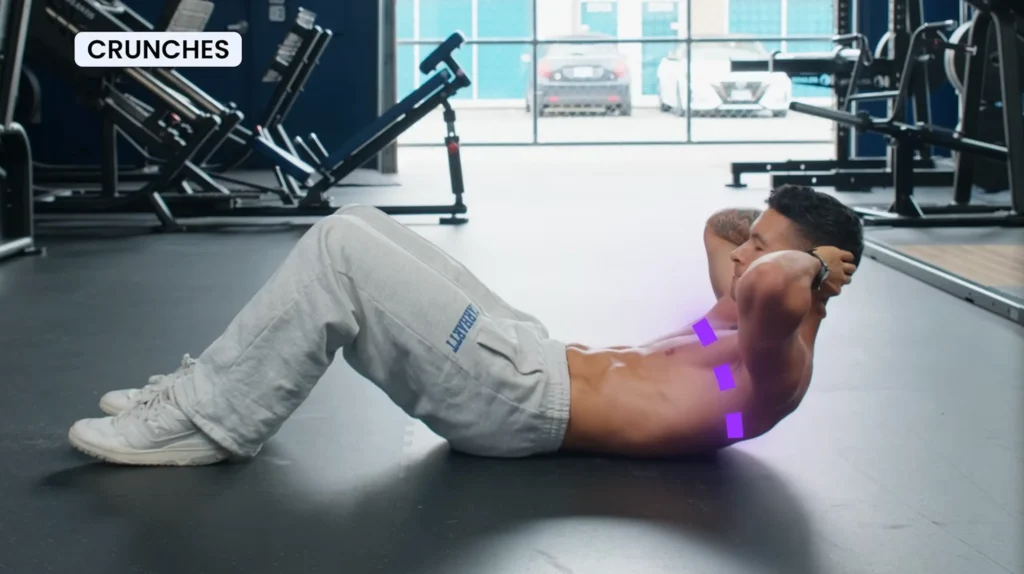
A crunch removes the portion of the sit-up where the hip flexors start taking over.
Instead, the movement focuses more directly on what the abs are meant to do: bring the rib cage down toward the pelvis by flexing the spine into a C-shape.
Our EMG reflected that change, showing far less hip-flexor activation and far more ab activation.
However, the floor still prevents the abs from getting a deep stretch at the bottom.
That puts crunches in C-tier on our list of the best ab exercises.
Crunches With An Ab Mat Or Towel — A-Tier
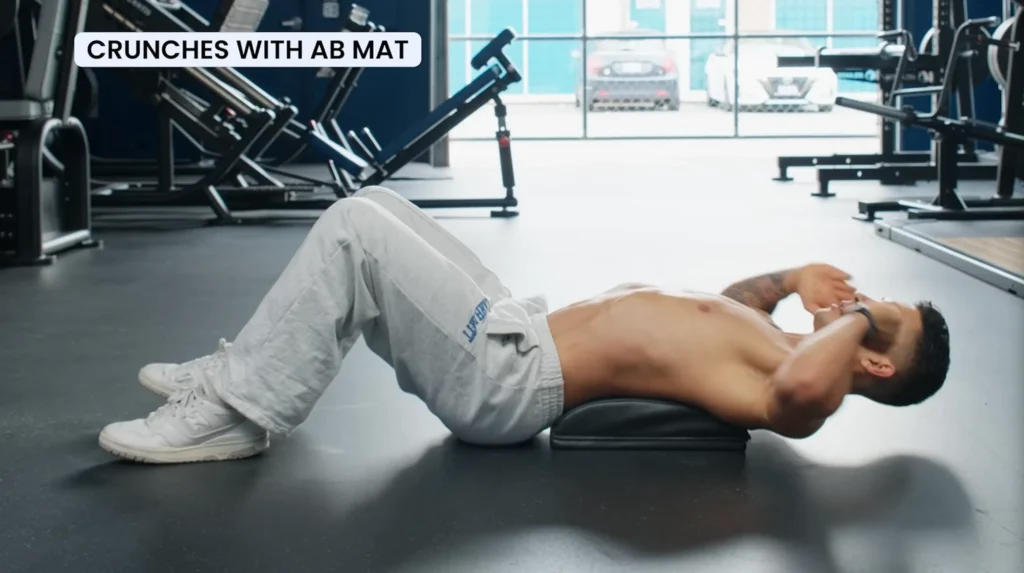
Put an ab mat — or even a rolled-up towel — under your lower back, and the movement changes considerably.
Now your abs can move into a much deeper stretch, making this the first exercise we’ve tested that ticks all three boxes.
There are still drawbacks. It requires an extra piece of equipment, and Dennis demonstrated two common ways people can cheat the exercise: swinging the arms or sticking the neck forward instead of keeping the tension on the abs.
It’s the best option so far, but I think we can do better. A-tier on our list of the best ab exercises.
Unassisted Lat Pulldown Crunch — A-Tier
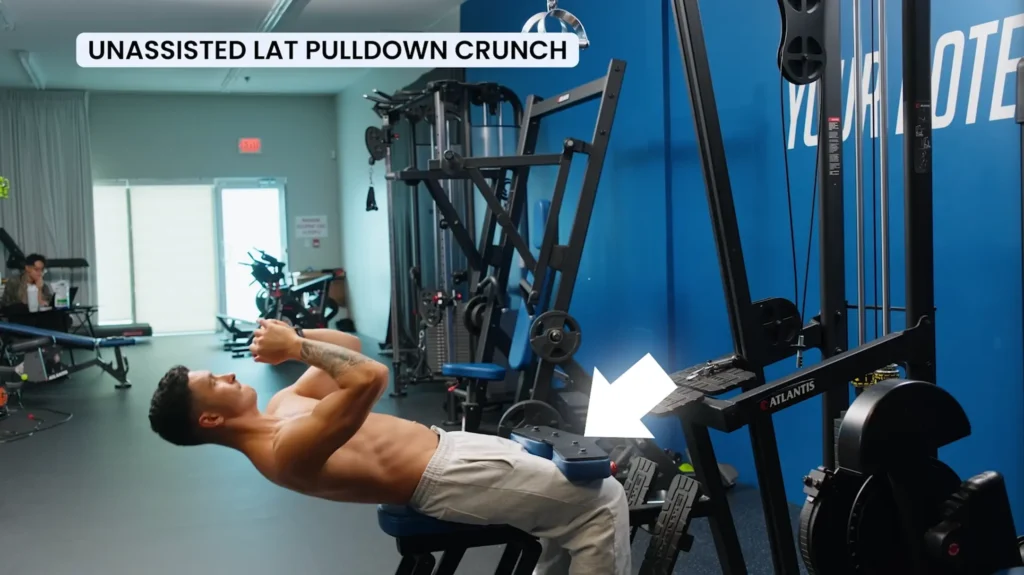
You can also perform crunches on a lat pulldown machine.
The pad locks your knees into position, creating more stability. And because the floor isn’t limiting your movement, your abs can reach a deep stretch at the bottom.
The problem is difficulty.
Even I can only get around eight clean reps before my form starts breaking down. Dennis couldn’t complete the full range of motion and ended up using his hands to help.
So while this probably isn’t going to be one of our two best ab exercises for beginners, it’s still an excellent movement if you can perform it properly. A-tier on our list of the best ab exercises.
Assisted Lat Pulldown Crunch — S-Tier
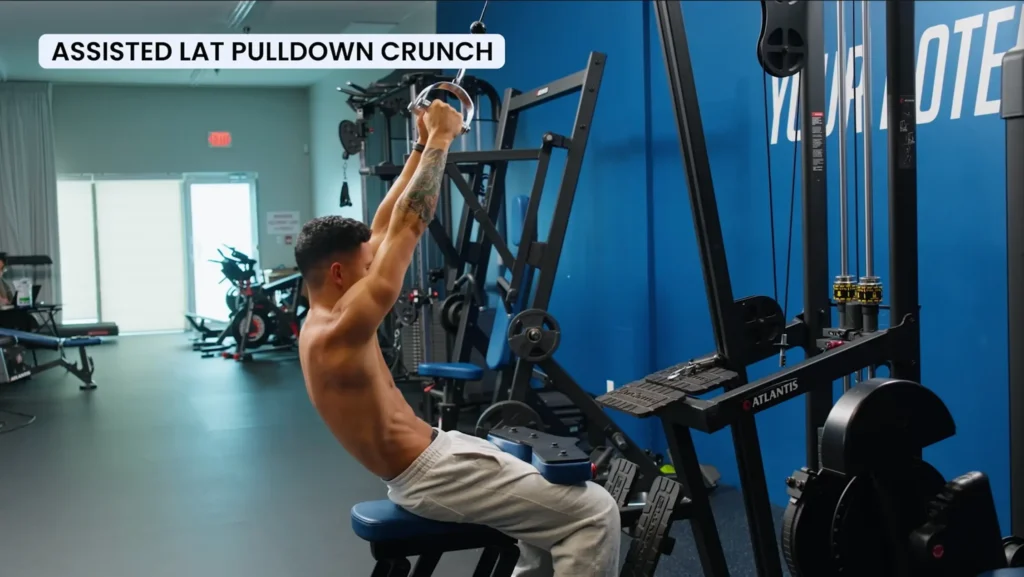
The assisted version solves the difficulty problem by using the cable to provide a light upward pull.
It works almost like an assisted pull-up machine: the cable helps you control the descent and assists you as you crunch back up. The heavier the weight you select, the more assistance you receive.
Dennis went from being unable to complete one unassisted rep to performing a set of 10.
He also found the movement extremely stable because the two pads prevented his body from shifting around.
That makes the assisted lat pulldown crunch our first S-tier exercise, the cream of the crop for the best ab exercises.
Can You Target Your Upper And Lower Abs?
Your “abs” are technically one continuous muscle, so you can’t isolate the upper and lower abs in the same way you might isolate an entirely different muscle.
However, certain movements do seem to place more demand on the upper versus lower fibers.
Across the crunch-type movements we’d tested so far, our EMG measurements consistently showed considerably more upper-ab activation than lower-ab activation.
Nobody has yet actually studied whether this difference would lead to more growth in one region. My guess is that it could make a difference, but that’s still a guess rather than something we can say has been demonstrated.
With that in mind, we tracked whether each exercise emphasized the upper abs, lower abs, or both relatively equally.
And that brings us to one of the most popular “lower-ab” exercises: leg raises.
Are Leg Raises Good For Your Abs?
Leg raises can increase lower-ab activation, but simply lifting your legs primarily involves the hip flexors. The exercise becomes much more effective for the abs when you actively curl the pelvis into a C-shape rather than just raising the legs.
Lying Leg Raises — D-Tier
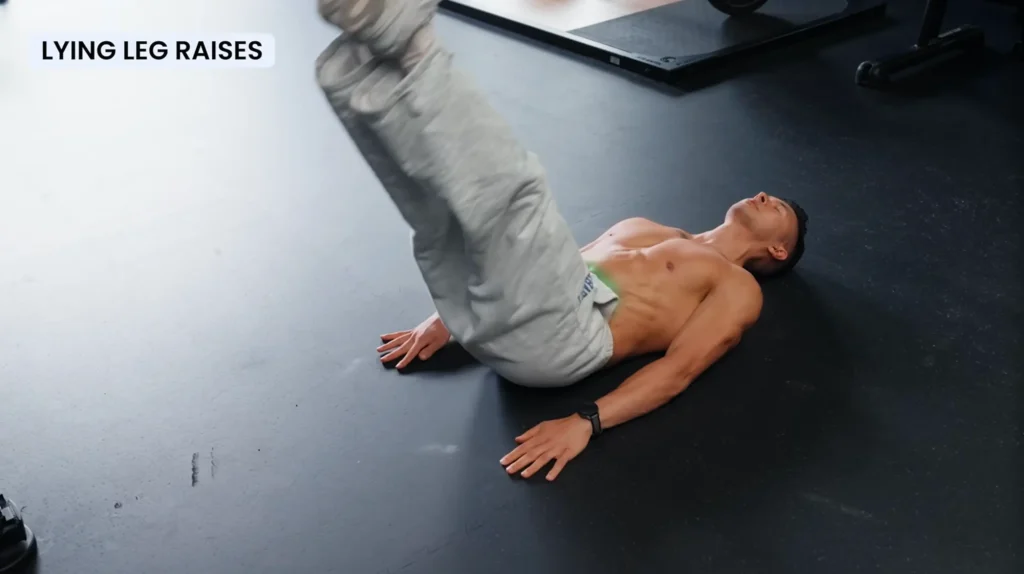
Lying leg raises produced the highest hip-flexor activation of any exercise we’d tested up to this point in our search for the best ab exercises.
That’s because your abs are mainly stabilizing your body while your hip flexors pull your legs upward.
They also have the same problem as floor crunches: the floor prevents your abs from reaching a full stretch.
That said, lower-ab activation was higher than during crunches, suggesting this general type of motion may be important for increasing demand on the lower abs.
Overall, though, lying leg raises go into D-tier on our list of the best ab exercises.
Hanging Bent-Knee Leg Raises — D-Tier
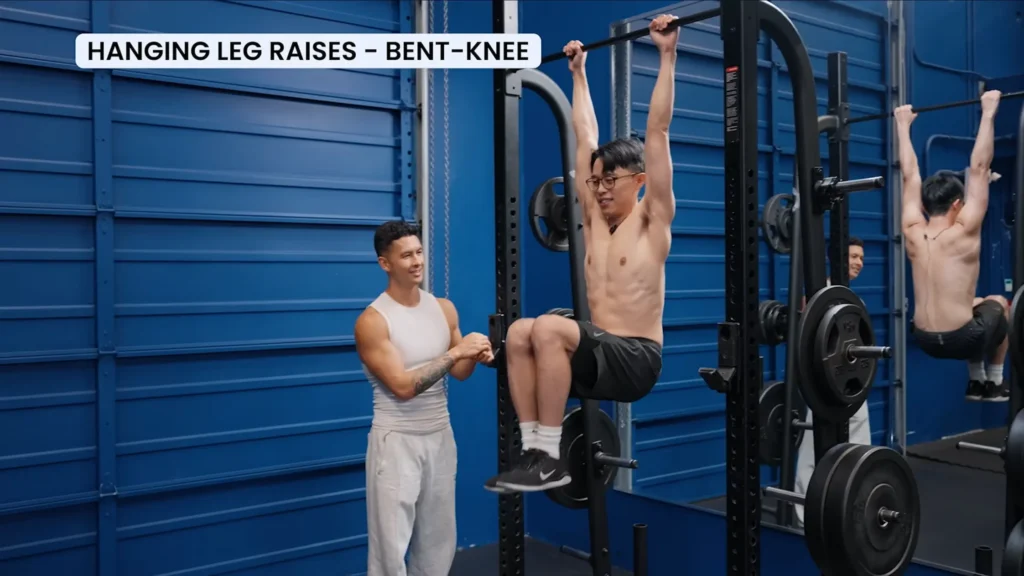
Hanging from a bar doesn’t automatically solve the problem.
With the bent-knee version, your hip flexors are again primarily responsible for pulling your knees upward.
That makes this a good hip-flexor exercise, but not a great choice based on what we’re looking for in terms of the best ab exercises. D-tier.
Hanging Straight-Leg Raises — D-Tier
Straightening your legs into an L makes the movement harder, but much of that additional difficulty goes to your hip flexors.
By straightening the legs, you’re creating a longer lever — similar to the difference between holding a weight close to your chest and holding it with your arms extended in front of you.
Our testing showed only a very slight increase in ab activation but a 40% increase in hip-flexor activity, from 473 to 663 µV.
That’s another D-tier on our list of the best ab exercises.
Hanging Leg Raises With A Curved Pelvis — B-Tier
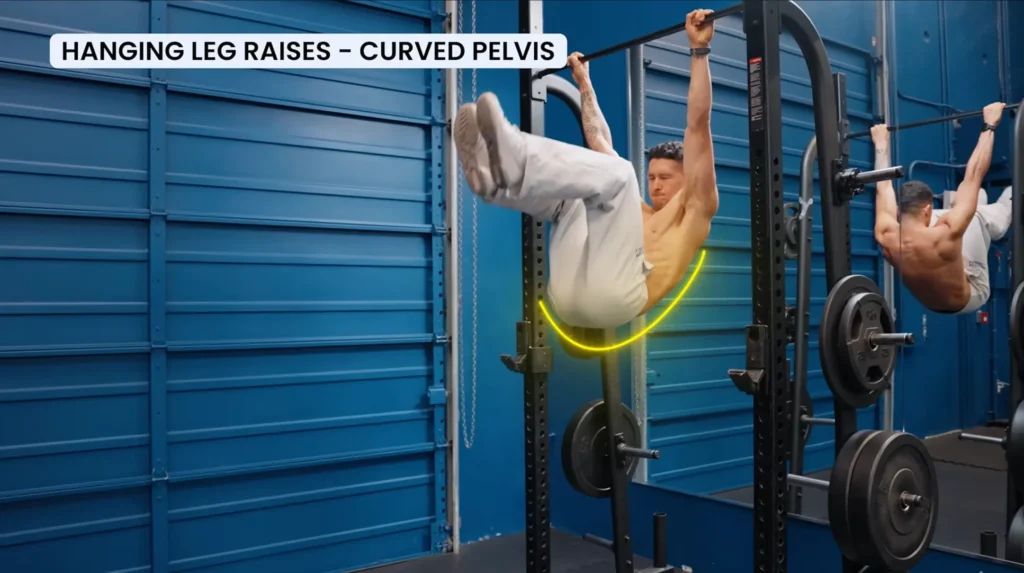
The exercise changes when you stop thinking about simply lifting your legs and instead focus on curling your pelvis into a C-shape.
Your legs still come along for the ride, but now your abs are actually contributing to the movement.
We saw a slight decrease in hip-flexor activation and an increase mainly in upper-ab activation, possibly because the upper abs were helping with the crunching motion at the top.
The biggest drawback is stability. Swinging at the bottom makes it harder to control the movement and focus on your form.
That puts this variation in B-tier of our list of the best ab exercises.
Stabilized Hanging Leg Raises — A-Tier
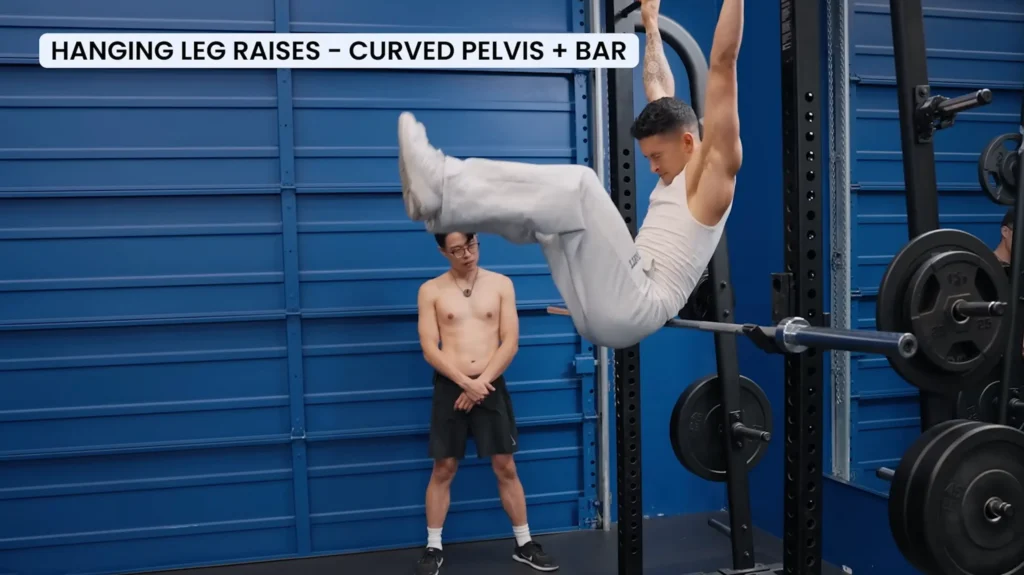
There’s a simple variation that fixes much of that stability problem: perform the movement with a bar positioned behind you for support.
The added stability lets you focus almost entirely on creating that C-shape.
I found it much easier to feel my abs working, and we even saw a slight boost in lower-ab activation. One possible explanation is that the added stability allows the abs to reach a slightly deeper stretch at the bottom.
Progression is straightforward, too. As you get stronger, you can wear ankle weights or hold a dumbbell between your feet.
Dennis was initially skeptical but ended up loving how stable the exercise felt.
It checks all three boxes for our criteria of the best ab exercises. A-tier.
Captain’s Chair Leg Raises — A-Tier
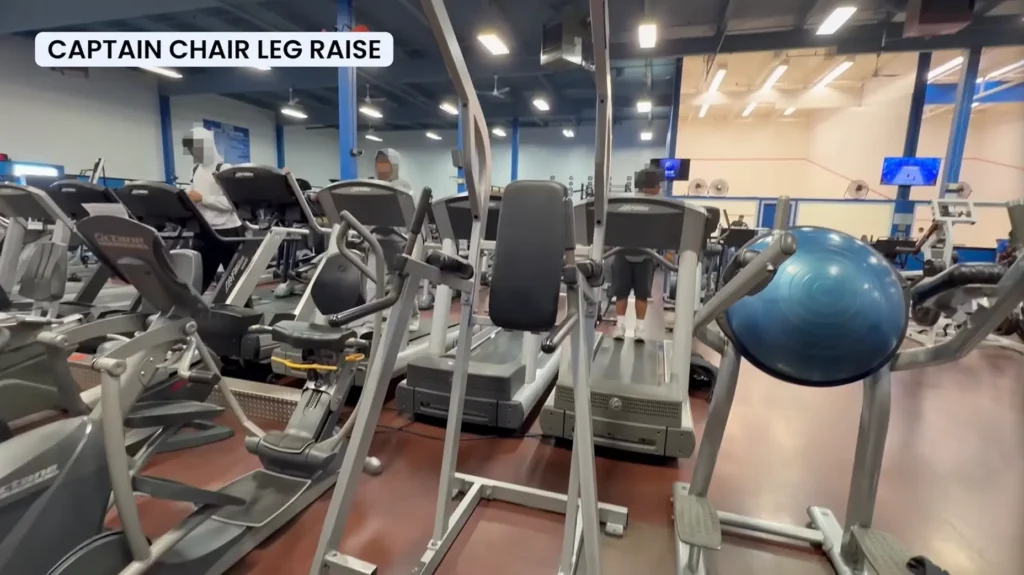
If grip strength is limiting you during hanging exercises, the Captain’s Chair provides another option.
Instead of hanging from your hands, you rest your forearms on the pads and use the back pad to stabilize yourself.
As long as you allow your abs to fully stretch at the bottom and then curl your pelvis upward into that same C-shape, you can get many of the benefits of the previous exercise without needing to hang from a bar. A-tier on our list of best ab exercises.
Are Planks Good For Building Abs?
Planks can teach beginners to brace and stabilize their spine, but they don’t score particularly well against our criteria for building the abs.
Plank — F-Tier
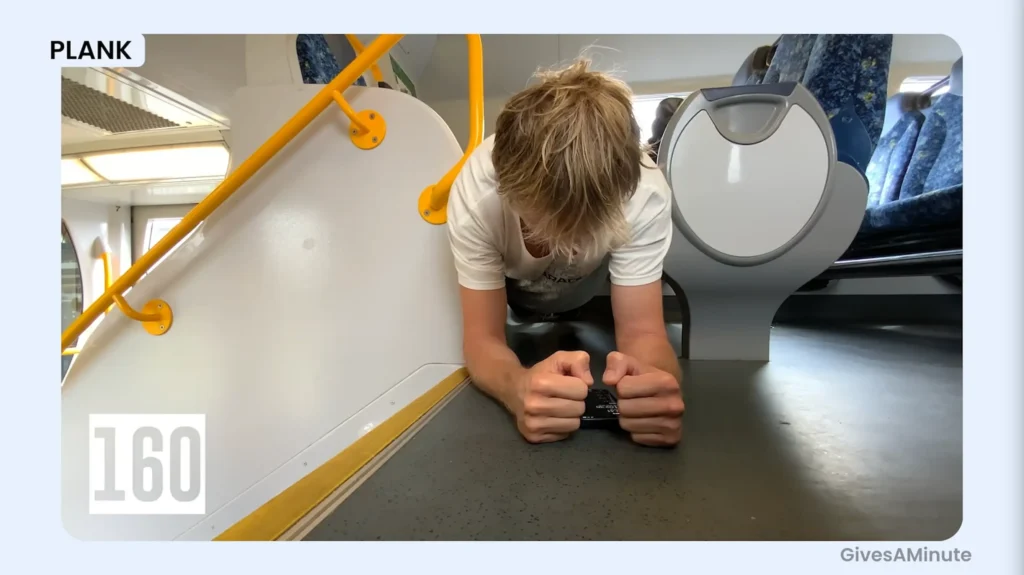
The regular plank is one of the most popular core exercises and is often considered one of the best ab exercises, and you can do it almost anywhere.
But it doesn’t give your abs a deep stretch or take them through a full range of motion. Your abs are simply contracting isometrically to prevent your lower back from sagging — it works as a core-stability exercise more than an ab builder.
Progressive overload is also difficult unless you have someone available to add weight to your back.
Hip-flexor takeover isn’t much of a concern here, but I often find that people’s shoulders fatigue before their core does.
A plank can be a decent way to teach a beginner how to brace and stabilize the spine against gravity. But specifically for building the abs, I’m putting it in F-tier on our list of the best ab exercises.
RKC Plank — C-Tier
The RKC plank instantly improves on a conventional plank.
You shift your forearms up more, actively pull your elbows down against the floor, and squeeze your quads and glutes. That full-body tension forces the core to work considerably harder.
In our testing, this almost tripled my ab activation, and I could only maintain the position for around 10–20 seconds.
However, it can be difficult for beginners to coordinate, and it still carries many of the same disadvantages as a normal plank. C-tier on our list of the best ab exercises.
How Good Are Advanced Isometric Ab Exercises?
Some advanced isometric exercises can create extremely high ab activation, but high activation alone doesn’t solve the limitations created by a lack of full range of motion.
Dragon Flag — B-Tier
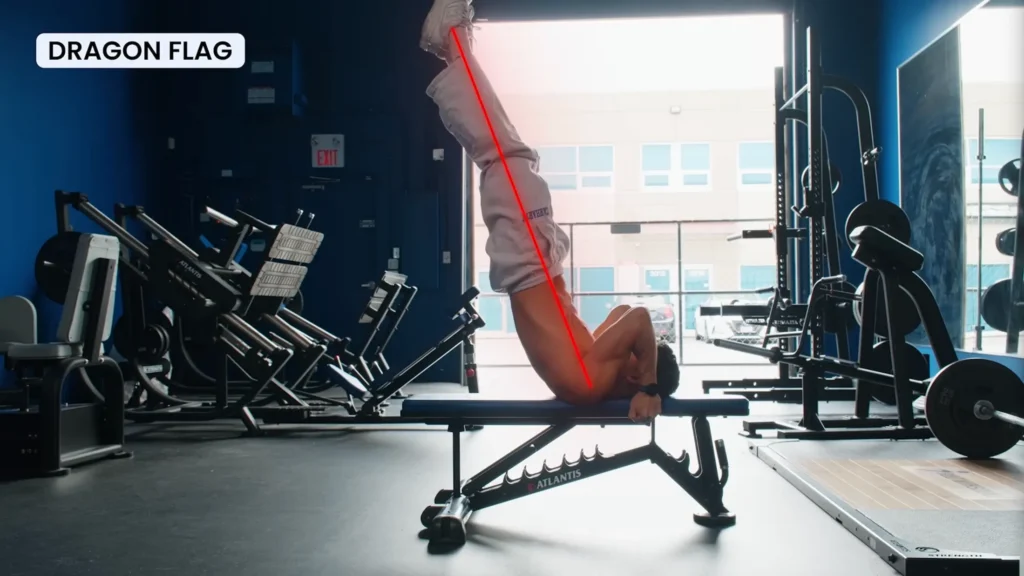
The dragon flag, famously associated with Bruce Lee, is brutally difficult.
You keep your entire body in a straight line from your shoulders to your feet and slowly lower yourself before coming back up without allowing your hips to sag or your lower back to arch.
It produced the highest upper- and lower-ab activation of any exercise we’d tested up to this point.
But that doesn’t necessarily mean it’s doing something unique to your abs. The movement is simply so demanding that your abs have to contract almost maximally to keep your body rigid — the same bracing role they play during heavy compound lifts, almost like performing a one-rep max for your core.
This was actually my first time trying it, and I could only perform two or three clean reps at a time. Surprisingly, Dennis wasn’t too far from learning it himself.
As good as the dragon flag is for challenging and strengthening your core, your abs aren’t being placed into a deep stretch or moving through a full range of motion. They’re mainly contracting isometrically to hold your body rigid.
It completely wrecked my core the next day, and it’s something I’ll continue experimenting with, but specifically for building the abs I’m putting it in B-tier of our list of the best ab exercises.
Front Lever Raises — B-Tier
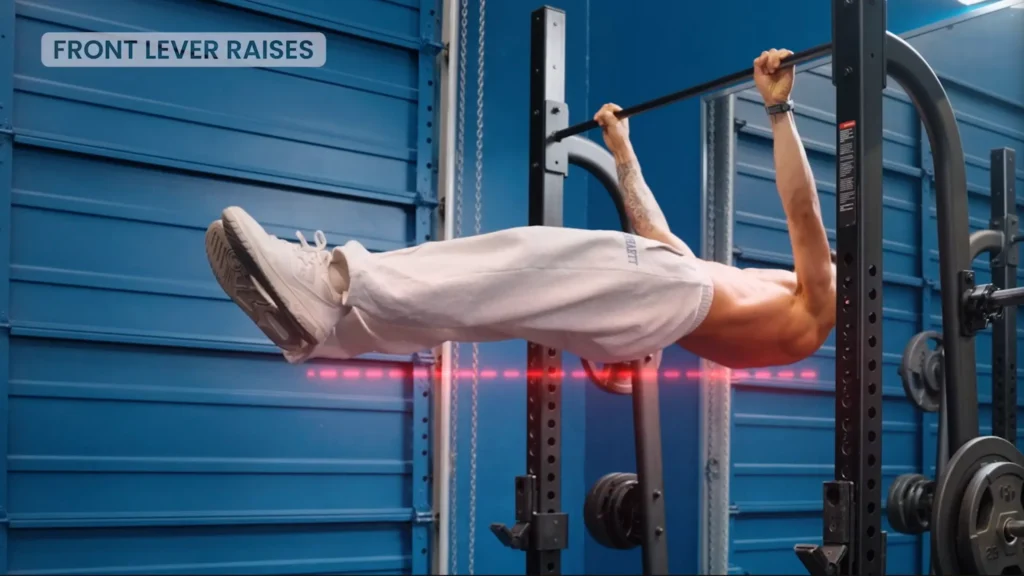
Front lever raises are a similar variation that help train you toward a front lever hold.
They share the same general benefits and limitations as dragon flags but are slightly easier to perform. B-tier.
Garhammer Hold — A-Tier
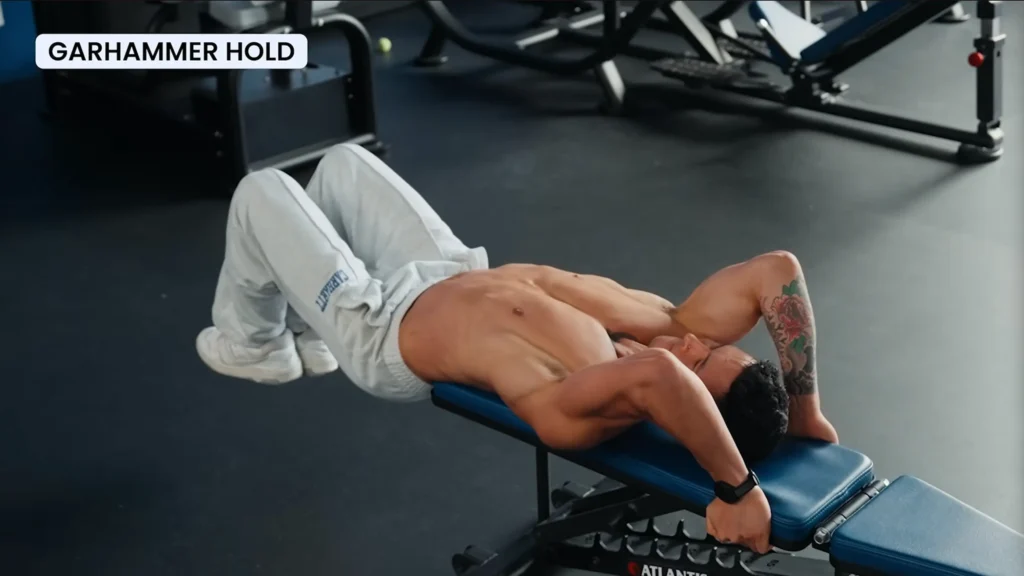
The Garhammer hold is an interesting exception among the isometric exercises.
You hang your hips off the end of a bench, tuck your knees in, lower your legs as far as possible without allowing your feet to touch the floor, and hold the position.
Even though your abs aren’t moving, they’re under tremendous tension while stretched — almost like a weighted stretch.
Some newer research in other muscles suggests that isometrics performed with a muscle in a stretched position might produce similar muscle growth to full-range-of-motion repetitions.
Our EMG also showed ab activation increasing higher and higher the longer I held the position, similar to what happens as a muscle gets closer to failure during a normal set.
More interestingly, the lower-to-upper-ab activation ratio was higher here than in any exercise we’d tested so far. I could feel that difference as well. My guess is that this position forces the lower portion of the abs to work harder to prevent the pelvis from falling.
But the exercise is far harder than it looks. I can only hold it for around 30 seconds without weight.
I’m tempted to put it in S-tier, but it’s still missing the full range of motion I’d want before feeling completely confident in it. Progressive overload is also harder to track when you’re relying mainly on hold duration.
For now, A-tier on our list of the best ab exercises.
Garhammer Raises — S-Tier
Instead of holding the Garhammer position, you can move up and down.
That’s the Garhammer raise, and it ticks all three of our boxes.
You get a deep stretch. You can increase the difficulty by extending your legs farther or adding ankle weights. And as long as you keep your knees at roughly 90 degrees and focus on curling your pelvis upward, your hip flexors are less able to take over the movement.
Just as we saw with the Garhammer hold, this produced the best lower-to-upper-ab activation ratio we’d seen so far.
That earns the Garhammer raise a well-deserved S-tier on our list of the best ab exercises.
Are Reverse Crunches Good For Building Lower Abs?
Reverse crunches use the same pelvis-curling motion as Garhammer raises but are considerably more accessible. Adding an ab mat or rolled-up towel also addresses their biggest limitation by allowing the abs to stretch farther at the bottom.
Reverse Crunch — A-Tier
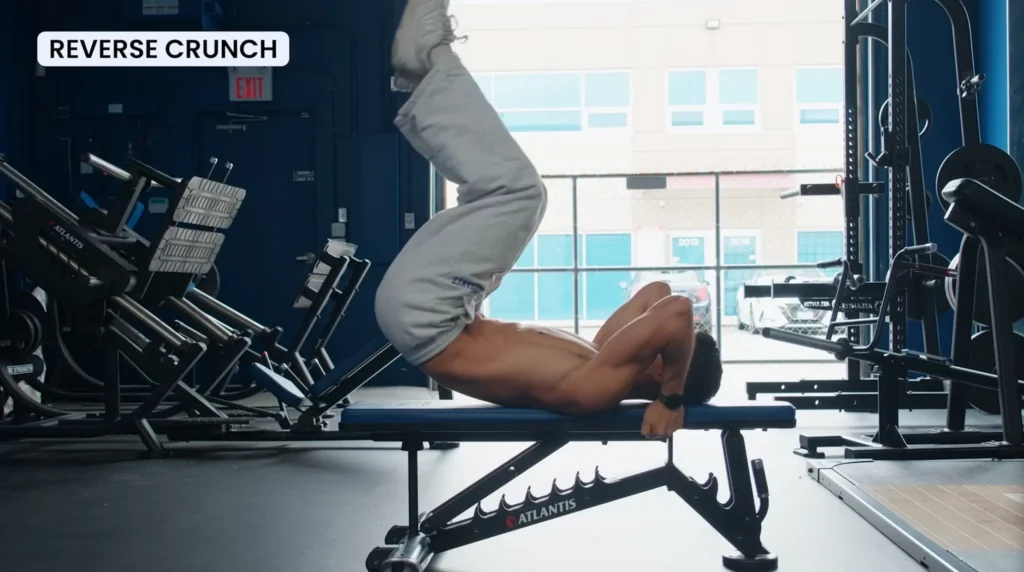
Garhammer raises are difficult. Dennis could only complete a few reps before his form started breaking down.
Fortunately, reverse crunches can provide many of the same benefits in a more manageable exercise.
Dennis had actually used reverse crunches in an ab routine he performed every other day for a previous experiment. After 30 days, his MRI scans showed his abs had grown by 20%.
To perform the movement, keep your knees at roughly 90 degrees and think about pushing your tailbone upward while curling your pelvis into a C-shape.
When Dennis first started, he could lift his pelvis only an inch or two. Now he can perform around eight to 10 full reps.
Progression is simple: extend your legs farther out to make the exercise more difficult.
The main limitation is that the bench prevents the abs from getting a deep stretch at the bottom.
That keeps the standard reverse crunch in A-tier on our list of the best ab exercises.
Reverse Crunch With An Ab Mat — S-Tier
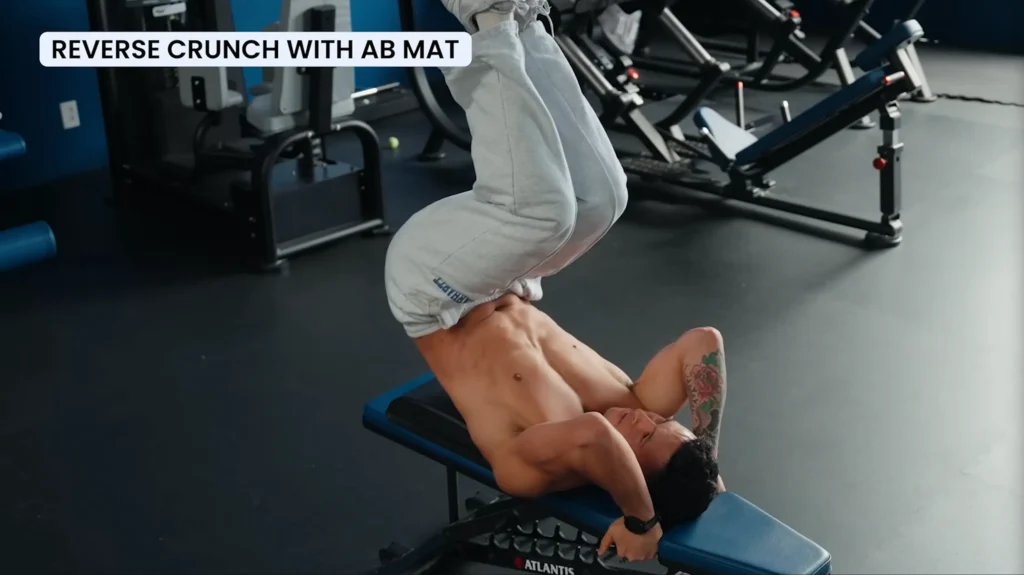
You can solve the stretch problem by placing an ab mat — or even a rolled-up towel — underneath your lower back.
That gives your spine more room to extend at the bottom and allows your abs to reach a fuller stretch.
With that upgrade, there’s no reason not to put the reverse crunch in S-tier on our list of the best ab exercises.
Is The Ab Roller Good For Building Abs?
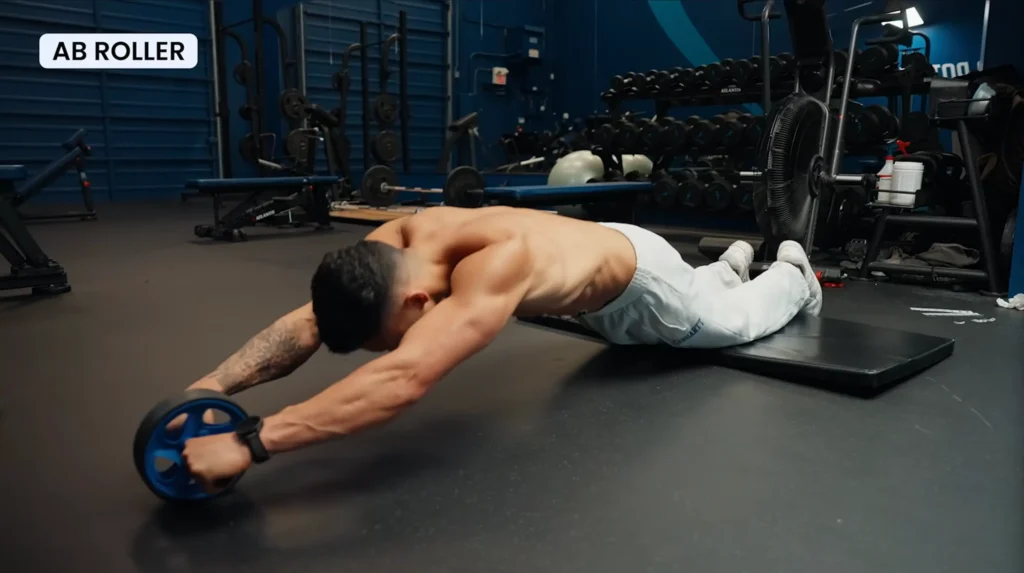
The ab roller challenges your abs isometrically as they prevent your hips from falling, and the exercise gets harder the farther you roll out. However, progression eventually becomes a major limitation.
Dennis was actually quite good at this exercise because he’d practiced it while growing up. But he still made one of the most common mistakes: swinging the hips on the way back and allowing the hip flexors to take over.
Instead, your hips should stay at roughly 90 degrees from the starting position. To fully engage your abs, create a flexed shape through your spine and roll out only as far as you can without allowing your back to arch.
The biggest problem is progression. Eventually, you can only roll the wheel so far. You can progress from your knees to your feet, but that’s an enormous jump in difficulty — even I couldn’t complete one full rep yet.
That puts the ab roller in C-tier on our list of the best ab exercises.
Which Popular Bodyweight Ab Exercises Are Worth Doing?
Several common bodyweight ab exercises become less useful for building muscle once you’re strong enough that the movement no longer challenges your abs. Others primarily challenge the hip flexors or function more as conditioning exercises.
Bicycle Crunches — D-Tier
Bicycle crunches exposed one of the biggest problems with many bodyweight ab exercises.
My ab activation was extremely low compared with our other tests, while Dennis showed much higher activation.
As you become stronger, the movement may simply stop challenging your abs enough, and there’s no reliable way to make it harder other than performing more repetitions.
Your abs also never reach a full stretch. D-tier on our list of the best ab exercises.
V-Ups — D-Tier
V-ups were challenging, but they involved far too much hip-flexor activity for what we’re looking for. D-tier on our list of the best ab exercises.
Butterfly Kicks — F-Tier
Butterfly kicks were even worse.
The movement produced almost all hip-flexor activity compared with ab activity, which matched Dennis’ experience: he mostly felt his legs working. F-tier on our list of the best ab exercises.
Mountain Climbers — F-Tier
Mountain climbers functioned more like a cardio exercise than an ab-building movement. F-tier on our list of the best ab exercises.
Dead Bugs — C-Tier
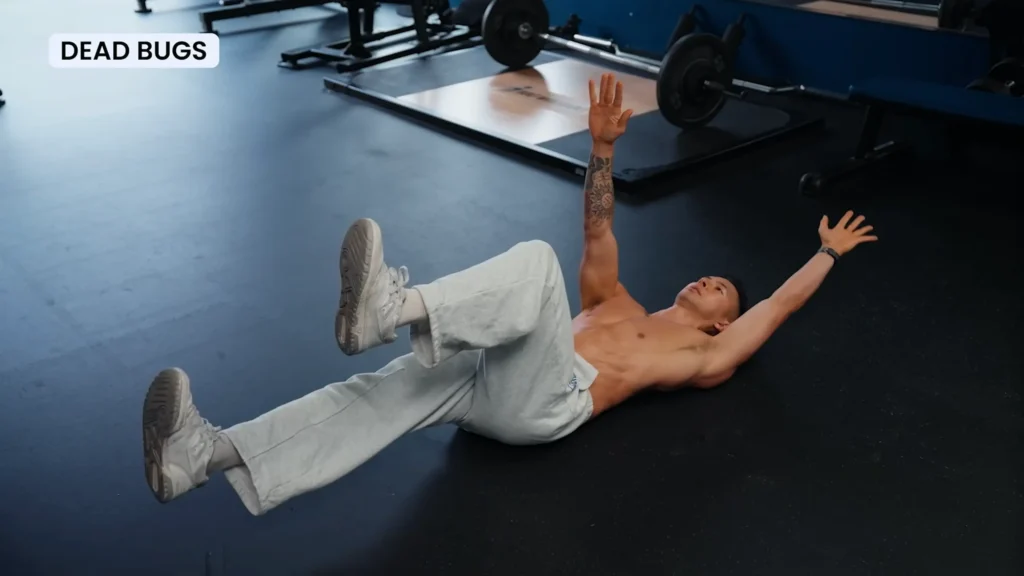
Dead bugs are more useful, but for a somewhat different reason.
You engage your core to flatten your lower back against the floor and then extend the opposite arm and leg. The goal is to reach as far as possible without allowing space to develop between your lower back and the floor.
This is actually one of my favorite ways to test someone’s true core strength and teach them how to properly engage those muscles.
But when the specific goal is building your abs, it wouldn’t be my first choice. C-tier.
Are Cable Crunches Good For Building Abs?
Cable crunches deserve their reputation as a strong ab-building exercise because they’re easy to progressively overload. However, changing your position relative to the cable can improve the resistance when your abs are stretched and make the movement more stable.
Kneeling Cable Crunch — A-Tier
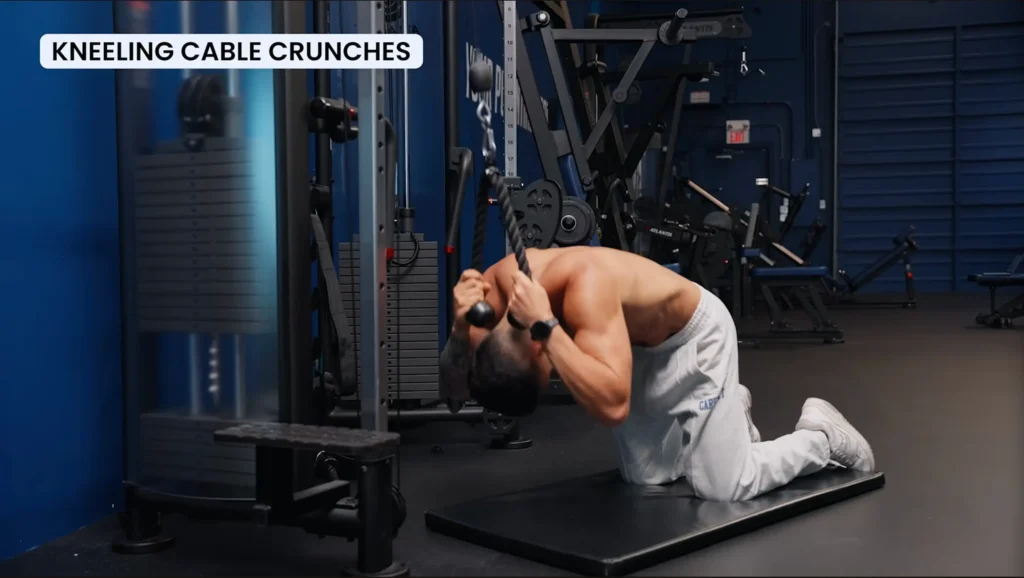
Many people argue that cable crunches are the single best ab exercise, and they do live up to much of the hype — assuming you perform them correctly.
Lock your hips at roughly 90 degrees, fully extend your spine, and then round it into a C-shape as you crunch downward.
As you become stronger, progression is as simple as selecting a heavier weight.
There are two main drawbacks. First, there isn’t much tension at the top when your abs are stretched. Second, because your hips aren’t physically locked in place, it’s easy to cheat by swinging them around.
That puts the conventional kneeling cable crunch in A-tier on our list of the best ab exercises.
Face-Away Kneeling Cable Crunch — S-Tier
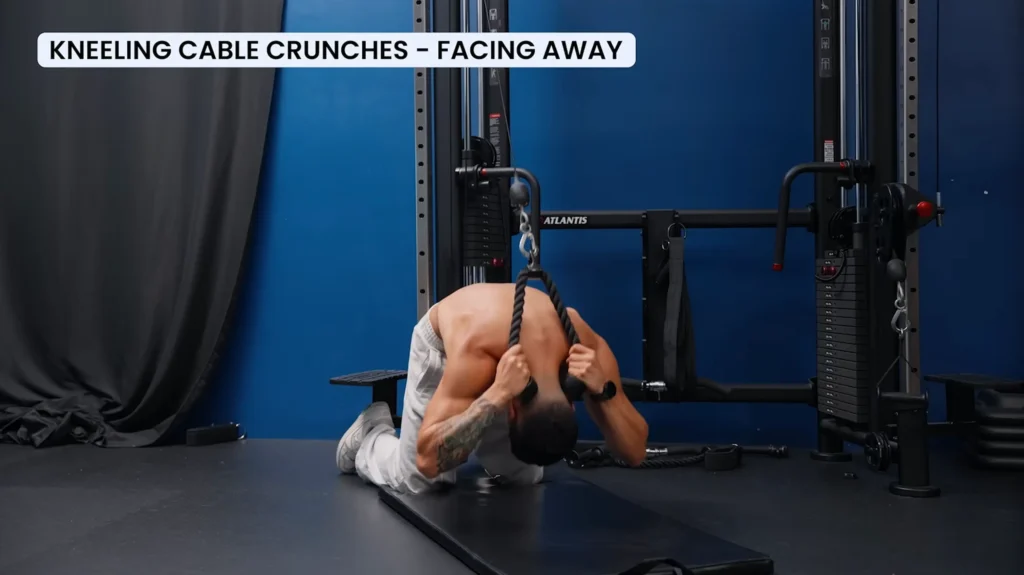
Turn around so you’re facing away from the cable machine and the resistance changes.
It’s the same basic crunching movement, but now the exercise becomes much harder at the top when your abs are stretched.
You can also rest your butt against the machine’s pole to help lock your hips in place.
Those two improvements move the face-away variation into S-tier on our list of the best ab exercises.
Face-Away Standing Cable Crunch — S-Tier
You can perform the same movement while standing and place a bar pad against the pole for comfort.
I personally prefer the standing version because it feels slightly more stable than kneeling.
It also earns S-tier on our list of the best ab exercises.
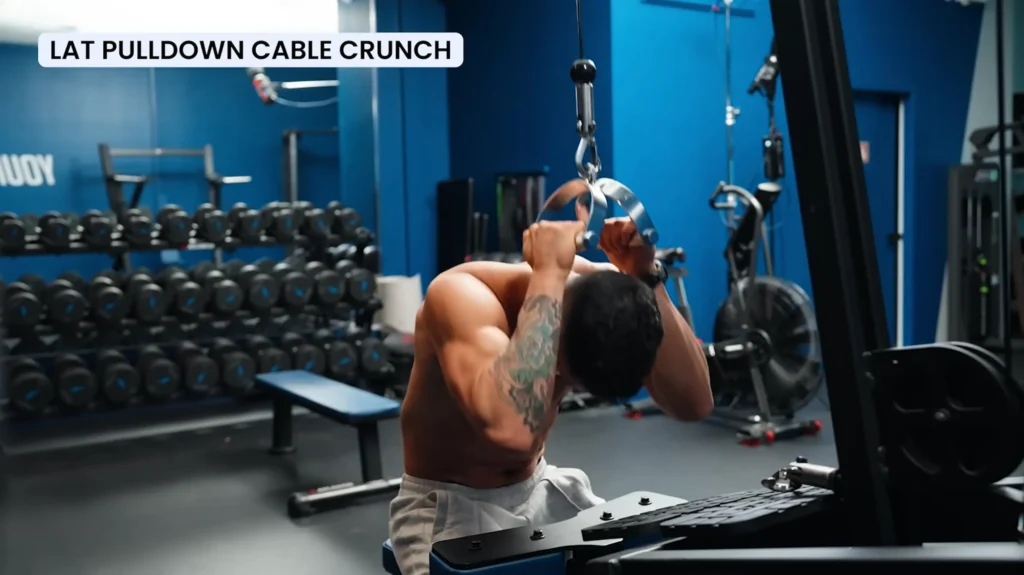
Lat Pulldown Cable Crunch — A-Tier
Earlier, we used the lat pulldown machine to perform crunches where the cable assisted us on the way up.
This time, the cable itself provides the resistance as you crunch.
I actually prefer this setup to the kneeling cable crunch because it’s considerably more stable. However, it comes with one important limitation: you can’t fully stretch your abs.
That puts it in A-tier on our list of the best ab exercises.
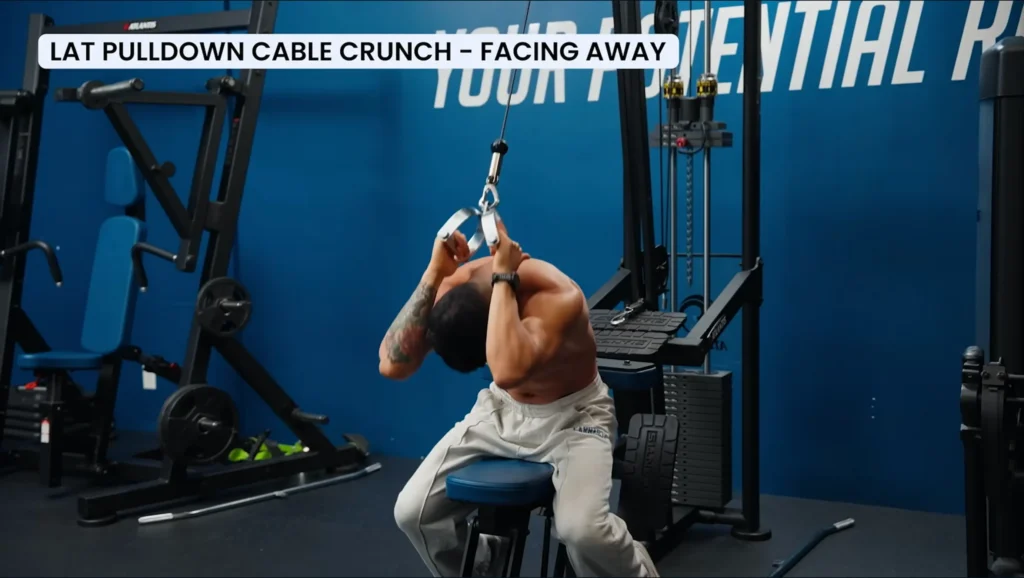
Face-Away Lat Pulldown Cable Crunch — S-Tier
Turn around and face away from the cable and you solve that problem.
The new position creates considerably more tension at the top and lets you open up into a full stretch.
Raise the seat pad and you also get excellent lower-back support, helping lock your hips into position.
Dennis loved the setup when he tried it, and it combines the qualities we’re looking for exceptionally well. S-tier on our list of the best ab exercises.
The Full Tier List: All 30 Ab Exercises Ranked
Here’s how all 30 exercises we tested rank for building your abs, from the best ab exercises in S-tier down to the worst in F-tier.
| Tier | Exercises (best → worst for building abs) |
| S | Assisted lat pulldown crunch, Garhammer raises, reverse crunch with an ab mat, face-away kneeling cable crunch, face-away standing cable crunch, face-away lat pulldown cable crunch |
| A | Crunches with an ab mat or towel, unassisted lat pulldown crunch, stabilized hanging leg raises, captain’s chair leg raises, Garhammer hold, reverse crunch, kneeling cable crunch, lat pulldown cable crunch |
| B | Hanging leg raises with a curved pelvis, dragon flag, front lever raises |
| C | Crunches, RKC plank, ab roller, dead bugs |
| D | Sit-ups, lying leg raises, hanging bent-knee leg raises, hanging straight-leg raises, bicycle crunches, v-ups |
| F | Plank, butterfly kicks, mountain climbers |
What Are The Best Ab Exercises For Beginners And Advanced Lifters?
If I could choose only two exercises to cover all the bases, my selections would depend slightly on your experience level.
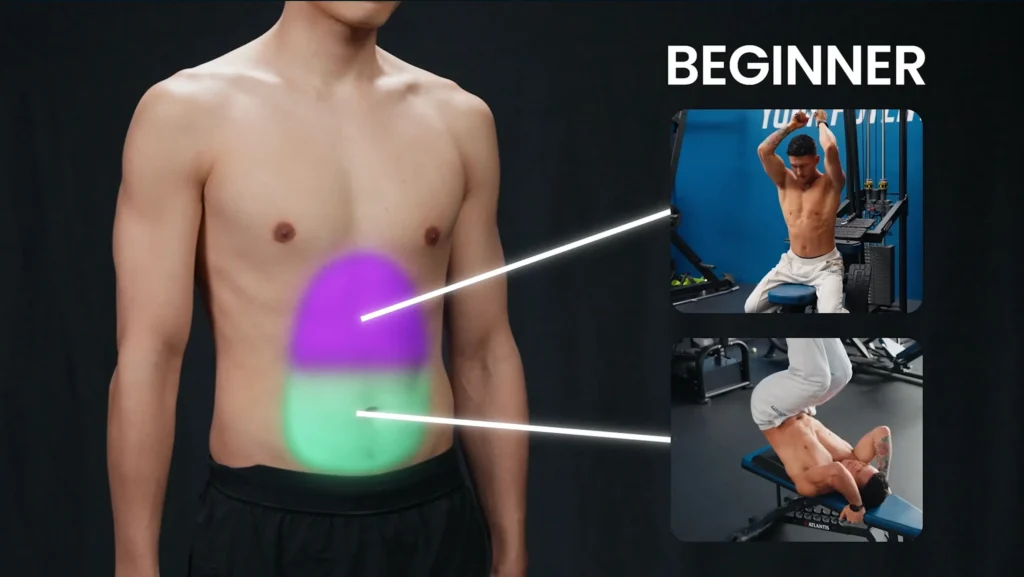
For beginners, I’d choose the face-away lat pulldown cable crunch for the upper abs and the reverse crunch with an ab mat for the lower abs.
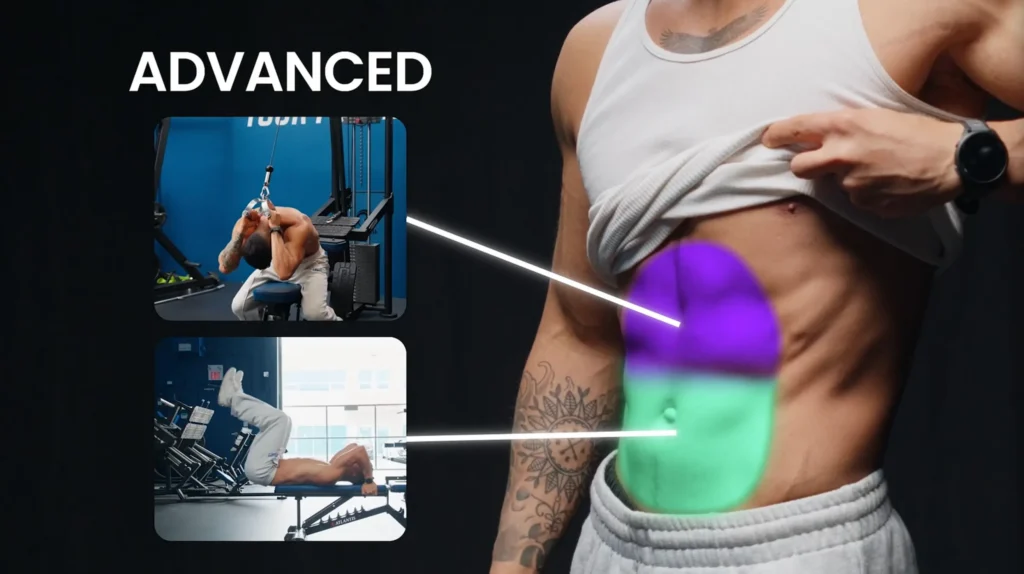
For advanced lifters, I’d still choose the face-away lat pulldown cable crunch for the upper abs, but I’d use Garhammer raises for the lower abs.
Those picks are the best ab exercises for building abs from everything we tested — they combine the qualities we’ve been looking for throughout the testing while also accounting for how difficult the exercises are to perform.
And remember: even well-developed abs aren’t going to show if your diet isn’t also locked in. If you want to dial in the calories to reveal them, our body recomposition calculator is a quick place to start.
If you want the guesswork taken out of both your training and diet, you can try two weeks free of my fitness app at Built With Science.
Best Ab Exercises: Frequently Asked Questions
What Are The Best Ab Exercises For Building Abs?
The best ab exercises for building abs are the ones that let you progressively overload, put the abs under tension in a deep stretch, and keep the work on the abs rather than the hip flexors. In our testing, the standout picks were the face-away lat pulldown cable crunch for the upper abs, plus the reverse crunch with an ab mat (for beginners) or Garhammer raises (for advanced lifters) for the lower abs.
What Are The Best Ab Exercises For Beginners?
For beginners, my two picks are the face-away lat pulldown cable crunch for the upper abs and reverse crunches with an ab mat for the lower abs. Both performed well against the criteria used throughout the testing while remaining more appropriate for beginners than some of the harder alternatives, and they slot easily into a full-body workout routine.
What Are The Best Ab Exercises For Advanced Lifters?
For advanced lifters, I’d choose the face-away lat pulldown cable crunch for the upper abs and Garhammer raises for the lower abs. Garhammer raises provide a deep stretch, can be progressively overloaded, and produced the best lower-to-upper-ab activation ratio in our testing.
Can You Isolate Your Upper And Lower Abs?
Not in the strict sense. Your abs are one continuous muscle, but different movements seem to place more demand on the upper versus lower fibers. Our EMG testing showed clear differences between exercises, but whether those differences actually lead to more growth in one region hasn’t been directly studied. So the regional-growth implication should be treated as a hypothesis rather than an established fact.
Are Sit-Ups Good For Building Abs?
Sit-ups aren’t one of my preferred exercises for building abs. Although they’re easy to progressively overload, the floor limits the stretch of the abs and our testing showed the hip flexors increasingly taking over during the latter portion of the movement. That’s why I ranked standard sit-ups in D-tier.
Are Planks Good For Building Abs?
Planks can be useful for teaching beginners how to brace and stabilize their spine, but they aren’t one of my preferred exercises specifically for building the abs. They don’t take the abs through a full range of motion or deep stretch, and they’re difficult to progressively overload. For that specific goal, I ranked the standard plank in F-tier.
Are Leg Raises Good For Lower Abs?
Leg-raise movements produced more lower-ab activation than the crunch-type movements in our testing, but simply lifting the legs can involve a lot of hip-flexor activity. The movement becomes much more useful for the abs when you focus on curling your pelvis into a C-shape rather than just raising your legs. That’s why standard lying and hanging leg raises ranked poorly, while stabilized variations using the pelvis-curling technique ranked considerably higher.