

TDEE vs BMR: What's the Difference (And Which One Actually Matters)?
If you've ever tried to figure out how many calories you should be eating, you've probably run into two terms that sound like they mean the same thing: TDEE and BMR. They get thrown around interchangeably in fitness circles, which is confusing because they're actually measuring two different things.
Here's the short version: BMR is the calories you burn doing absolutely nothing just to keep your body alive & functioning. TDEE is the calories you burn living your actual life. And when it comes to setting up your diet, only one of them is useful as a target.
Let me break down what each one means, how they're calculated, and why the distinction matters for your fat loss or muscle building goals.
What Is BMR?
BMR stands for Basal Metabolic Rate. It's the number of calories your body needs just to keep you alive at complete rest. We're talking about the energy required to power your brain, pump blood through your heart, expand and contract your lungs, regulate body temperature, and keep your organs functioning. Basic survival stuff.
If you were to lie in bed all day without moving, eating, or even digesting food, your body would still burn calories. That's your BMR.
For most people, BMR accounts for somewhere between 60% and 75% of total daily calorie burn. It's the biggest chunk of your energy expenditure by far, which is why people with more muscle mass tend to have higher metabolisms. Muscle tissue is metabolically expensive to maintain. Fat tissue is not.
The most accurate way to measure BMR is through indirect calorimetry, where you breathe into a machine that analyzes oxygen consumption and carbon dioxide production. But since most of us don't have access to a metabolic lab, we use equations to estimate it that have already been validated through research.
Common BMR formulas include Harris-Benedict (developed in 1918, revised in 1984), Mifflin-St Jeor (1990), and Katch-McArdle. The Built With Science calorie calculator uses the Katch-McArdle equation, which factors in lean body mass rather than just total weight. This makes it more accurate for athletes and lifters who carry more muscle than the average person.
What Is TDEE?
TDEE stands for Total Daily Energy Expenditure. It's the total number of calories you burn in a 24-hour period when you account for everything: your BMR plus all the physical activity you do throughout the day.
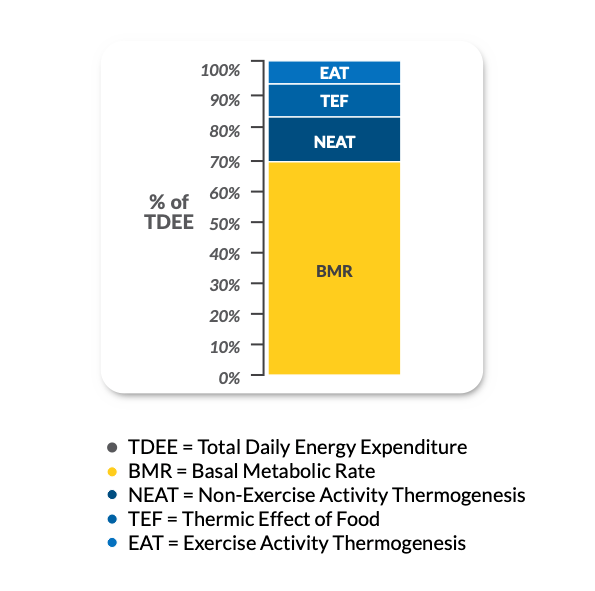
TDEE includes four components:
- BMR (60-75% of total): The baseline we just covered.
- NEAT (15-30% of total): Non-Exercise Activity Thermogenesis. This is all the movement you do that isn't intentional exercise. Walking to your car, fidgeting at your desk, carrying groceries, standing while you cook. NEAT varies wildly between individuals and is one of the biggest reasons two people with the same stats can have very different calorie needs.
- TEF (about 10% of total): The Thermic Effect of Food. Your body burns calories digesting and processing the food you eat. Protein has the highest thermic effect (20-30% of calories consumed), followed by carbs (5-10%), then fat (0-3%).
- EAT (5-15% of total): Exercise Activity Thermogenesis. The calories you burn during intentional workouts. Despite what your fitness tracker tells you, this is usually the smallest component of TDEE for most people.
Your TDEE is essentially your maintenance calories. Eat this amount and your weight stays stable. Eat below it and you lose weight. Eat above it and you gain weight.
Activity level affects more than calorie burn. If your workouts, steps, or daily movement change, the Built With Science water intake calculator can help you estimate how your daily fluid needs may change alongside your TDEE.
BMR vs TDEE: Why It Matters
Here's where people get tripped up. They calculate their BMR, see a number like 1,600 calories, and think that's how much they should eat to lose weight.
That's a mistake.
Your BMR is not a calorie target. It's a component of your calorie target. If you eat at your BMR, you're creating a massive deficit because you're not accounting for any of the activity you do throughout the day.
Let's say you're a moderately active person with a BMR of 1,600 calories. Your TDEE might be somewhere around 2,200 to 2,400 calories depending on your activity level. If you eat 1,600 calories thinking that's appropriate, you're actually in a 600 to 800 calorie deficit. That's aggressive. You'll lose weight fast initially, but you'll also likely lose muscle, feel terrible, and eventually burn out or binge.
When you're setting up a diet for fat loss, you want to subtract calories from your TDEE, not eat at your BMR. A moderate deficit of 300 to 500 calories below TDEE works for most people. That produces steady fat loss of about 0.5% to 1% of body weight per week without the downsides of extreme restriction.
For muscle gain, you add calories to your TDEE. A surplus of 200 to 300 calories supports muscle growth without excessive fat gain.
For maintenance, you eat at your TDEE.
BMR never enters the equation as a target. It's just part of how TDEE gets calculated.
How to Find Your Numbers
You can estimate both BMR and TDEE using online calculators. If you want a tool built specifically for that, use the TDEE calculator to estimate your maintenance calories and set calorie targets based on your goal, whether that's fat loss, maintenance, or muscle gain.
Keep in mind that all calculator estimates have a margin of error around 10-15%. The formulas can't account for individual variation in metabolism, how much you move outside of exercise, or how your body responds to different foods. Research on the accuracy of predictive equations confirms that even the best formulas are estimates, not exact measurements.
Use your calculated TDEE as a starting point, then adjust based on what actually happens. Track your weight for two to three weeks. If you're losing faster than expected, you're in a bigger deficit than you thought, so add calories. If you're not losing at all, your true TDEE is lower than calculated, so reduce calories. The calculator gets you in the neighborhood. Real-world feedback dials it in.
BMR is the calories you burn at rest. TDEE is the calories you burn living your life. When setting calorie targets, TDEE is the number that matters.
If you take away one thing from this article, let it be this: don't eat at your BMR. Calculate your TDEE, adjust it based on your goal, and use that as your starting point. Then pay attention to what your body actually does and make adjustments from there. Once you have your calorie target, use the macro calculator to break it into protein, carbs and fat. For a more detailed breakdown of how to set up your calories and macros based on your specific goal, check out the science-based approach to fat loss.