

How to Calculate Your Calorie Deficit (And Actually Stick to It)
A calorie deficit is the only thing that makes fat loss happen. You can eat clean, cut carbs, do intermittent fasting, or follow whatever diet is trending this month, but if you're not in a deficit, you're not losing fat. That's not opinion. That's thermodynamics.
The good news is that calculating your deficit isn't complicated. The math is straightforward. The harder part is setting it up in a way you can actually sustain for more than a few weeks.
Here's how to figure out your numbers and avoid the common mistakes that derail most people.
Step 1: Find Your Maintenance Calories
Before you can create a deficit, you need to know your starting point. That's your maintenance calories, also called your Total Daily Energy Expenditure or TDEE. This is the number of calories you burn in a day through basic bodily functions, daily movement, and exercise combined.
The easiest way to estimate this is with a TDEE calculator. Plug in your stats, select your activity level, and you'll get a number to work with.
A few notes on activity level since this is where people tend to get it wrong. Most people overestimate how active they are. If you work a desk job and hit the gym three or four times a week, you're probably "lightly active" or "moderately active" at best. Save "very active" for people who train hard daily or have physically demanding jobs. When in doubt, go one level lower than you think.
Also keep in mind that all calculator estimates have a margin of error. They're based on population averages, and you're not an average. You're an individual with your own metabolism, movement patterns, and genetics. The calculator gives you a starting point, not a final answer.
Step 2: Subtract Calories to Create Your Deficit
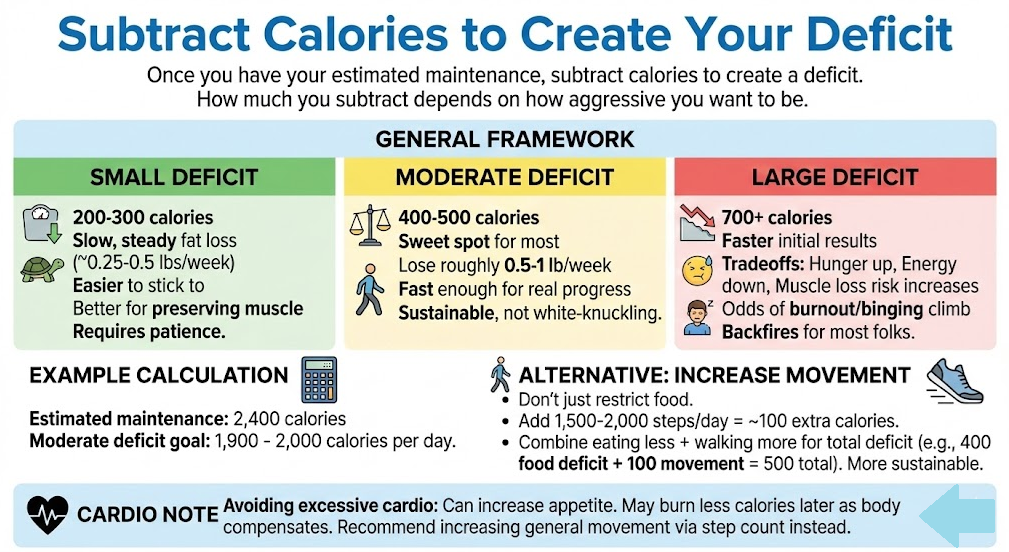
Once you have your estimated maintenance, subtract calories to create a deficit. How much you subtract depends on how aggressive you want to be.
Here's a general framework:
A small deficit of 200 to 300 calories produces slow, steady fat loss of maybe 0.25 to 0.5 pounds per week. This is easier to stick to and better for preserving muscle, but progress feels slow and it requires patience.
A moderate deficit of 400 to 500 calories is the sweet spot for most people. You'll lose roughly 0.5 to 1 pound per week, which is fast enough to see real progress but sustainable enough that you're not white-knuckling it every day.
A large deficit of 700 or more calories produces faster initial results, but it comes with tradeoffs. Hunger goes up. Energy goes down. Muscle loss risk increases. And the odds of burning out or binging climb significantly. This approach can work for people with a lot of fat to lose, but for most folks, it backfires.
For example, if your estimated maintenance is 2,400 calories, a moderate deficit would put you around 1,900 to 2,000 calories per day.
From there, the macro calculator can help you turn that calorie target into daily protein, carbs and fat.
One thing worth noting: you don't have to create your entire deficit through food restriction. Increasing your daily movement works too. Adding 1,500 to 2,000 steps to your day burns roughly 100 extra calories. That means you could eat at a 400 calorie deficit and walk a bit more to hit a total deficit of 500, which feels more sustainable than just eating less.
As a side note here, you might be thinking “well if I want to burn more calories, I should just add cardio to my day instead of steps.” And while this is technically correct, we wouldn’t necessarily recommend adding in a ton of extra cardio to your day outside of walking because there can be appetite changes with increasing cardio. So while you may burn an extra “x” calories in a cardio session, your appetite can increase accordingly to make it so you want to eat back some of those calories.
And without getting too complicated, the more you increase your cardio, the increased potential there is for burning less calories than you think throughout the rest of the day as your body’s compensation method to conserving calories.
That’s why we’re a big fan of increasing general movement throughout the day via a step count (not to mention that the average American is walking <5,000 steps per day anyways).
Step 3: Track and Adjust Based on Results
Here's where most calorie deficit advice stops, but this step is actually the most important one.
Your calculated deficit is an estimate. Your body doesn't know what the calculator said. It only knows what's actually happening. So you need to track your results and adjust based on real data.
Weigh yourself daily at the same time, ideally first thing in the morning after using the bathroom. Then look at your weekly average, not individual days. Daily weight fluctuates based on water retention, sodium intake, sleep, stress, and a dozen other factors. The weekly trend is what matters.
If your average weight is dropping 0.5 to 1% of your body weight per week, you're in a good spot. Keep doing what you're doing.
If you're losing faster than that, you might be in too large a deficit. This is fine in the short term for the first month of starting a new diet because of all the water changes, but if it continues, consider adding 100 to 200 calories to preserve muscle and avoid burnout.
If you're not losing weight at all after two to three weeks, your actual maintenance is lower than you calculated. Reduce calories by 100 to 200 or increase daily movement. Don't panic and slash 500 calories overnight. Small adjustments are easier to sustain.
This feedback loop is the whole game. Calculate, implement, measure, adjust. Repeat until you reach your goal.
Common Mistakes That Kill Progress
A few pitfalls to watch for:
Eating back exercise calories. Fitness trackers and cardio machines overestimate calories burned by 30 to 50% or more. If you eat back all those "earned" calories, you may erase your deficit entirely. The activity multiplier in most calculators already accounts for your exercise, so you generally don't need to add more food on training days.
Weekend blowouts. A 500 calorie daily deficit from Monday through Friday creates a 2,500 calorie weekly deficit. Two days of overeating by 1,000 calories each wipes out most of that. Consistency matters more than perfection, but the math has to work over the full week.
Setting the deficit too aggressively. The best deficit is the largest one you can sustain without misery. For most people, that's 400 to 500 calories. Going bigger feels productive at first, but it usually leads to compensatory behaviors like reduced NEAT, increased hunger, and eventual overeating that undoes the progress.
Not tracking accurately. Eyeballing portions works for some people, but most of us underestimate how much we're eating. Research on self-reported food intake consistently shows people underreport calories by 20 to 50%. If you're not losing weight and you're confident your deficit is correct, the tracking is usually the problem.
Calculating a calorie deficit comes down to three steps: estimate your maintenance, subtract 400 to 500 calories, and adjust based on what actually happens to your weight over time.
The math isn't the hard part. Sticking to it is. So set a deficit you can actually live with, track your results honestly, and make small adjustments as needed. Sustainable beats aggressive every time.For help figuring out how to split those calories into protein, carbs, and fat once you have your target, check out what to eat when dieting for guidance on building your meals around your calorie goal.