
What Every Body Type Actually Looks Like And How To Change It
Quick Answer
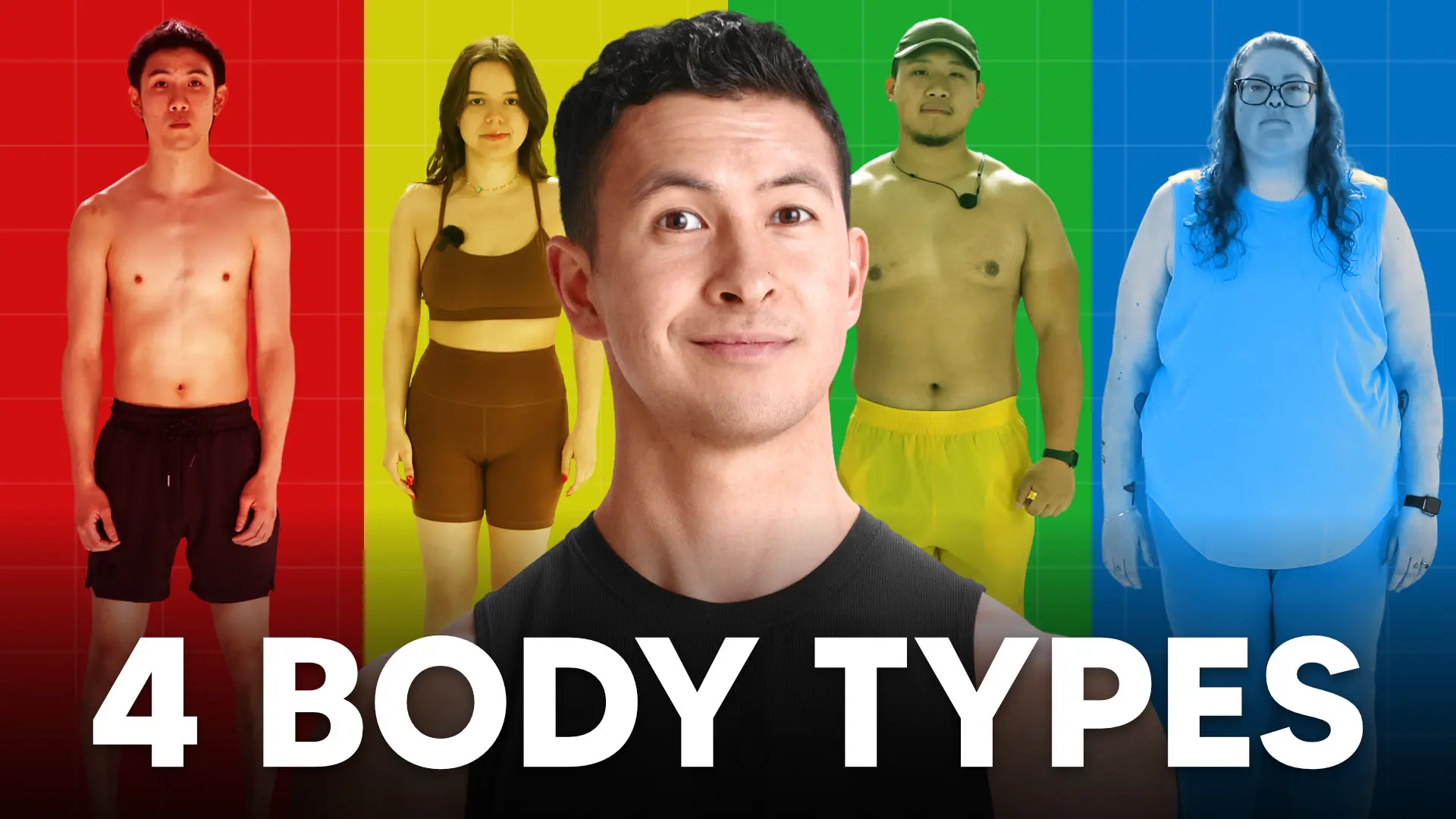
What every body type actually looks like and how to change it comes down to four starting points: skinny, skinny fat, bulky, and high body fat. Each one has a different mix of muscle mass and body fat, and each one needs a different combination of training and nutrition to actually change. The right plan depends on which body type you are starting from — a fat-loss plan is wrong for someone who is already lean, and a bulk is wrong for someone with plenty of muscle hiding under body fat. Knowing your body type is the difference between a plan that works and one that goes nowhere.
Key Takeaways
- There are four main starting body types: skinny, skinny fat, bulky, and high body fat. An athletic physique is the destination most people are working toward, not a fifth starting point.
- You can sort your body type using two numbers: BMI and body fat percentage. The thresholds are different for men and women.
- Skinny body types need to gain weight to build muscle, not lose fat. Three full-body workouts a week and a slight calorie surplus is the right starting setup.
- Skinny fat body types are the best candidates for body recomposition — building muscle and losing fat at the same time — if they train hard, eat enough protein, and run a small calorie deficit.
- Bulky body types usually do not need to train differently. The lever that matters most is tracking food accurately, because most underestimate intake by hundreds of calories.
- High body fat body types often have higher daily calorie burn than they realize, which means a more aggressive deficit and simple food swaps can move the needle fast.
- Resting metabolism scales almost perfectly with body weight. “I just have a slow metabolism” is rarely the real story — the gap is usually between actual intake and what people think they are eating.
- Knowing your body type and how to change it is the difference between picking the right plan and chasing one built for someone else’s starting point.
If two people follow the exact same diet and workout plan, they can end up with completely different results.
One gets leaner. One builds muscle. One barely changes.
And in some cases, the same plan can even make someone look worse.
That is not because they are doing anything wrong. It is because most fitness advice assumes everyone has the same body type and responds the same way when starting points are actually very different.
Some people are lean but under-muscled. Some look small in clothes but carry more fat than they realize. Some already have plenty of muscle, but it is hidden under body fat. And some are starting from a much higher body-fat level entirely.
To make sense of why, men and women with very different physiques came in for DXA scans to measure exact muscle and fat, strength testing, and the doubly labeled water test — the most accurate metabolism test available, used to study everyone from astronauts in space to remote tribesmen in Tanzania.
It estimates how many calories someone actually burns and eats, not just what they think.
A clear pattern showed up: most participants sorted into one of four starting body types, each with its own benefits, challenges, and best next step.
You can also be healthy and active across multiple body types — different starting points are not the same as different problems to fix.
Why The Same Diet And Workout Plan Does Not Work For Everyone
Your body does not only respond to what you do now. It also responds to what you are starting with.
If you are already very lean and do not have much muscle, a fat-loss plan is usually the wrong move. If you already have a solid amount of muscle but are carrying extra fat, bulking harder is usually the wrong move. And if you look “small” overall, that still does not tell you whether your main issue is low muscle, higher body fat, or both.
That is why two people can eat similarly, train similarly, and still look completely different.
What Are The Four Main Body Types?
Skinny
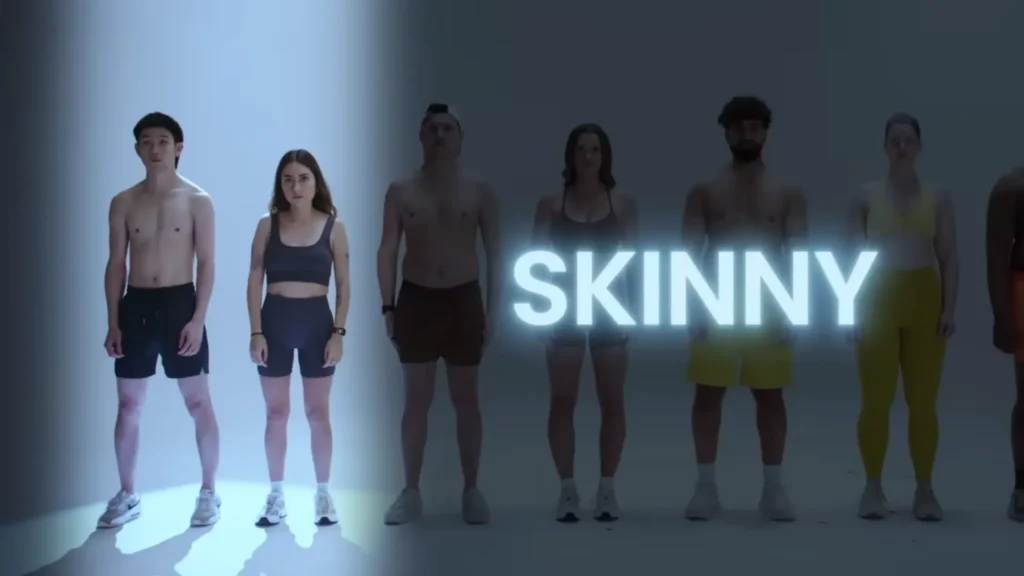
A skinny body type is lean, relatively light, and low in muscle mass. The frame is usually smaller, with less overall fullness through the shoulders, arms, and thighs.
Aaron fits this category well.

He was around 13% body fat, but his total muscle mass was below average. He did not lift weights, yet he stayed lean because he was constantly active through retail work, pickleball, longboarding, and racking up 10,000 to 12,000 steps a day on shift.
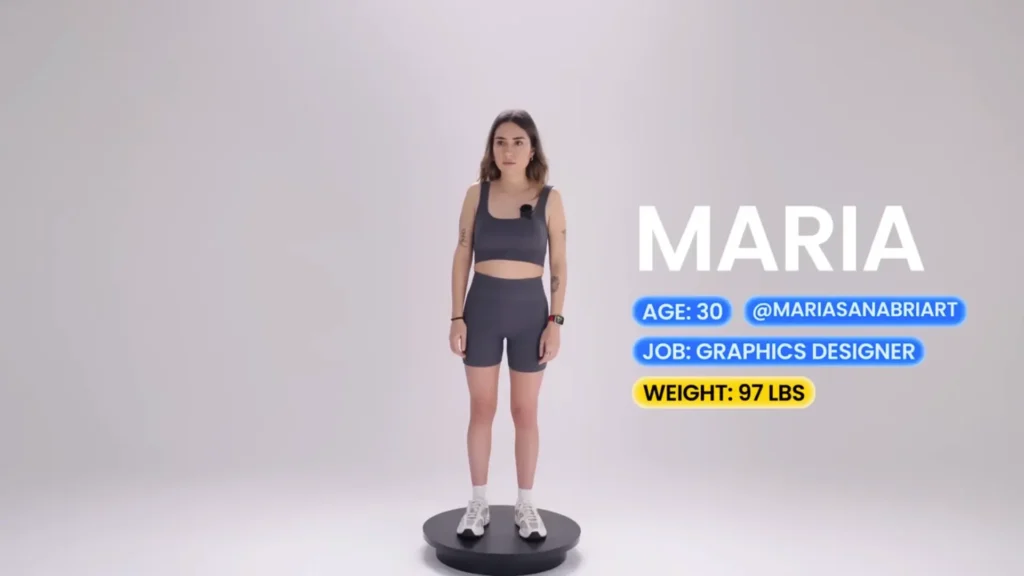
Maria showed the same starting point in a female participant: weighing in at just 97 pounds, wanting to feel stronger overall, especially in her upper body.
And being skinny does not automatically mean being healthy.
Maria’s strength testing came in at 5.09, just below the 5.4 threshold associated with sarcopenia risk — the rapid loss of muscle that can come with age. Her DXA scan also showed bone density lower than 72% of others her age, which raises fracture risk over time. Both findings pointed to the same recommendation: lift weights, build muscle, make her bones and muscles stronger.
The skinny body type is healthy and active for many people, but it does not guarantee strength or resilience on its own.
Skinny Fat
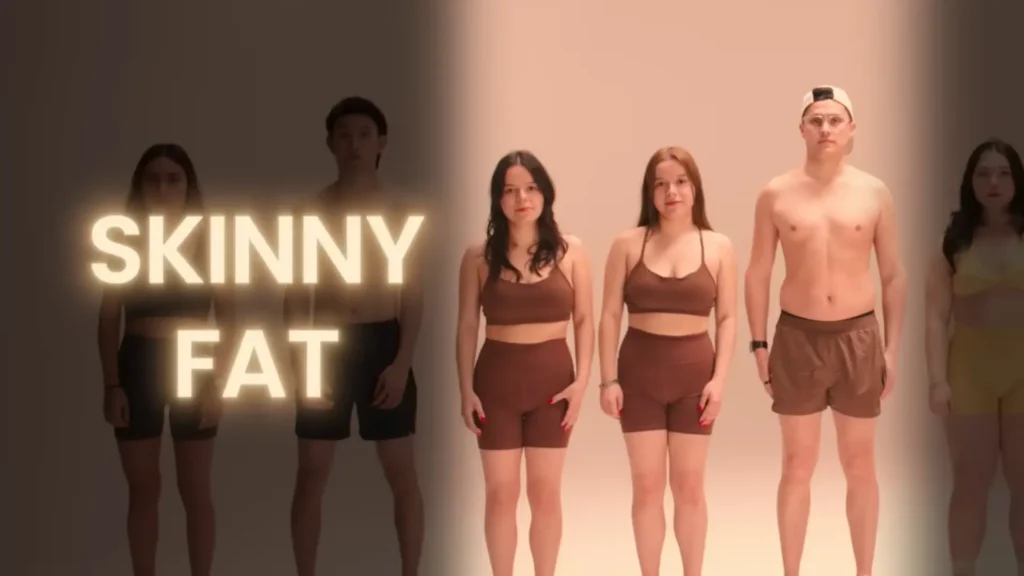
A skinny fat body type usually looks smaller or fairly normal in clothes, but carries more body fat than expected and not enough muscle underneath — often around the belly and love handles. It can show up in a leaner form or a softer form.
The common thread is below-average muscle mass.
Two people can look similar in a T-shirt while having very different body compositions underneath. That is part of why this body type is so common, especially when someone is younger.
The average person quietly gains roughly one to two pounds every year, and without proper resistance training, most of that extra weight is stored as fat.
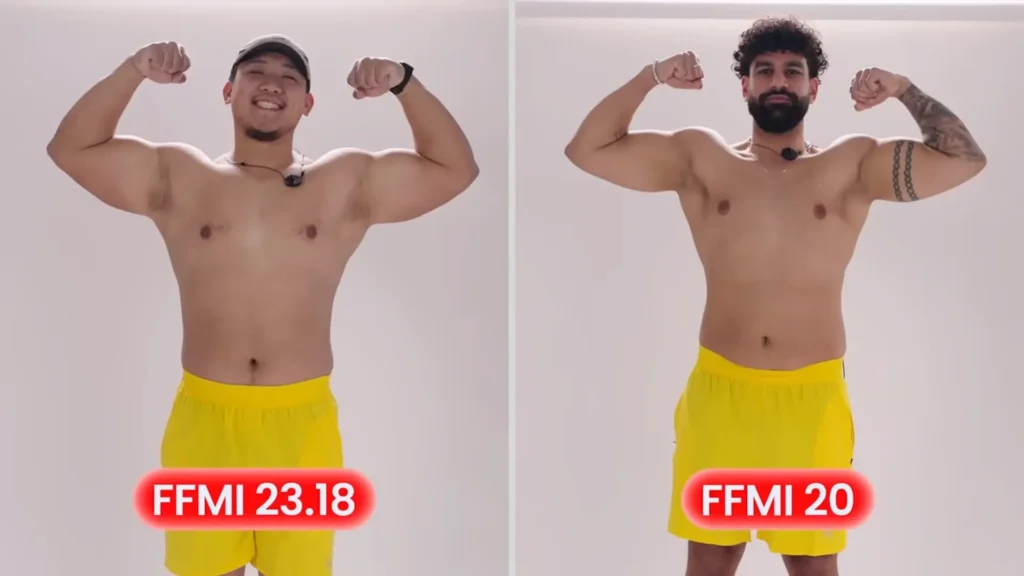
Researchers measure muscle mass using a score called Fat Free Mass Index, or FFMI — total lean mass divided by height squared. Average FFMI sits around 18 for men and just below 16 for women. Everyone in the skinny fat group came in below those averages.
Bulky
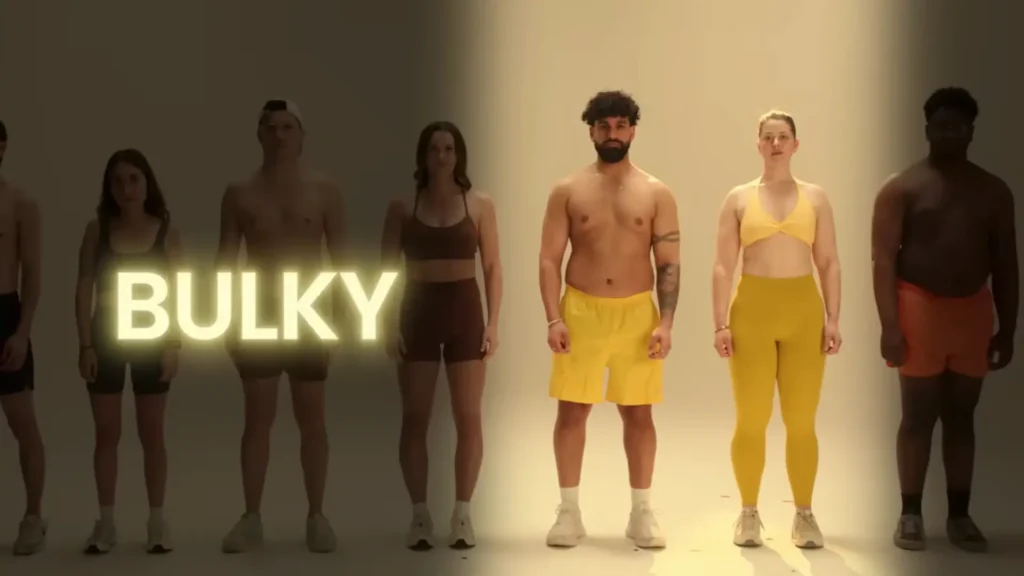
A bulky body type has above-average muscle mass, but enough body fat to blur a lot of that definition. This is the classic “I clearly lift, but I do not look as lean as I want” physique.
Sahil and Eric fit this category.
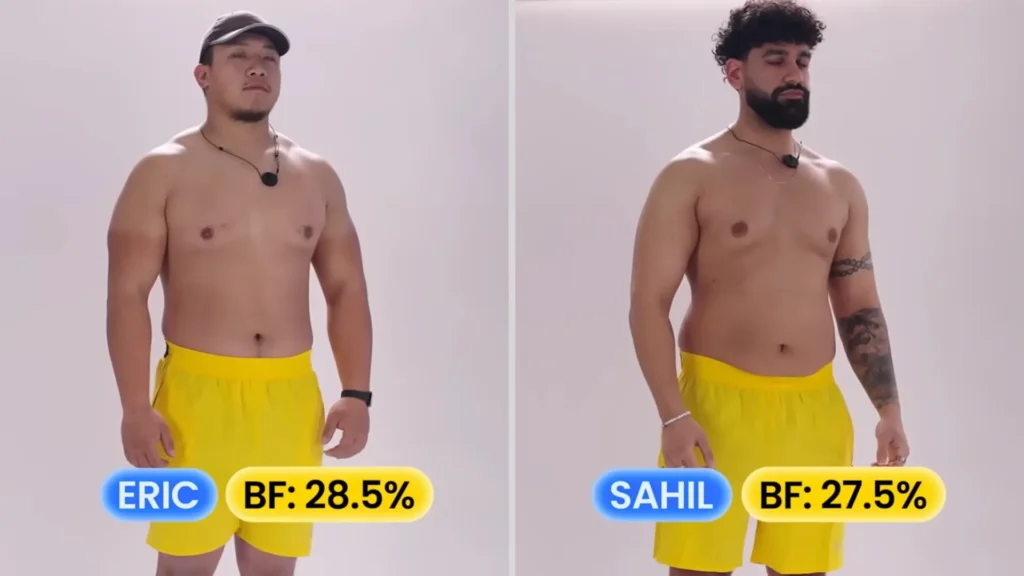
Both carried much more muscle than the skinny fat group and dominated the strength testing — Eric’s FFMI came in just two points shy of what most people consider the natural ceiling for muscle mass. But both also sat in the high twenties for body fat, which hid a lot of that muscle visually.
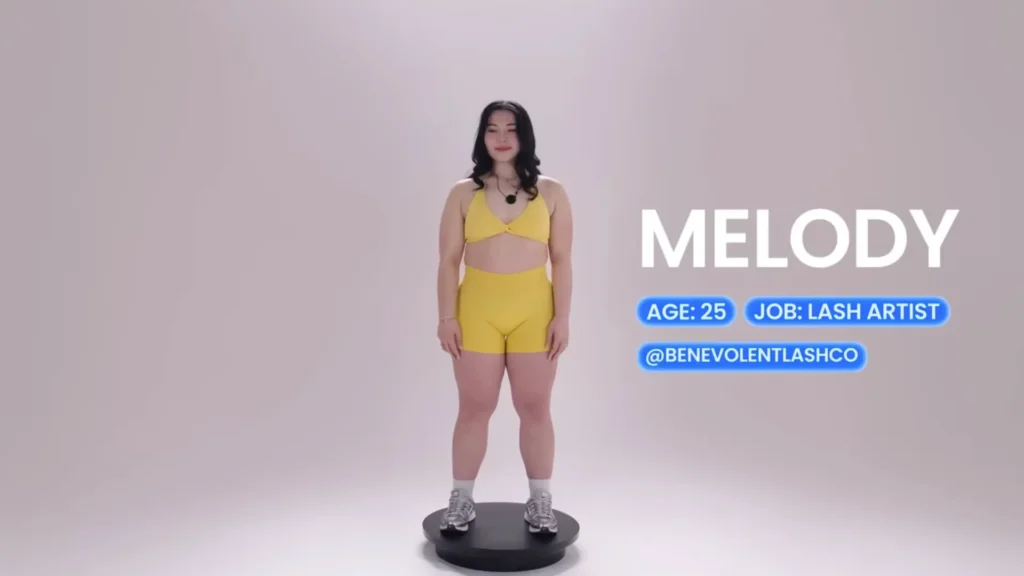
Melody showed the same idea from a female participant: after five years of weight training she had built a solid muscle base, but her body fat at 33.7% meant the next move was leaning out rather than adding more size.
High Body Fat
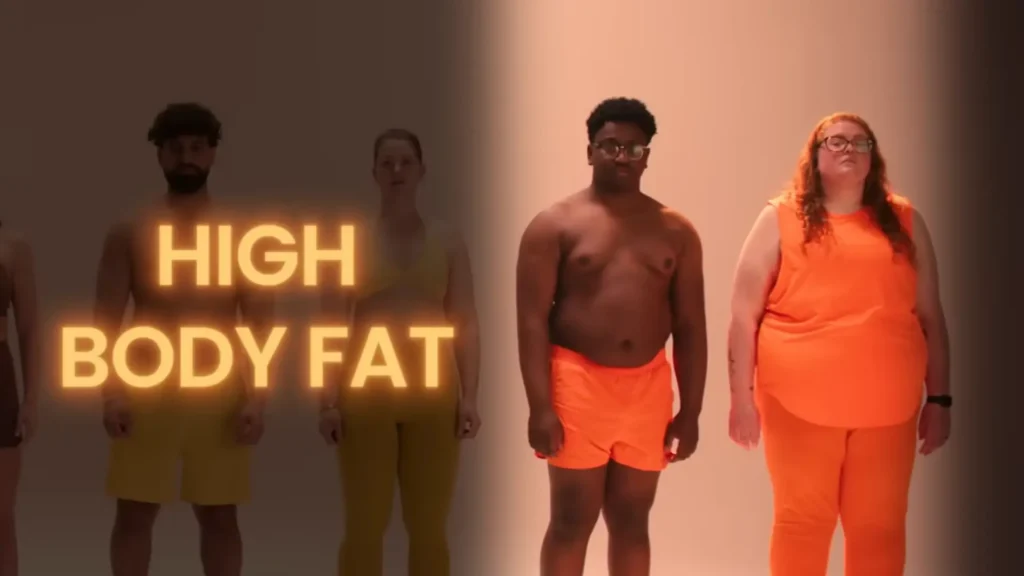
A high body fat body type carries a significantly high level of body fat — over 30% for men and over 40% for women in this framework.
AJ and Michelle fit here. Both also had more muscle than many people would expect — Michelle had more muscle than every female participant and most of the men, despite not training.
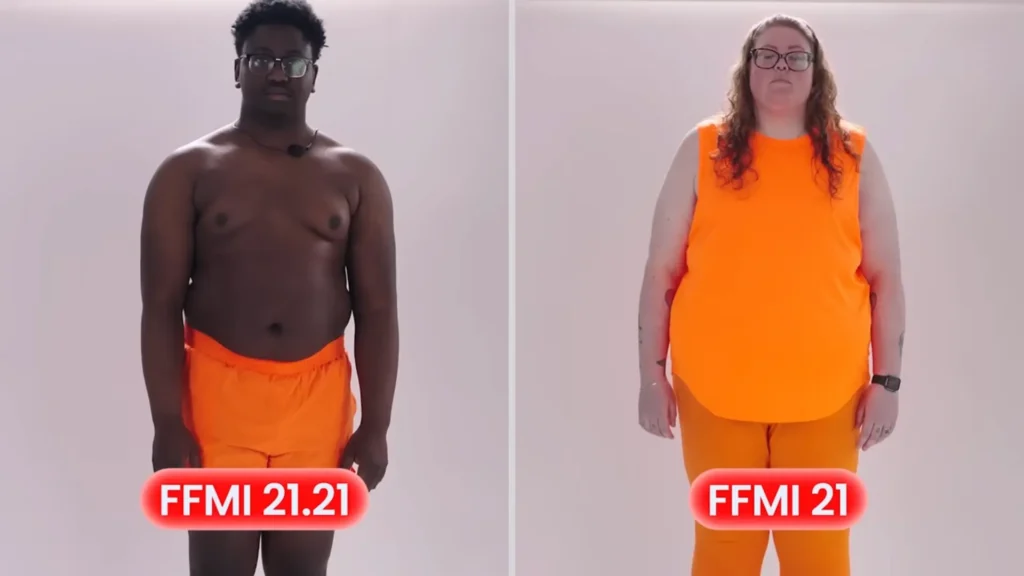
Higher body fat does not automatically mean low muscle.
But the extra weight made movement harder (Michelle had dealt with severe plantar fasciitis from working on her feet) and came with more obvious health concerns.
How Can You Figure Out Your Own Body Type?
This framework uses two numbers: BMI and body fat percentage. Together, they give you a practical way to sort your starting point. (You can use a BMI calculator and a body fat estimate to find both.)
Male
| Category | Body Fat % Range | BMI Range |
| Skinny | BF% < 18% | BMI < 21 |
| Athletic | BF% < 18% | BMI ≥ 21 |
| Skinny Fat | BF% ≥ 18% | BMI < 27 |
| Bulky / Thick | 18% ≤ BF% < 30% | BMI ≥ 27 |
| High Body Fat | BF% ≥ 30% | BMI ≥ 27 |
Female
| Category | Body Fat % Range | BMI Range |
| Skinny | BF% < 28% | BMI < 21 |
| Athletic | BF% < 28% | BMI ≥ 21 |
| Skinny Fat | BF% ≥ 28% | BMI < 27 |
| Bulky / Thick | 28% ≤ BF% < 40% | BMI ≥ 27 |
| High Body Fat | BF% ≥ 40% | BMI ≥ 27 |
Treat that as a practical sorting tool, not a verdict on health or potential.
What Does An Athletic Physique Look Like?

An athletic physique is a body with above-average muscle and relatively low body fat — in this framework, generally below 18% body fat for men and below 28% for women.
There is still a wide range inside that.
Some participants in this category looked like aspiring bodybuilders.
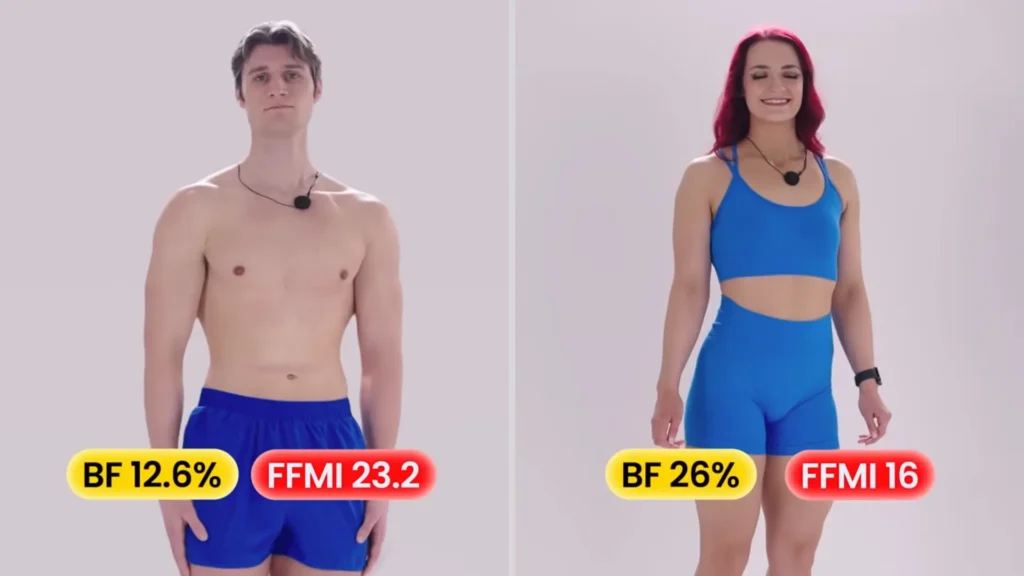
Others were lean and capable but were not actually carrying that much more muscle than some of the skinnier participants.
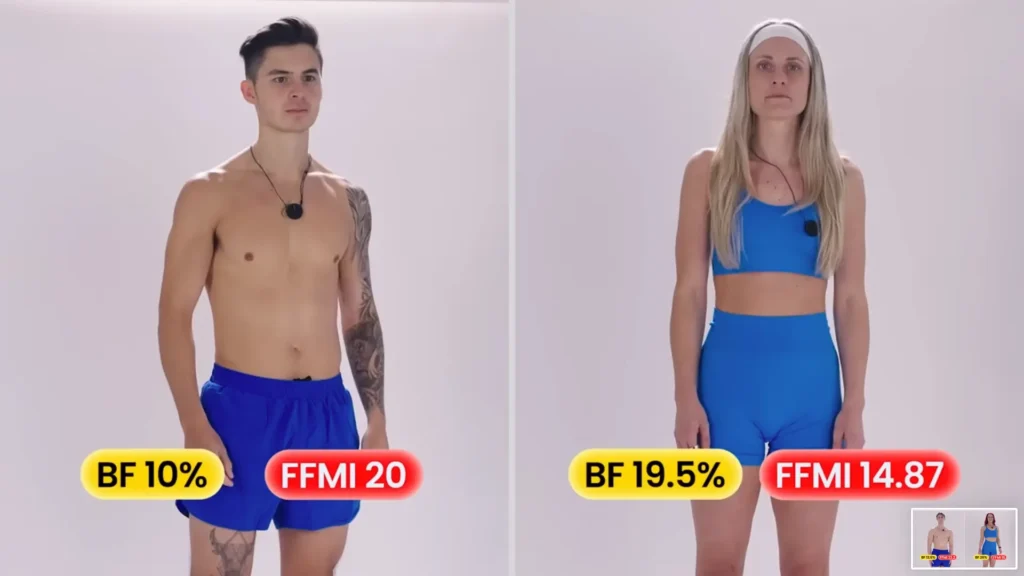
The common thread is not one exact look. It is a better muscle-to-fat ratio.
That is the point most people are working toward, even if the exact look they want is different.
What Causes Each Body Type?
Why Are Some People Naturally Skinny?
Being skinny is not always about a freakishly fast metabolism.
Aaron is the clearest example. His resting metabolism was around 1,500 calories — normal for his size. But he was burning roughly 2,700 more calories a day from activity, putting his total daily burn at 4,221 calories. That is why he could eat about 1,000 calories more per day than AJ despite weighing far less. His intake matched his output.
Maria stayed skinny for a different reason.
Her actual intake came in at 2,080 calories — close to her own prediction, suggesting she pays attention to what she eats. She cooks at home most of the week, does not eat a lot of sweets, and her overall pattern is consistent.
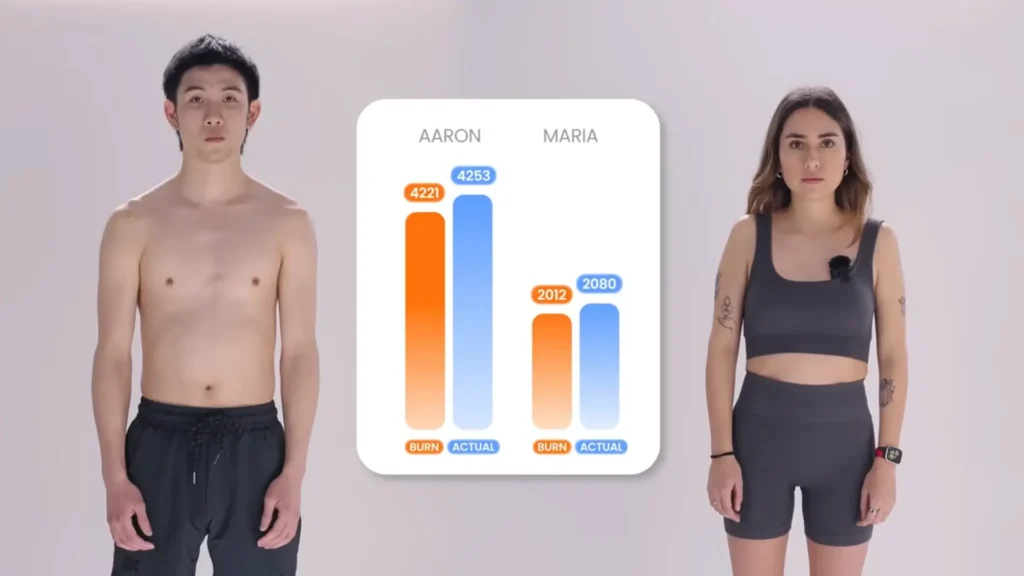
Across the participants tested, resting metabolism scaled almost perfectly with body weight — the more someone weighed, the more they burned just by existing.
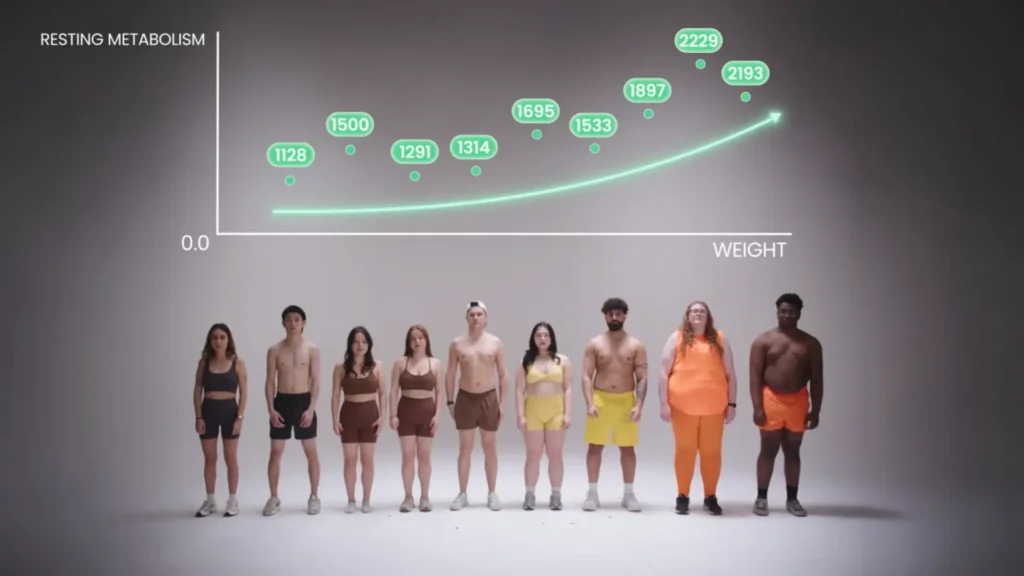
None of the nine tested had an abnormally fast or slow metabolism once size was accounted for. “I just have a slow metabolism” is rarely the real story.
Why Do People End Up Skinny Fat?
A skinny fat body type usually comes from some mix of low muscle mass, ineffective resistance training, and extra calories being stored as fat over time.
David showed one version of that.
He thought he was eating around 2,000 calories a day. The test showed he was actually eating 3,300 — enough of a daily surplus to gain about a pound of fat per week.
Hidden cameras in the green room caught him gravitating toward the snack table repeatedly. Since he was not lifting consistently or hard enough to build muscle, that extra energy was mostly going to fat storage.
Paula and Paola, identical twins, showed another version.
Paula came in at 1,438 calories and Paola at 2,070 — both lower than Maria — and both said they had recently started watching their food more carefully. But because they were not strength training much, the concern was that the weight they lost would include too much muscle, leaving them lighter but still skinny fat rather than toned.
Across the skinny fat group, the common thread was the same.
Either lifting was inconsistent, cardio was doing most of the work, or sets were not being pushed hard enough — like Dennis, who admitted he stops when he gets really tired rather than pushing further. Without the right training stimulus, the body has no real reason to build muscle, and any extra calories drift toward fat storage instead.
Why Do Bulky Body Types Stall?
A bulky body type usually comes from doing a lot of things right — just not all the way right.
The bulky participants trained harder, moved more, and carried much more muscle than the skinny fat group. That alone drove their daily burn up.
Sahil burned over 3,000 calories a day. Melody burned 3,274.
On top of that, larger bodies burn more calories at rest, and muscle is metabolically active — it requires roughly three times as much energy to maintain as fat, with each pound of muscle burning about 10 extra calories per day.
That does not sound huge until you compare someone carrying 20 or 30 extra pounds of muscle. The result is that someone like Melody can lose fat eating 2,500 calories a day, while a smaller participant like Paula would have to drop to around 1,500 to lose at the same rate.
The advantage gets cancelled out when intake is underestimated.
Melody predicted she ate 1,800 to 2,200 calories. The test showed 3,300. Sahil was off by about 500 calories. Takeout, restaurant food, and calorie-dense meals — “easy to walk out and Uber Eats” as Sahil put it — made a much bigger dent than they realized.
This group also showed something important: a muscular build does not automatically mean low-risk fat distribution. Eric’s DXA scan showed over 1,000 grams of visceral fat, putting him at moderate-to-high risk.
Visceral fat is the “hidden fat” that builds up around your organs, mainly from what you eat. Unlike normal subcutaneous fat, it is metabolically active — it spits out harmful chemicals linked to disease and even early death, and it makes the gut look and feel bigger.
The good news: with the right diet and training, visceral fat is also the fastest type of fat to burn off.
Why Do People End Up With High Body Fat?
A high body fat body type is not usually explained by a mysteriously broken metabolism.
In this experiment, the bigger driver was eating much more than expected. Michelle predicted her intake and was off by a wide margin — her actual intake came in at 3,900 calories per day. AJ was eating about 800 calories above his guess.
Both described habits that made overeating easy: lots of chocolate bars and snacks for AJ, double cheeseburgers and not paying close attention to nutrition for Michelle.
Two extra factors came up here that go beyond simple intake.
The first is subconscious movement — sometimes called NEAT (non-exercise activity thermogenesis). When Michelle was sitting and waiting in the green room, she stayed almost completely still.
Bailey, by contrast, was constantly moving and fidgeting. These small involuntary movements are largely genetic and can add up to hundreds of extra calories burned each day.
The second is the brain’s reward response to food.
Some brains produce a much stronger dopamine response to eating, encouraging continued eating and leaving people less full after a meal. Researchers have used this to predict which children are most likely to become overweight later in life.
Calories still matter.
But why some people consistently overeat is more layered than “they just need more discipline.” Michelle has been open about her own context: she and her husband moved through addiction, and food became a replacement habit when other substances stopped.
What Should You Do For Your Body Type?
How To Change A Skinny Body Type
If you are skinny, the first priority is usually building muscle, not losing fat.
That means eating enough to gain weight and giving your body a reason to use those extra calories for growth.
The recommendation here is a slight calorie surplus aimed at gaining roughly 1% of body weight per month, paired with three full-body workouts per week focused on lifting rather than piling on extra cardio. A simple starting intake formula: body weight in pounds × 14 calories — or use the Built With Science calorie calculator to dial in a more individualized number.
Aim for a fist-sized portion of protein at every meal. Expected progress: about 5 to 7 pounds of muscle in 3 to 6 months.
Even just 5 pounds of new muscle makes a meaningful visual change when you are starting lean. Add another 10 to 15 pounds and the physique transforms.
How To Change A Skinny Fat Body Type
If you are skinny fat, the goal is usually body recomposition — building muscle and losing fat at the same time.
This is one of the few groups well positioned to pull it off, but it only works if three conditions are met.
First: hard resistance training. Most people get stuck skinny fat because they default to cardio, or because when they do lift they do not push close enough to failure to give muscles a reason to grow.
Second: a small calorie deficit, roughly 250 to 500 calories below maintenance.
With the right training stimulus and enough protein, your body can pull from stored body fat for fuel while still putting on muscle from the work in the gym — a kind of two-for-one. Done properly, this leads to about half a pound to a maximum of one pound of weight loss per week. Body weight drops slowly, but visual changes can come faster.
Third: high protein intake. There is good evidence it helps preserve and build muscle while in a deficit. A practical minimum: 0.8 grams per pound of body weight per day.
Expected outcome: 3 to 5 pounds of muscle gained and 5 to 10 pounds of fat lost over 3 to 6 months. Because you are starting with low muscle, even modest gains plus modest fat loss create some of the most dramatic visual changes of any body type.
How To Change A Bulky Body Type
If you are bulky, the main job is usually not training harder. It is getting more accurate with food.
That was the clearest difference between the bulky group and the leaner athletic group. It was not a special workout split or a different training plan. It was tracking food more accurately.
Bailey, in the athletic group, predicted she ate around 1,800 calories — her actual intake came in at 1,950, nearly bang on, because she weighs her food. Melody was off by almost 1,000.
The recommendation: keep training the same, start tracking food, and create a 500 to 700 calorie deficit. Most people lose 1 to 2 pounds per week at that pace. Expected outcome: roughly 20 pounds of fat loss in 3 months without losing muscle. You do not need to track forever, but you need enough accuracy to know you are actually in the deficit you think you are.
If the muscle is already there, food accuracy usually moves the needle more than adding training volume.
How To Change A High Body Fat Body Type
If you are starting with high body fat, you may have more room to move than you think.
Larger bodies often burn a lot of calories.
Michelle’s daily burn came in at 3,379 — more than many professional athletes burn. That means fat loss can happen while still eating more food than smaller people need just to maintain. This group can also run a more aggressive deficit — 500 to 1,000 calories — and lose as much as 2 to 4 pounds per week without losing muscle.
The deficit usually comes from a few high-impact food swaps rather than overhauling everything at once: oil spray instead of pouring oil, zero-sugar drinks instead of sugary ones, protein bars instead of chocolate bars, fixing snack patterns rather than eliminating snacks.
Training can stay simple — two full-body workouts per week is enough to preserve and build muscle.
Expected outcome: 70 to 100 pounds of fat loss in 8 months without losing muscle.
This group also benefits the most from having a clear reason to change that goes beyond appearance. Michelle has talked about wanting to have kids and being borderline pre-diabetic. AJ talked about a heart issue that was a wake-up call for him. Reasons like that usually outlast the urge to look a certain way.
Body Type Plans At A Glance
| Skinny | Skinny Fat | Bulky | High Body Fat | |
| Nutrition | Slight surplus, gain 1%/month. Start at body weight × 14 calories. | Maintenance to 250–500 cal deficit. Protein ≥ 0.8 g/lb. | 500–700 cal deficit. Track food. | 500–1,000 cal deficit. Swap high-cal snacks and liquid calories. |
| Training | 3 full-body workouts/week | Weights > cardio. Push close to failure. | Keep current training. | 2 full-body workouts/week |
| Expected outcome | Gain 5–7 lb muscle in 3–6 months. | Build 3–5 lb muscle, lose 5–10 lb fat in 3–6 months. | Lose 20 lb fat in 3 months without losing muscle. | Lose 70–100 lb fat in 8 months without losing muscle. |
What Every Body Type Looks Like And How To Change It: FAQs
What are the four body types and how do you change each one?
The four body types are skinny, skinny fat, bulky, and high body fat. Skinny body types build muscle by gaining weight in a slight calorie surplus while lifting. Skinny fat body types use body recomposition — hard resistance training, a small calorie deficit, and high protein intake. Bulky body types keep training the same and dial in food tracking to run a 500–700 calorie deficit. High body fat body types use a more aggressive 500–1,000 calorie deficit, simple food swaps, and two full-body workouts a week.
Can you be skinny and still be unfit?
Yes. Being skinny does not automatically mean strong, athletic, or healthy. Maria, for example, came in just below the threshold associated with sarcopenia risk and had bone density lower than 72% of others her age — even though she looked lean. Low muscle mass and weaker bones can hide behind a lean appearance.
Is skinny fat the same as being overweight?
No. Skinny fat usually means below-average muscle mass with more body fat than expected for how small or normal you look in clothes. The body weight on the scale may not look high, but the composition underneath is the issue.
Is a slow metabolism usually the main problem?
Not usually. Among the nine participants tested with the doubly labeled water test, resting metabolism scaled almost perfectly with body weight — the more someone weighed, the more they burned at rest. None had an abnormally fast or slow metabolism once size was accounted for. The bigger gap was almost always between actual intake and what people thought they were eating.
Can you build muscle and lose fat at the same time?
Yes. With hard training and enough protein, your body can pull from stored fat for fuel while still putting on muscle — sometimes called body recomposition. It works best for skinny fat starters or people early in their lifting journey, which is why recomp is the recommended approach for that group.
Do bulky people just need more cardio?
Not really. The clearest difference between the bulky group and the leaner athletic group was tracking food accurately, not adding more cardio. If someone already lifts and moves a lot, more activity rarely fixes consistent overeating.
What is visceral fat and why does it matter?
Visceral fat is the fat stored around your organs, often called “hidden fat” because someone can look reasonably muscular and still carry too much of it. It is metabolically active — it produces harmful chemicals linked to disease — and is mainly driven by what you eat. The good news: with the right diet and training, it is also the fastest type of fat to burn off.
How much protein do you need for body recomposition?
A practical minimum is 0.8 grams of protein per pound of body weight per day. There is good evidence higher protein helps preserve and build muscle while in a calorie deficit, which is exactly what skinny fat or bulky cutters are trying to do.
What is the best first step if you have high body fat?
Usually, cutting the biggest calorie leaks first. Examples from this experiment: oil spray instead of pouring oil, zero-sugar drinks instead of sugary ones, protein bars instead of chocolate bars. Those swaps move the needle faster than trying to overhaul the whole diet at once.
Want A Structured Plan To Change Your Body Type?
Knowing your body type is the first step. Following a plan built specifically for it is what actually changes how you look. Inside the Built With Science Plus app, training and nutrition are calibrated to your starting point — whether that is gaining muscle from a skinny base, recomposing from skinny fat, leaning out from bulky, or losing significant fat from a higher starting point — so you stop guessing and start progressing.
If you want a structured way to train and eat for your body type without figuring it all out yourself, you can try the BWS+ app — or run your numbers through the calorie calculator first to see exactly where to start.
Click the button below to try the BWS+ app for 2 weeks, for free, no strings attached:
↓
Final Takeaway
Most people do not need a radically different fitness plan. They need the right starting strategy for the body they actually have.
If you are skinny, eat a bit more and lift.
If you are skinny fat, train hard, keep protein high, and use a small deficit.
If you are bulky, keep training and get honest about food intake.
If you are starting with high body fat, use the higher calorie burn to your advantage and simplify the diet first.
Same big goal. Different starting problem. Different first move. As long as you are eating a balanced diet and staying active, you do not have to look one specific way — but if you do want to change, knowing your starting point is what makes the next step actually work.
Of the 18 participants in this experiment, one is being selected for a year-long transformation: Michelle. The full follow-through on that experiment will play out over the next 365 days.
By the way, here’s the article summed up into a YouTube video:
