Can You Target Belly Fat? What A 60-Day MRI Experiment Found
TL;DR
You probably can't target belly fat directly — but a 60-day MRI experiment found that calorie tracking and strength training beat the spot-reduction protocol for belly-fat loss and overall body-composition change.
Key Takeaways
- You probably can’t reliably target belly fat directly, even with ab-focused workouts.
- In this 60-day MRI experiment, calorie tracking and strength training led to far greater belly-fat loss than the spot-reduction protocol.
- Direct ab training did help Dennis and Vicky grow their ab muscles, which can make the midsection look more defined.
- Cardio can support fat loss, but it may backfire if it increases hunger or causes you to eat back the calories burned.
- The most effective approach for visible abs is still the basics: a calorie deficit, enough protein, consistent strength training, and optional direct ab work.
- Stubborn belly fat can change — but the best results came when Dennis and Vicky stopped trying to target it and focused on overall fat loss.
Quick Answer: Can You Target Belly Fat?
You probably cannot reliably choose exactly where your body loses fat first. Newer research suggests spot reduction may be possible under very specific conditions, but when we tested a belly-fat targeting protocol for 30 days using MRI, the results were much less convincing.
What worked better was simpler: calorie tracking, strength training, and enough protein-focused meals to lose fat while protecting muscle. In the second 30-day phase, Dennis and Vicky lost far more belly fat than they did during the spot-reduction phase — even without direct ab training or cardio.
That does not mean ab training is useless. In this experiment, direct ab work helped their abs grow, which made their midsections look more defined. But for actually losing belly fat, diet and strength training had the biggest impact.
What Is Spot Reduction?
Spot reduction is the idea that you can train one area of your body to lose more fat from that specific area. For example, doing ab exercises to lose belly fat, or arm exercises to lose arm fat.
For years, the standard advice has been that spot reduction does not work. You can lose body fat overall, but your genetics, sex, body-fat level, and individual fat-storage patterns largely determine where that fat comes off first.
But recently, a few studies have challenged that idea.
Why New Research Made Belly Fat Targeting Look Possible
A 2023 study tested a unique protocol designed to increase fat loss from a specific area. The logic was simple: before your body can burn fat, it first has to release that fat from the fat cell. This process is called fat mobilization.
When you train a muscle, blood flow increases around that area. In theory, that could also increase fat mobilization in the fat stored near that muscle. So if you train your abs hard, you may increase blood flow around your belly and release more fat from that area.
But releasing fat is only half the equation.
If your body releases fat from storage but does not actually burn it for energy, that fat can simply be stored again. That is why crunches and sit-ups alone have not been very convincing for belly-fat loss. One earlier study even had participants perform more than 5,000 sit-ups in 27 days, and it did not meaningfully change belly fat.
The 2023 study tried to solve that problem by pairing localized training with cardio.
One group jogged for 45 minutes. The spot-reduction group jogged for 27 minutes, then immediately performed ab training. After 10 weeks, both groups lost a similar amount of total body fat. But the spot-reduction group reportedly lost almost 2.5 times more fat from around the belly: 1,171 grams, or about 2.6 pounds, versus 470 grams, or about 1 pound.
A 2017 study tested a similar idea with arm and leg fat and also reported evidence of spot reduction.
So the studies were interesting — well-designed enough to take seriously, not random TikTok theories.
But there was one major issue.
Why The Measurement Method Matters
DEXA scans are useful for measuring total body fat, but they may not be precise enough to confidently detect small fat changes in specific areas. That matters because spot reduction is a regional fat-loss claim. You are not just asking, "Did body fat go down?" You are asking, "Did fat go down more in this exact area than everywhere else?"
That is why this experiment used MRI.
MRI is much more precise for tracking changes in fat and muscle thickness. It is rarely used in studies because it is expensive and hard to access, but for a spot-reduction experiment, it gives a much clearer picture than visual progress photos or regional estimates alone.
For Dennis and Vicky, MRI scans were used to measure fat thickness across three points along the spine: the upper belly, middle belly, and lower belly.
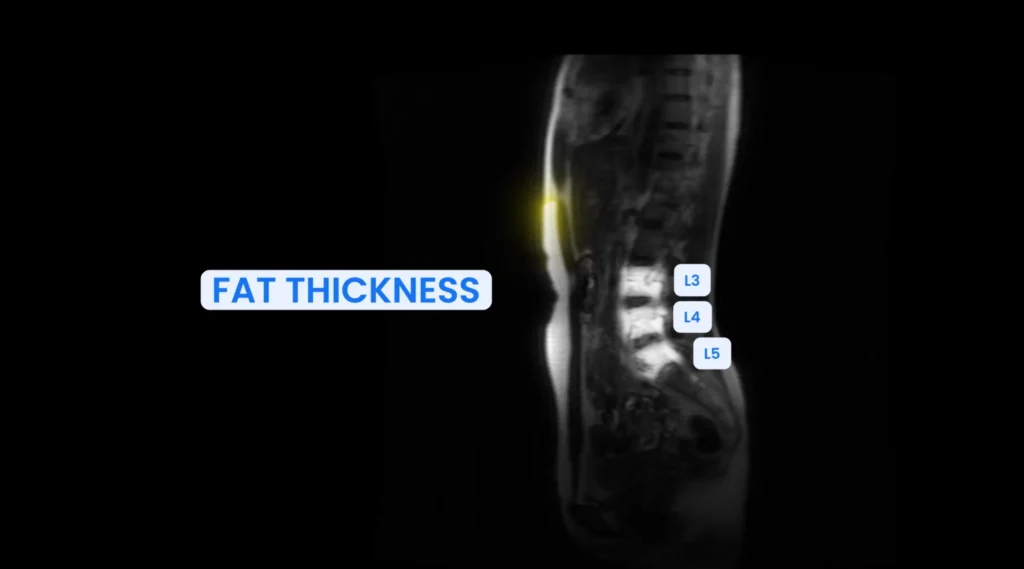
The scans also measured the thickness of their ab muscles.
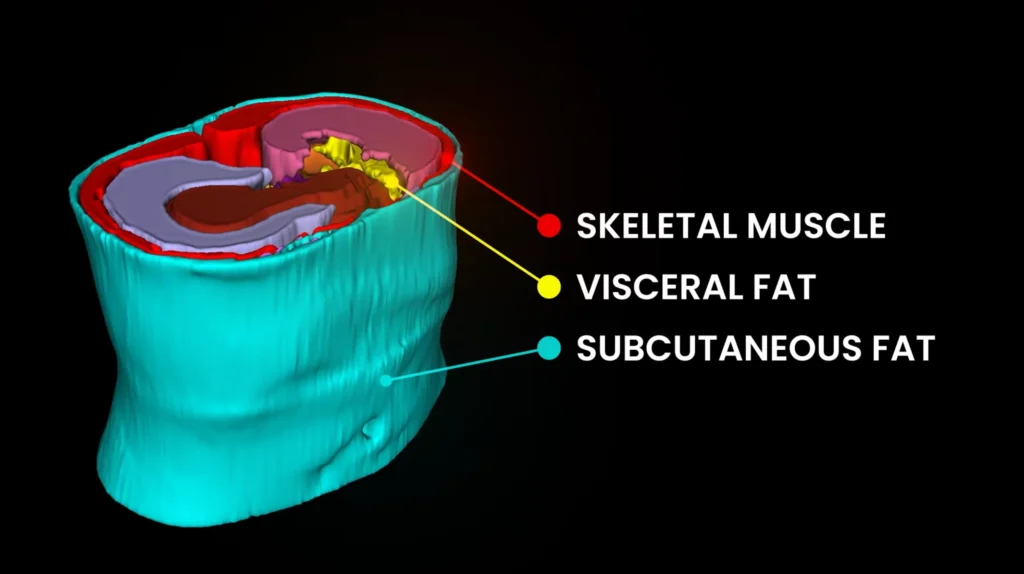
How We Tested Belly Fat Loss With MRI
The experiment had two 30-day phases.
The first 30 days tested the spot-reduction idea. Dennis and Vicky followed a protocol based closely on the 2023 study: moderate-intensity cardio immediately followed by direct ab training.
The second 30 days removed cardio and direct ab training entirely. Instead, they focused on calorie tracking and strength training to see how regular fat loss compared against the targeted approach.
The goal was simple: test whether trying to target belly fat worked better than losing fat through diet and lifting.
Who Took Part In The Experiment?
Dennis, the Creative Director, had struggled with belly fat since he was a kid.

He already worked out four days per week and did not eat much junk food, but he had never been able to fully reveal his abs.
His starting DEXA scan showed 17.5% total body fat, with his belly at 16%.
Vicky was also active, but wanted to lose the final layer of belly fat covering her ab definition.

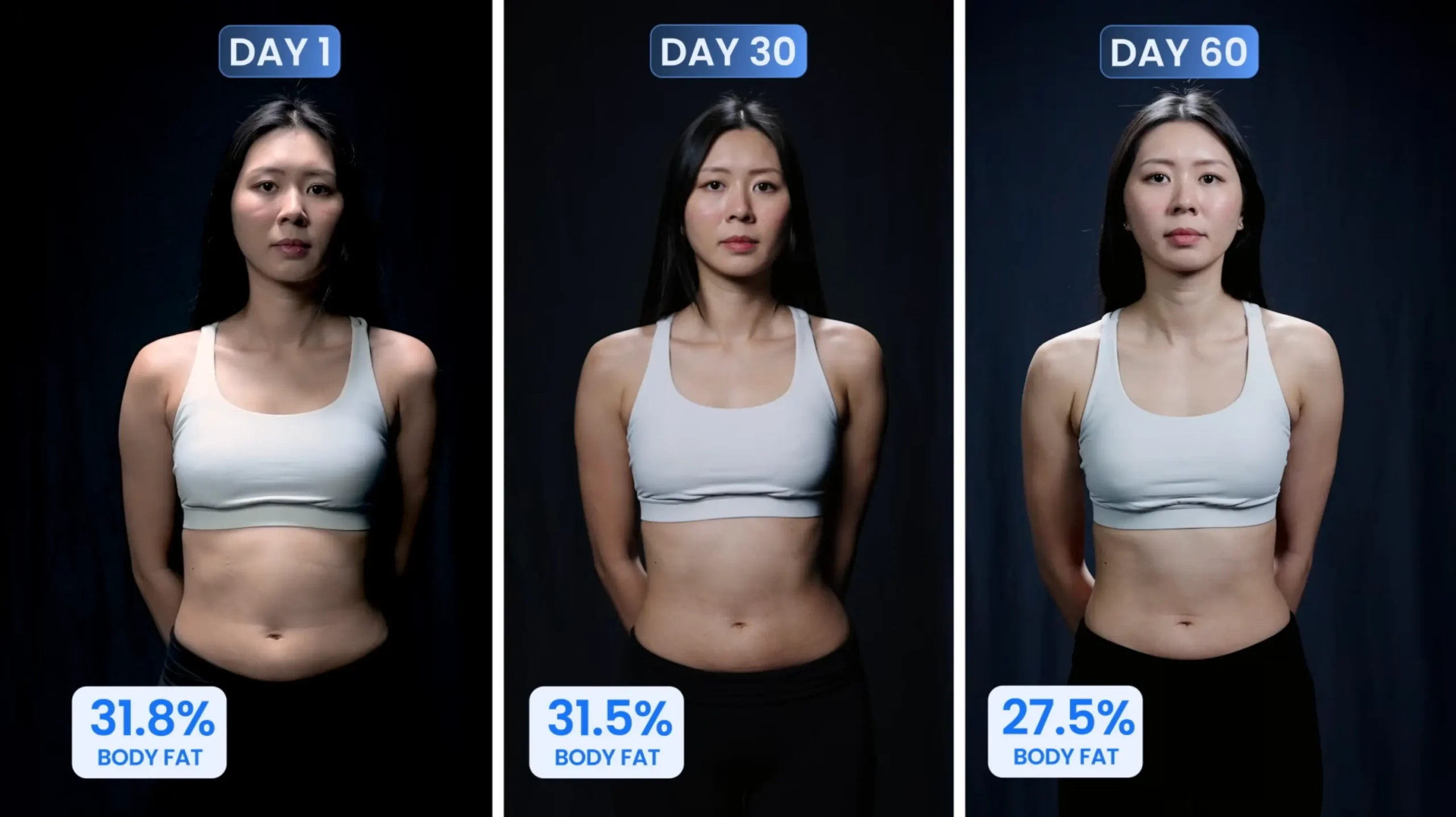
Her starting DEXA scan showed 31.8% total body fat. Her belly specifically measured 24.7%, meaning she actually stored less fat in her belly than in other areas.
That made the experiment especially interesting: Dennis was leaner overall but more focused on stubborn belly definition, while Vicky had more total fat to lose but did not store as much of it in her belly relative to the rest of her body.
Phase 1: Cardio Plus Direct Ab Training
Phase 1 was designed to match the spot-reduction protocol as closely as possible, with one small upgrade to the ab exercises.
Dennis and Vicky did:
- 25 minutes of moderate-intensity cardio
- 4 sets of weighted crunches for upper abs
- 4 sets of reverse crunches for lower abs
- The workout every other day
- No planned diet changes
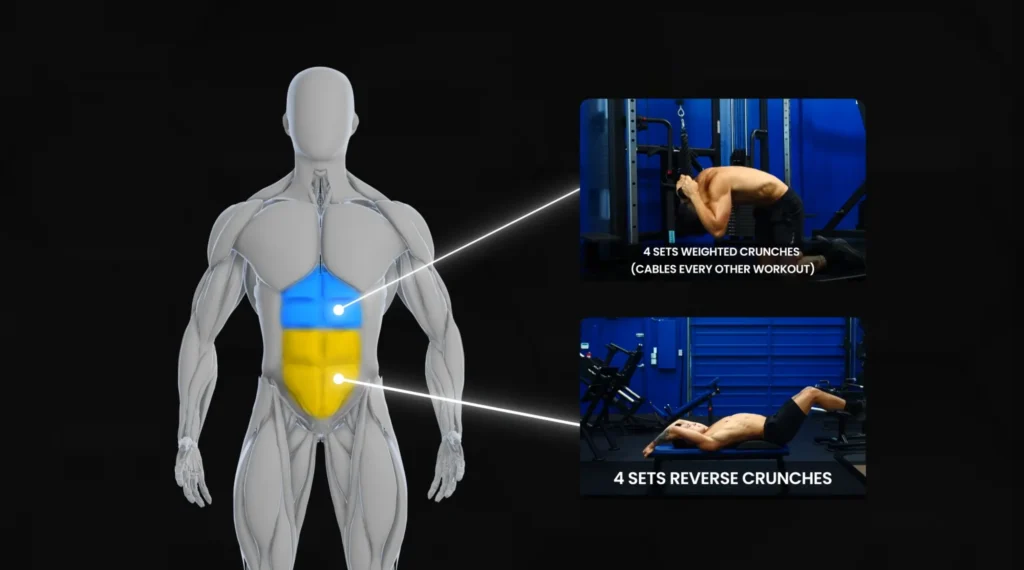
Vicky did only the cardio and ab work because she was not lifting weights at the time. Dennis continued his usual three-day lifting routine alongside the protocol.
That difference ended up mattering.
Why Belly Fat Is Often So Stubborn
Belly fat can be frustrating because it is often one of the slowest areas to change.
After analyzing more than eight years of DXA scans from nearly 18,000 people, a clear pattern showed up. Early in life, women tend to store more fat around the hips, with more of that storage shifting toward the belly later in life. Men, on the other hand, tend to store more fat in the belly from the start, and this becomes much more pronounced once body fat rises above roughly 25-30%.
Fat also does not come off evenly. In the scan data, the belly was consistently one of the slower areas to change, while areas like the arms and legs often leaned out first.
That helps explain why people keep trying to target belly fat directly. The frustration is real. The question is whether targeting it actually works.
Why Upper Abs Usually Show Before Lower Abs
Upper abs often become visible before lower abs because ab definition depends on two things: low enough body fat and ab muscles that are thick enough to show through.
The lower belly is thought to be harder to lean out because fat cells in that area may have a higher ratio of alpha-2 receptors. Alpha-2 receptors slow fat release, while beta receptors accelerate it. In plain English, lower-belly fat may be more resistant to being released and burned.
The muscles themselves also matter. Upper abs tend to be thicker and easier to see, while lower abs are often thinner. Depending on your ab genetics, you may also have less lower-ab separation than someone else.
That is why this experiment tracked both belly fat and ab-muscle thickness. If their abs grew, their midsections might look more defined even if belly fat did not drop much.
What Happened During The First 30 Days?
The first month looked promising visually, but the visual evidence was messy.
Dennis felt like his abs were becoming more visible, especially under good lighting. Vicky also noticed more upper-ab definition, even though her lower belly did not seem to change as much.
But lighting can be misleading. Dennis took two photos on the exact same day that looked noticeably different just because of lighting. Influencers use this all the time, and even very lean people will not look six-pack shredded in every environment.

That is exactly why MRI mattered. Small changes in lighting, posing, or hydration can make it look like a plan is working even if the actual fat measurements do not support it.
After 30 days, Dennis and Vicky had completed 375 minutes of cardio and 15 ab sessions. Visually, Dennis looked slightly more defined, while Vicky looked more toned overall.
But the numbers told a more complicated story.
Phase 1 Results: Did Spot Reduction Work?
The 30-day spot-reduction phase did not clearly show targeted belly-fat loss.
Dennis had a small body recomposition. His body fat went from 17.5% to 17%, but he gained about half a pound overall. Based on MRI, most of his fat loss came from his arms and hips, not his belly. His belly fat dropped by only about 0.3%.
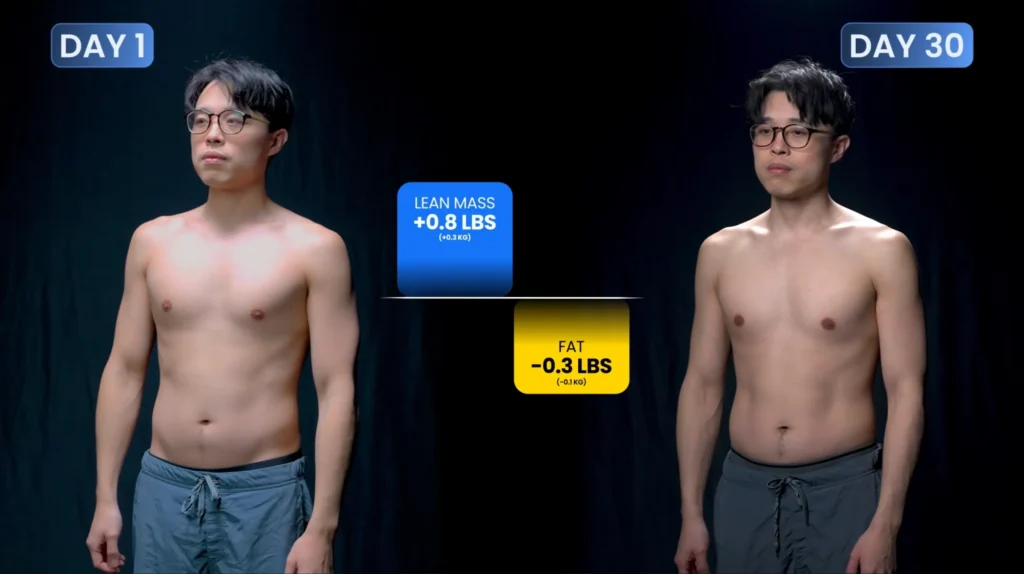
So for Dennis, Phase 1 produced more muscle and slightly better-looking abs, but no strong sign that spot reduction worked.
Diet may have been a major reason. His food intake was not controlled, just like in the 2023 spot-reduction study. Based on his vlogs, his cardio sessions made him hungry enough that he often ate back much of what he burned.
Vicky's results were more dramatic on the scale, but still not a clean win for spot reduction.
She lost 5 pounds in the first month. But 60% of that weight came from lean mass, and only 40% came from fat. Her body fat percentage went from 31.8% to 31.5%, which was a much smaller change than the scale alone suggested.
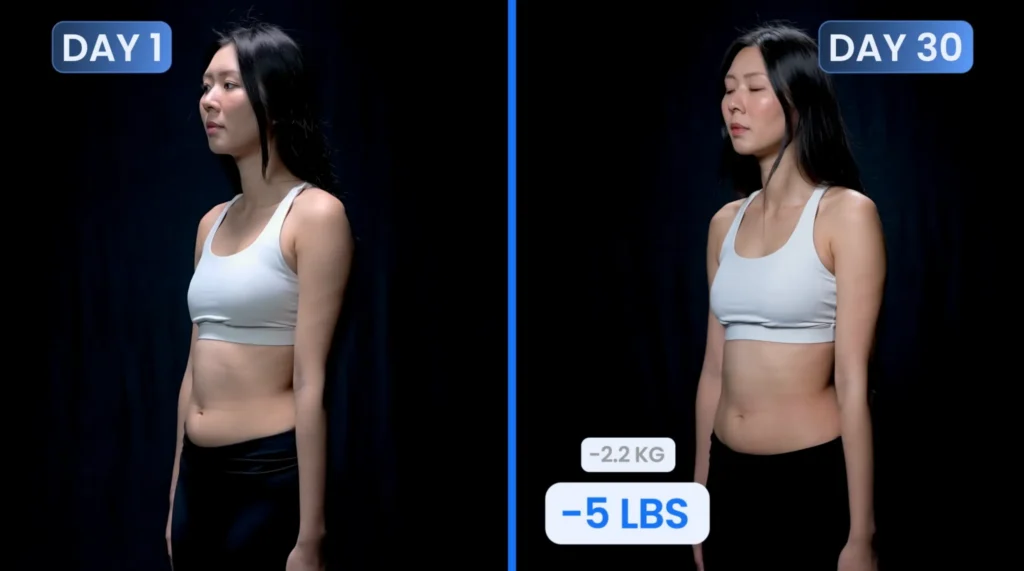
Her MRI did show belly-fat reductions, especially in her upper belly. On average, her belly fat dropped by about 3%, with the upper belly down about 5%, the middle belly down 0.27%, and the lower belly showing no change.
But when looking at her whole body, the belly-fat loss was proportional to fat loss in her arms, shoulders, and legs. Some of those areas even saw larger reductions.
That is the key point: Vicky lost fat, but the MRI did not clearly show that her belly was targeted more than the rest of her body.
What Happened To Their Ab Muscles?
The most promising Phase 1 finding was not belly-fat loss. It was ab growth.
Dennis' abs grew by about 20% on average, which was more than expected. That may explain why his abs looked slightly more visible even though his belly fat barely changed.
Vicky lost muscle in every measured muscle group except her abs. Her abs grew by about 15%, likely because she was directly training them even though she was not lifting weights.
So if the goal is making abs look more visible, direct ab training still seems useful. It can make the muscles thicker, which may help them show through.
But if the goal is losing belly fat, Phase 1 was not convincing.
Phase 2: Diet Plus Strength Training
Phase 2 removed the spot-reduction protocol completely.
No cardio. No direct ab training. No trying to target the belly.
Instead, Dennis and Vicky focused on two simple rules:
- Track food to hit a daily calorie target
- Strength train consistently
The calorie target was based on a rough body-weight formula: body weight in pounds multiplied by 12. For a more personalized number, readers could use the Built With Science calorie calculator.
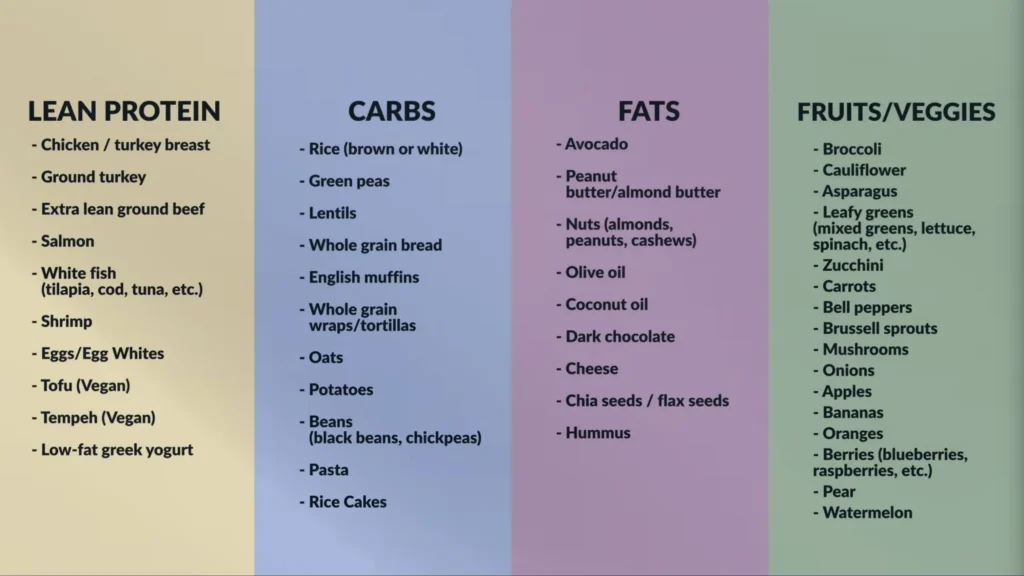
The food structure also changed. They built meals around core foods and included a fist-sized portion of lean protein at each meal to help protect muscle.
The training plan changed too. Vicky started a three-day full-body workout to hit every major muscle group. Dennis followed a four-day upper/lower split.
This phase directly addressed the biggest problem from Phase 1: Vicky lost too much lean mass, and Dennis may not have created enough of a calorie deficit.
Why Calories Mattered More Than Cardio
Calories mattered because fat loss still requires an energy deficit. You can do cardio, but if it makes you eat more or move less later, the expected fat loss can shrink fast.
Research has found that after aerobic exercise, some people compensate by eating more or reducing activity across the rest of the day. That helps explain why people often lose less weight than predicted when cardio is the main fat-loss tool.
That is not an argument against cardio. Cardio has real health benefits and can help speed up fat loss when used correctly. But in this experiment, cardio was removed to see what diet and strength training could do on their own.
The difference showed up quickly.
Dennis found dieting difficult at first because he loves eating out and lives downtown, where temptation is everywhere. Vicky also had a rough start, including a dim sum meal that used up a huge portion of her daily calories.
But both adapted. Dennis started pre-weighing meals so he knew exactly how much food he had left for the day. When eating out, he asked for sauces on the side, cut down high-calorie drinks, and weighed calorie-dense foods like peanut butter.
That sauce change matters more than people think. Something like hollandaise poured over eggs benedict can easily add hundreds of calories. Keeping it on the side and dipping with control can dramatically reduce the total.
Vicky also ran into a common fat-loss problem: liquid calories. A 300-calorie drink can be consumed in minutes, but burning the equivalent could take roughly an hour of incline walking or 30 minutes of running.
That is why trying to "burn off" food is usually a losing game. It is much easier to consume calories than to exercise them away.
Why Strength Training Changed The Result
Strength training helps shift weight loss toward fat loss instead of muscle loss.
Research comparing cardio plus diet to lifting plus diet has found that adding strength training can help more of the weight lost come from fat rather than muscle, even when total weight loss is similar.
In Phase 1, Vicky lost 5 pounds, but most of that came from lean mass. Phase 2 fixed that by adding full-body resistance training.
This is important because the goal is not just to weigh less. The goal is to look leaner. If you lose weight but much of it comes from muscle, your body-fat percentage may not improve much. If you lose fat while maintaining or gaining muscle, your body-fat percentage can drop much more dramatically.
That is exactly what happened in Phase 2.
Vicky started strength training as a beginner, which gave her a strong muscle-building stimulus. Dennis was already lifting, but the combination of structured diet and consistent training helped him finally create the deficit that Phase 1 lacked.
What Practical Diet Changes Helped?
The most useful changes were simple, not extreme.
Dennis swapped more fatty meats for lean fish. That gave him more protein for fewer calories. Vicky made a similar shift after realizing that salmon, while healthy and rich in omega-3s, was adding more calories than expected because of its fat content.
Here's a cheatsheet of how you could structure your meals:
And here are examples of lean protein:
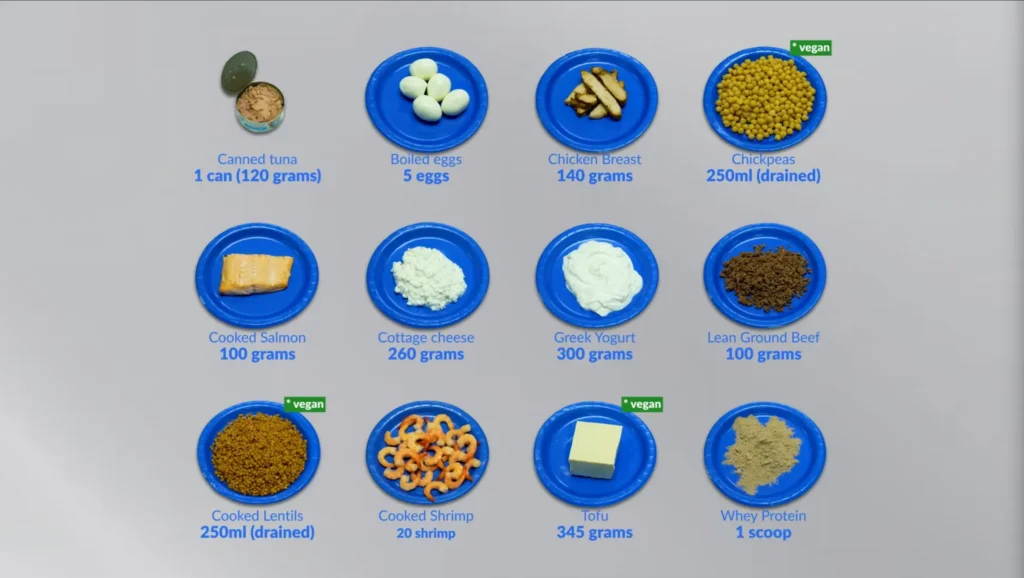
That does not make salmon bad. It just means that when calories are tight, leaner protein sources like white fish or shrimp can make it easier to get enough protein without overshooting calories.
Dennis also found ways to stay social without blowing up his calorie target. At parties, he quietly swapped whiskey for tea because the color looked similar and it did not make him feel out of place.
These are the kinds of changes that made the diet fit real life better. Not perfect eating. Just better control over the easiest calories to overconsume.
Phase 2 Results: What Worked Better?
Phase 2 worked much better than Phase 1 for belly-fat loss.
After 30 days of diet and strength training, Vicky's body fat dropped from 31.5% to 27.5%. Where Phase 1's 5-pound loss had been mostly lean mass — only about 2 of those 5 pounds were fat — Phase 2 inverted that. She gained almost 3 pounds of lean mass while losing weight.
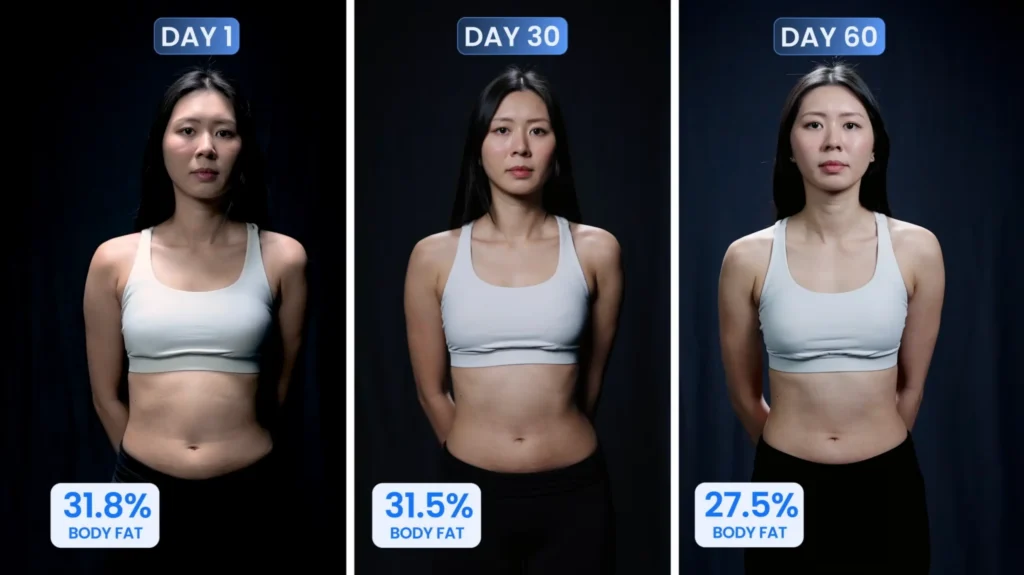
Her belly-fat results were even more dramatic. During Phase 1, her belly fat dropped by only about 3%. During Phase 2, her belly fat dropped by an average of 30%. Even her lower belly, which did not move during Phase 1, showed a major reduction.
Dennis saw a similar pattern.
In Phase 1, he gained half a pound and his body fat dropped by only 0.5 percentage points. His belly fat changed by just 0.3%.
In Phase 2, after 30 days of diet and strength training, he lost 6 pounds and dropped to 14.4% body fat. His belly fat dropped by an average of 26.3%.
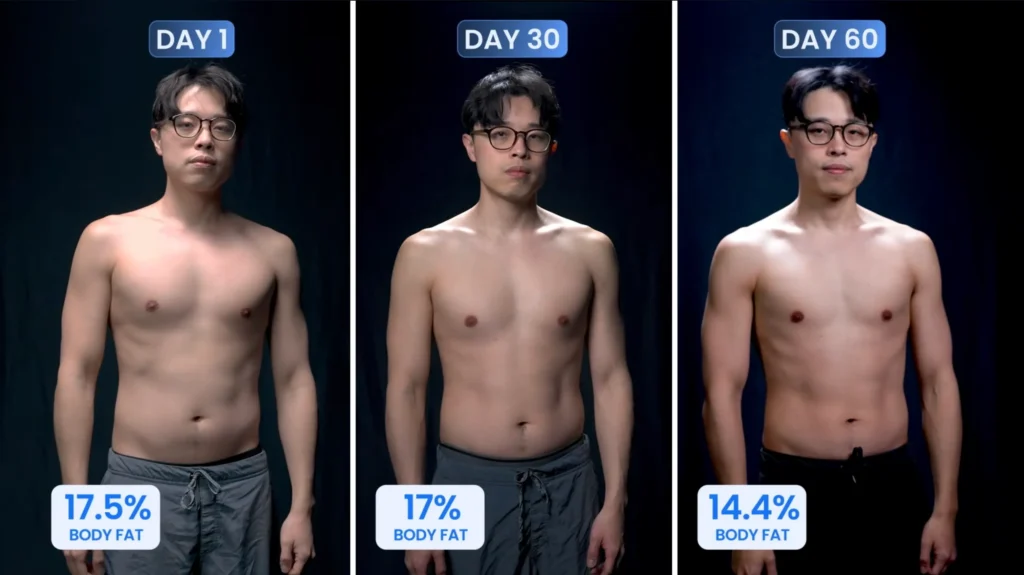
That is the clearest result of the whole experiment: the non-targeted fat-loss phase produced far better belly-fat results than the targeted spot-reduction phase.
What Happened To Their Abs Without Direct Ab Training?
Phase 2 also revealed an interesting difference in ab-muscle maintenance.
Vicky's abs did not grow more after direct ab training was removed, but they also did not really shrink. They mostly maintained their new size. One likely reason is that she was a beginner who had just started strength training, so heavy lifts gave her enough indirect ab stimulus to maintain her ab size.
Dennis was different. His abs became about 16% smaller after removing direct ab training, bringing him close to where he started before the ab-focused phase.
That does not mean squats and deadlifts do nothing for your abs. Research shows the abs are highly activated during heavy lifts like squats and deadlifts. But for someone who has already been lifting for a while, that indirect stimulus may not be enough to maintain the same ab growth achieved through direct ab work.
So the practical takeaway is simple: strength training and diet are the main drivers of belly-fat loss, but direct ab work may still help your abs look more defined.
So, Can You Actually Target Belly Fat?
Based on this 60-day experiment, targeting belly fat did not work better than regular fat loss.
The spot-reduction protocol was based on interesting research, and Phase 1 did produce ab growth. But MRI did not show a clear targeted belly-fat effect. Dennis barely lost belly fat, and Vicky's belly-fat loss was proportional to fat loss elsewhere.
Phase 2, on the other hand, produced much larger belly-fat reductions without cardio and without direct ab training. The major changes were calorie tracking, protein-focused meals, and strength training.
So the most honest answer is this: you may be able to influence how your abs look by training them directly, but you probably cannot reliably force your body to pull fat from your belly first.
What This Means If You Want More Visible Abs
If you want more visible abs, you need two things: less fat covering them and enough ab muscle to show through.
The experiment suggests that the best approach is not trying to burn belly fat with endless crunches or cardio. A better plan is to create a calorie deficit, strength train consistently, get enough protein, and use direct ab training if you want your abs to pop more.
Cardio can still be useful. It has health benefits and can support fat loss when used correctly. But if cardio makes you hungrier, causes you to eat back the calories, or replaces strength training, it may not produce the result you expect.
The good news is that even stubborn belly fat can change. In this experiment, the biggest belly-fat reductions happened when Dennis and Vicky stopped trying to target the belly and focused on the basics that actually drove fat loss.
If you want those basics built into a plan for you — calorie targets, protein-focused meals, and a structured strength program — that's exactly what the BWS+ app is designed to do. You can try it for free for 2 weeks here:
Click the button below to try the BWS+ app for 2 weeks, for free, no strings attached:
↓
By the way, here’s the article summed up into a YouTube video:

FAQ
Can you lose belly fat without cardio?
Yes, you can lose belly fat without cardio if you create a calorie deficit and strength train consistently. In this experiment, Dennis and Vicky lost far more belly fat during the no-cardio phase than they did during the cardio plus ab-training phase.
Do ab exercises burn belly fat?
Ab exercises can grow your ab muscles, but they do not reliably burn the fat covering your abs. In Phase 1, Dennis and Vicky's abs grew from direct ab training, but MRI did not show clear targeted belly-fat loss.
Why are lower abs harder to see?
Lower abs are usually harder to see because lower-belly fat tends to be more stubborn, and the lower-ab muscles are often thinner than the upper abs. Genetics also affect how your abs are shaped and how much lower-ab definition you can reveal.
Is cardio bad for fat loss?
No, cardio is not bad for fat loss. It has real health benefits and can help when used correctly. But if cardio makes you eat more, move less later, or skip strength training, the actual fat-loss result may be smaller than expected.
What is the best way to lose belly fat?
The best-supported approach is to lose fat overall through a calorie deficit while strength training to protect or build muscle. Direct ab work can help your abs look more defined, but diet and lifting are what made the biggest difference in this 60-day experiment.