The Best Ab Workout For Six Pack Abs (Based On Science)
In this article, find out the best science-based six pack abs workout you need to do for an impressive-looking midsection.
Let’s face it, acquiring a sculpted set of six-pack abs is a goal that most of us want to achieve.
Most of us also know that in order to achieve this, we need to strip off the excess fat that’s covering our abs by focusing on our diet.
And you’ll have to do this until you get down, depending on your gender:
- For men - To at least around 10-12% body fat
- For women - To around 14-18% body fat
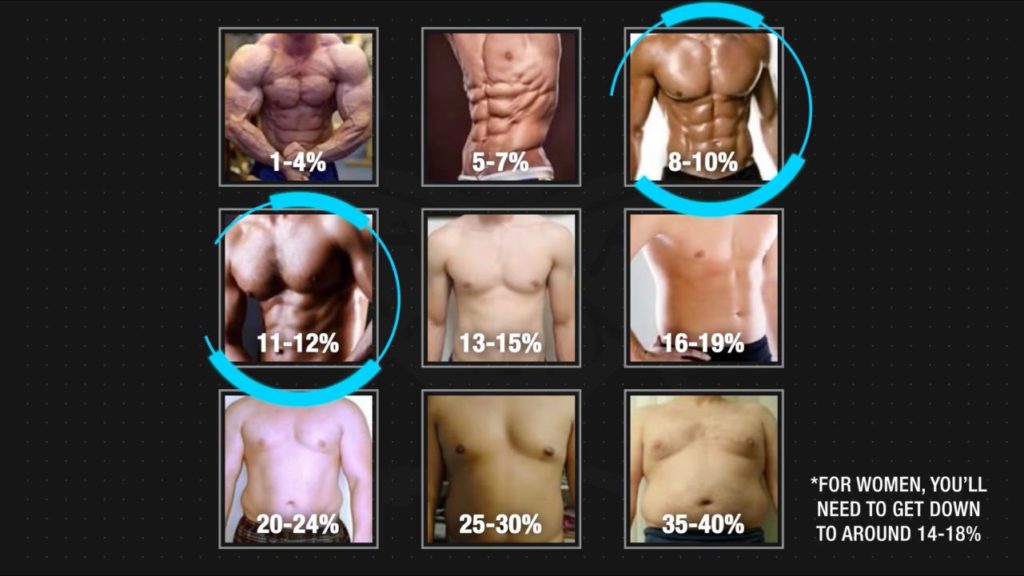
That said, achieving well-developed abs and an impressive looking midsection goes beyond this. Now, it's true that your diet will be mainly responsible for revealing your abs in the first place. But here's the crucial part. Your training will then be responsible for how developed and how well your abs and overall midsection look once they’re finally revealed.
But, of course, it's almost impossible to have a nice set of abs if your other muscle groups are lagging. That's why we've built multiple step-by-step, science-based programs - so you can finally achieve your dream physique. With those enviable six-packs. If you're interested:
Click the button below to take my analysis quiz to discover the best program for you:
↓
Either way. Adding direct abs and core work into your routine is definitely needed if you’d like to improve your six-pack development.
Basic Anatomy Of The Core Muscles
In order to best do this, you need to first understand the basic anatomy of the core muscles. That's because they each play a vital role in contributing to the overall look of your midsection.
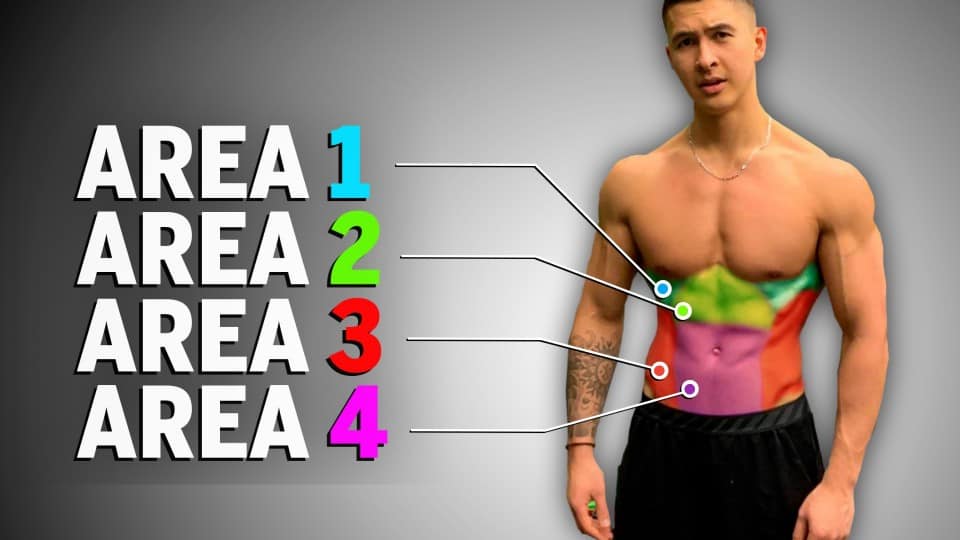
First off, there’s the rectus abdominis.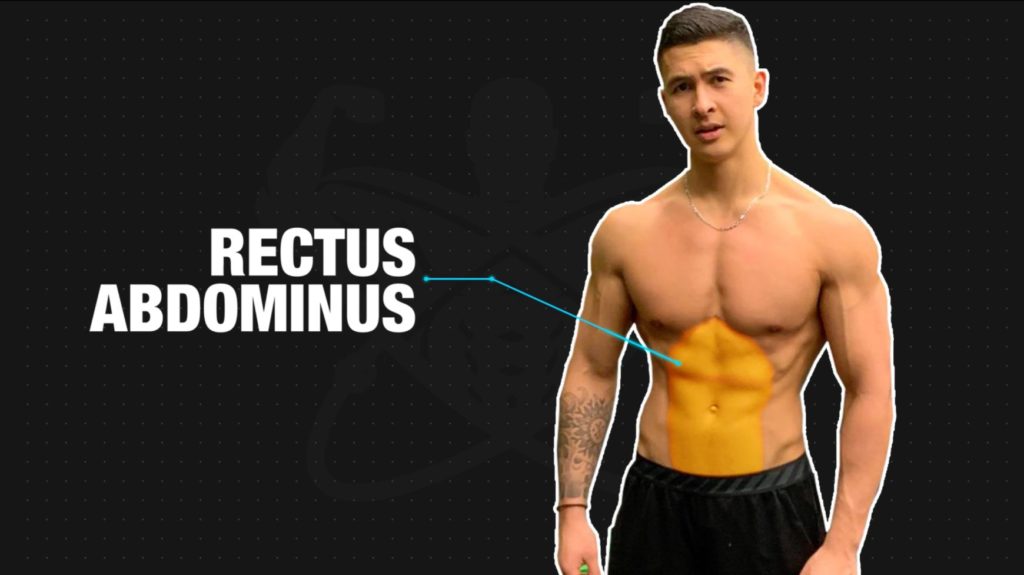 Which is the muscle group most associated with the coveted “six pack”. Now the rectus abdominis can be further divided into two regions:
And research has shown that each of these two regions can be selectively activated given that they’re innervated by different nerves. Which as you’ll see, will be accounted for when we get to our workout.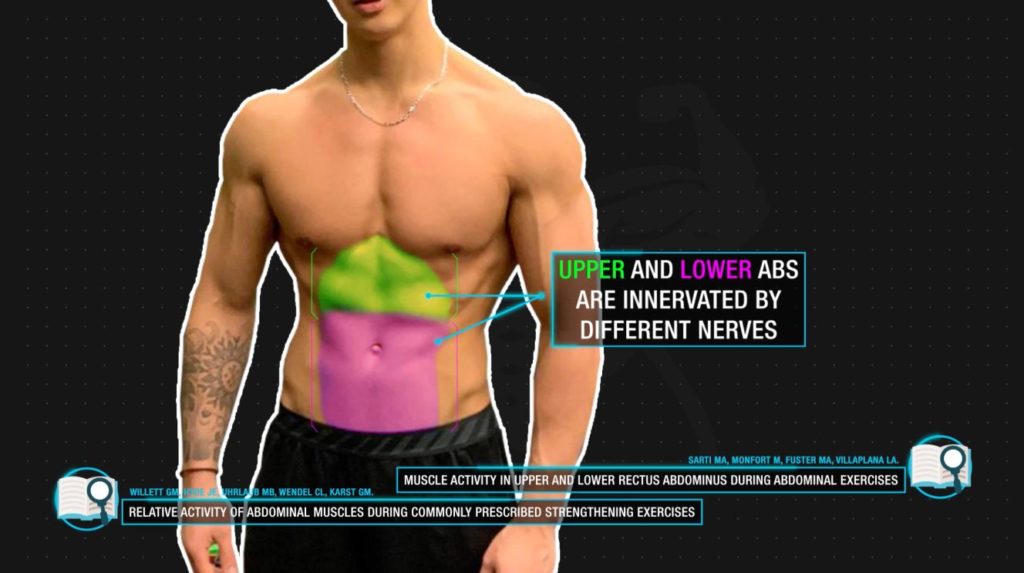
Next, there are the obliques. These run down the sides of the abs. In addition to adding definition to your mid-section, obliques can also help visually taper and narrow your waistline.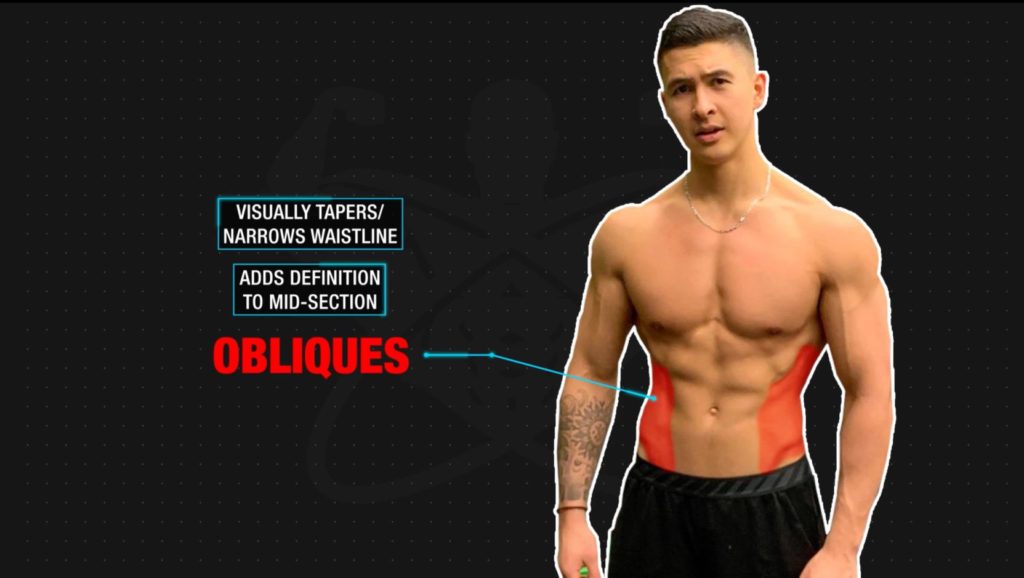
Lastly, there’s the serratus anterior situated right on top of the ribs. Which again adds more definition to your midsection. As well as plays a vital role in your shoulder health and injury prevention.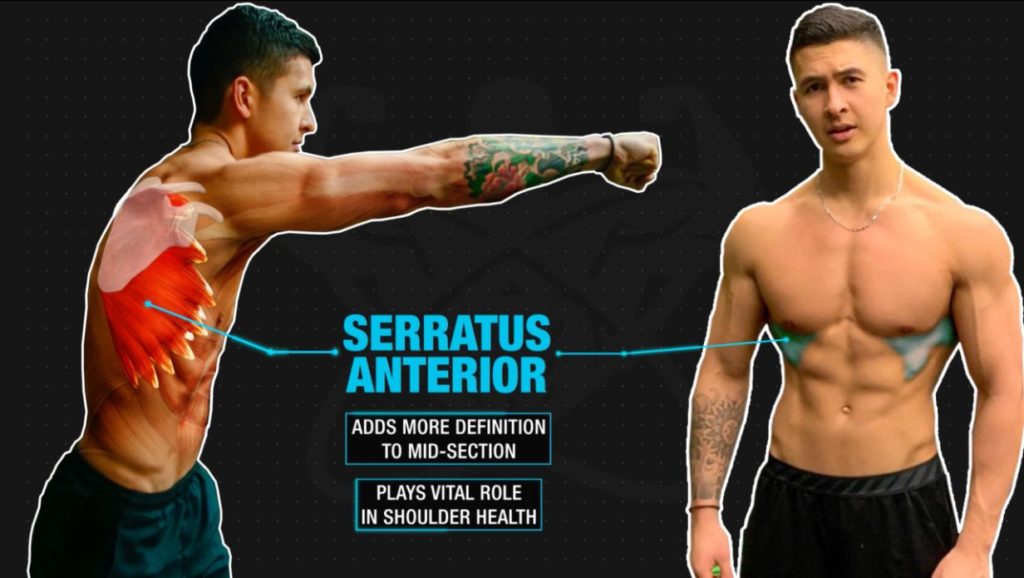
So, as you can see, each of these muscles plays a significant role in sculpting out an impressive midsection. Meaning that your abs routine needs to be designed in a way that hits each of these various muscles.
But this is something that most people fail to do with their ab workouts. That's really because of the overwhelming number of core exercises out there. Which makes it difficult to pinpoint exactly which ones you should be focusing your time and effort on. And which ones will speed up your core development most effectively.
In this article though, that’s exactly what I’ll show you how to do by crafting the best six pack abs workout for you based on:
- Scientific research and
- Our anatomical understanding of the core muscles
Exercise 1: Reverse Crunch (Lower Abs)
So the first exercise we’re going to perform is the reverse crunch. Now, the reverse crunch is categorized as a “bottom-up” abs exercise since the hips are brought up towards your shoulders. As a result, it effectively favours the lower abs over the upper abs in terms of activation.
Now the reason for starting out with this movement first in the workout is simply because bottom-up abs exercises are typically the most taxing to perform when compared to other abs exercises. And given that the lower abs are the region of the abdominals that most people struggle with not only losing fat from but also with developing, we’ll want to prioritize them by working them first in the workout when we’re fresh.
However, as I’ve stated in past articles, the key to this exercise’s effectiveness completely depends on how you perform it. Illustrating this is an EMG analysis. It found that subjects who performed the reverse crunch with the commonly done incorrect form where the legs were simply swung up and down were unable to elicit much lower abs activation. Whereas subjects who performed the reverse crunch with the correct form I’m about to show you were able to elicit significantly greater lower abs activation.
How To Perform The Reverse Crunch Correctly
So instead of doing this, what you want to do is:
- Before you even start, initiate something called posterior pelvic tilt. You can do so by squeezing your glutes and contracting your abs. This will force your pelvis to tilt upwards. And your back will flatten onto the bench. This will pre-activate your lower abs and will help keep them activated during each rep.
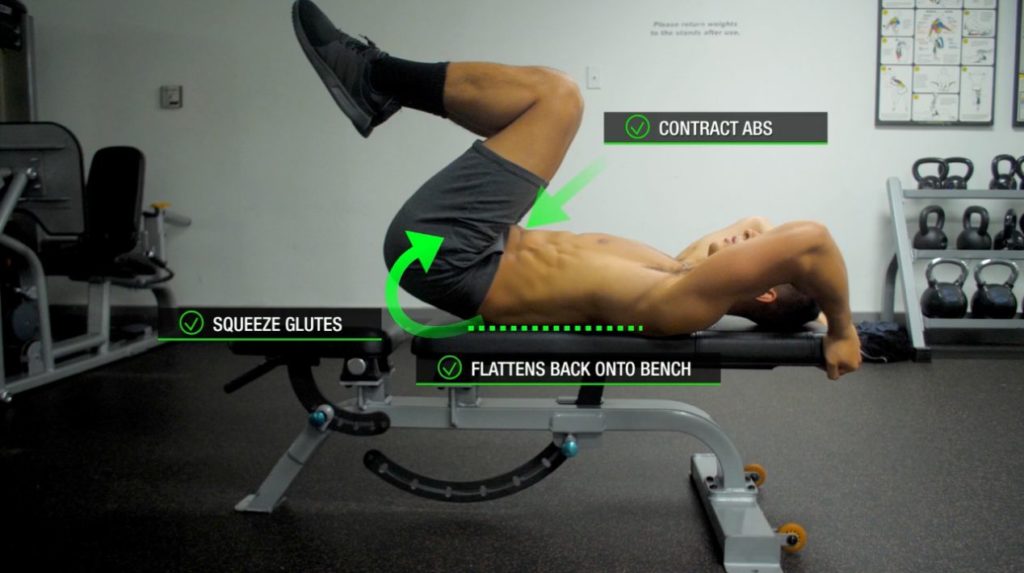
- Then, when you perform a rep, all I want you to think about is curling your pelvis up towards your belly button. And think about contracting your lower abs. You should feel a very strong contraction in the lower abs as a result of this.
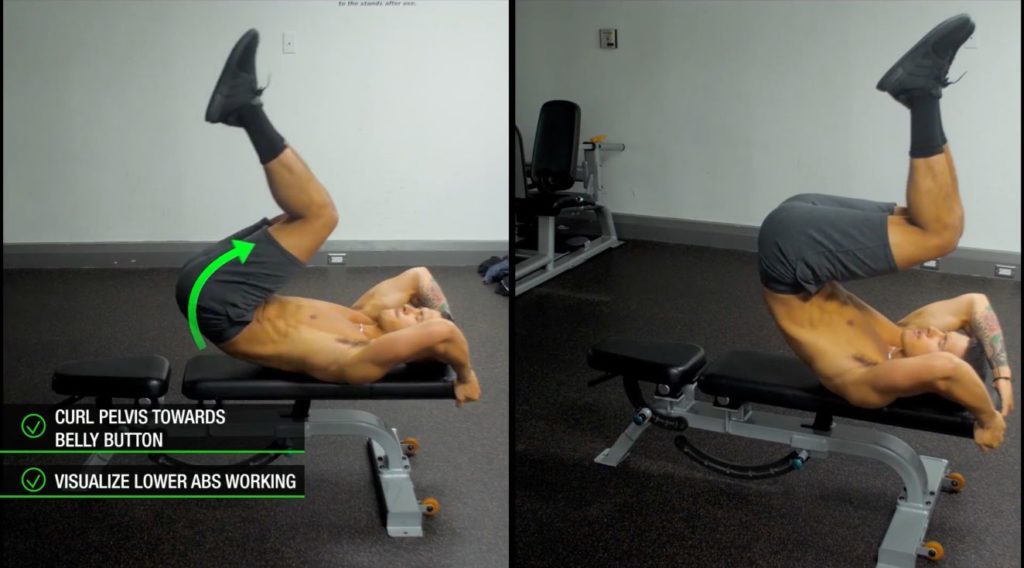
Incorporating The Reverse Crunch In A Six Pack Abs Workout
I’d recommend building up this movement to roughly 2-3 sets of 15-20 reps done with bodyweight and full control. And then move onto performing them weighted and/or with a decline implemented like so for 2-3 sets of 10-15 reps.
This is crucial that you do. Since just like any other muscle like your biceps, for example, you want to overload your abs with more weight over time. This allows you to best develop and stimulate their growth.
Still struggling to get the execution of the reverse crunch right? I understand how frustrating it can be. That's why I built the 3-on-1 coaching, so you get the necessary guidance. My team of experts - and I - will personally see that you perform every exercise as they're meant to. To find out more:
Click the button below to find out more about the 3-on-1 coaching program:
↓
Exercise 2: High To Low Cable Woodchoppers (Side Abs)
Next, we’ll move onto a rotational movement: the high to low woodchoppers. This allows us to shift our focus onto the all-important obliques. These are a great option to include in your core workout since they enable us to apply a weighted resistance directly in line with the diagonal way that the oblique fibres run.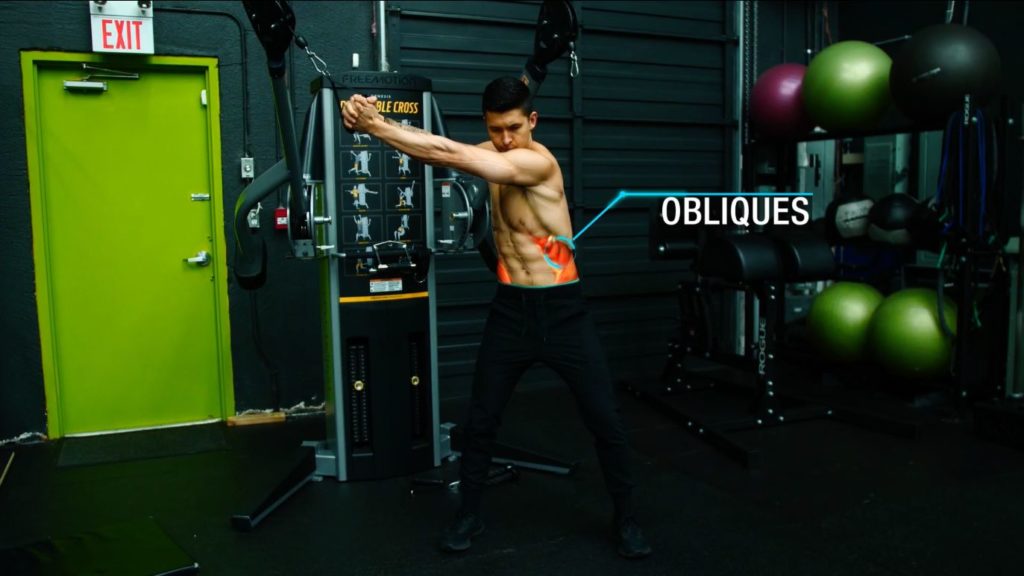
How To Perform The High To Low Cable Woodchoppers
And for these, you want to avoid simply swinging the weight down with your arms.
Instead:
- Keep your arms extended and elbows locked
- Then, use the one side of your obliques to rotate your torso down and across your body towards the opposite knee
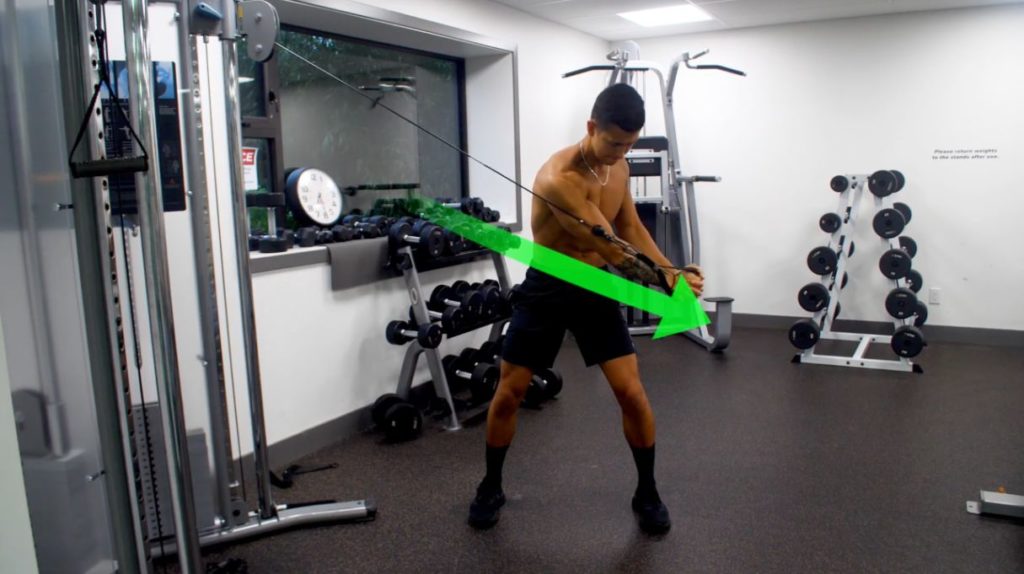
I’d recommend a set and rep range of roughly 2-3 sets of 10-15 reps, and adding more weight as this becomes easier.
Bicycle Crunches Are Good Alternatives To Include In Your Six Pack Abs Workout
However, if you find difficulty with this movement then a viable alternative are bicycle crunches.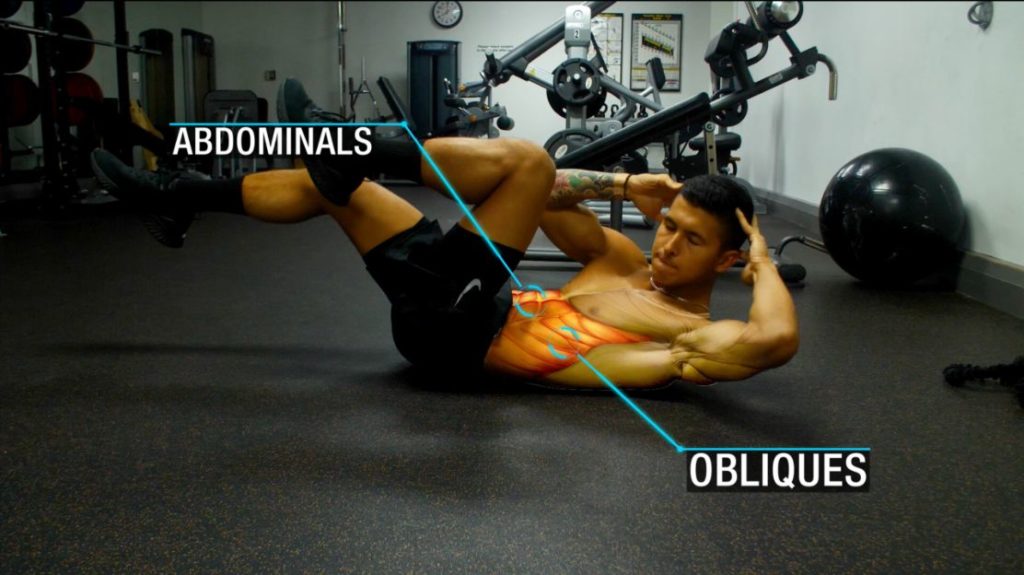 That's because bicycle crunches have been shown by the American Council of Exercise to elicit quite a high activation of the obliques when compared to other common obliques exercises.
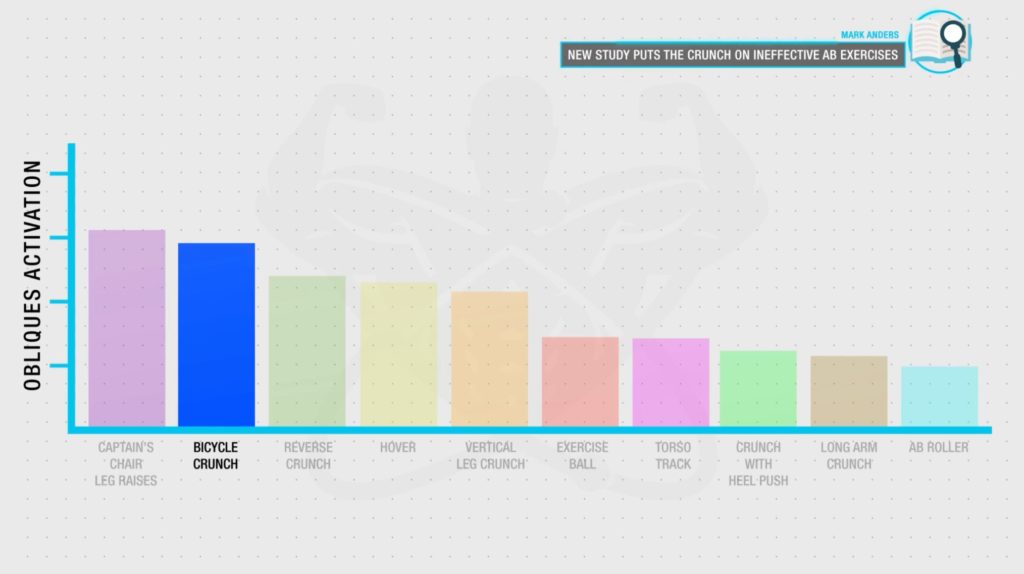 For these though, you’ll want to implement a higher rep range of roughly 20-30 reps. Or simply perform them to failure since you’ll be working just with your body weight here.
Exercise 3: Weighted Crunches (Upper Abs)
Next, it’s time to move onto weighted crunches. This exercise is a top-down abs movement that we know will now enable us to selectively emphasize the upper abs over the lower abs, which we've already worked earlier.
Now there are a variety of weighted crunches you can do here such as the stability ball crunch or weighted cable crunch, which are both effective at targeting the upper abs.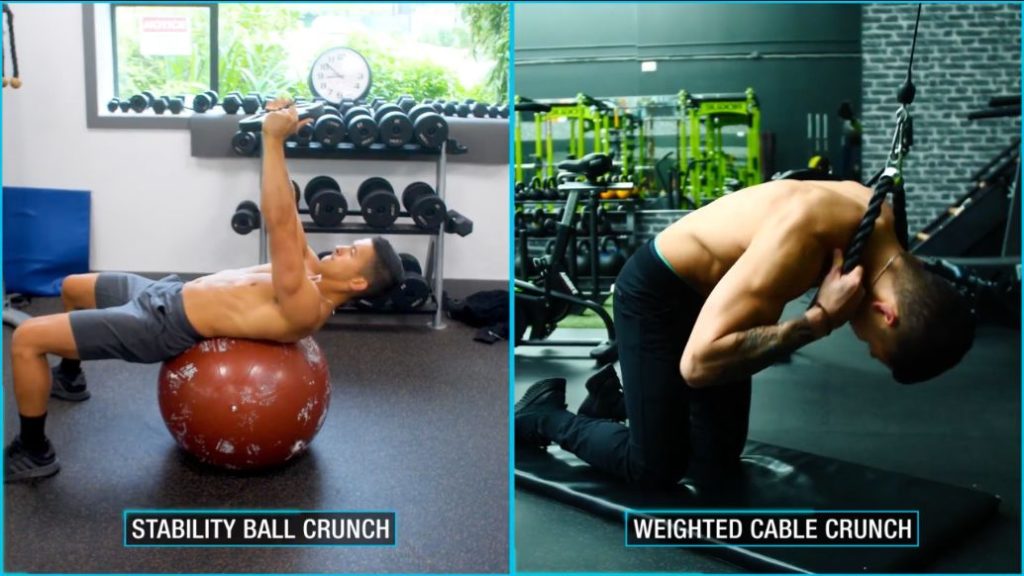 But the key is that you’re emphasizing the top-down aspect of these movements by focusing on simply bringing the rib cage forward and down towards the pelvis.
Your hips should simply remain stationary as you perform each rep which will enable your abs to be taken through their full range of motion.
And for these, you’ll want to use a moderate rep range of 2-3 sets of 10-15 reps and again, gradually overload these with more weight as your abs develop and strengthen over time.
Exercise 4: Serratus Jabs
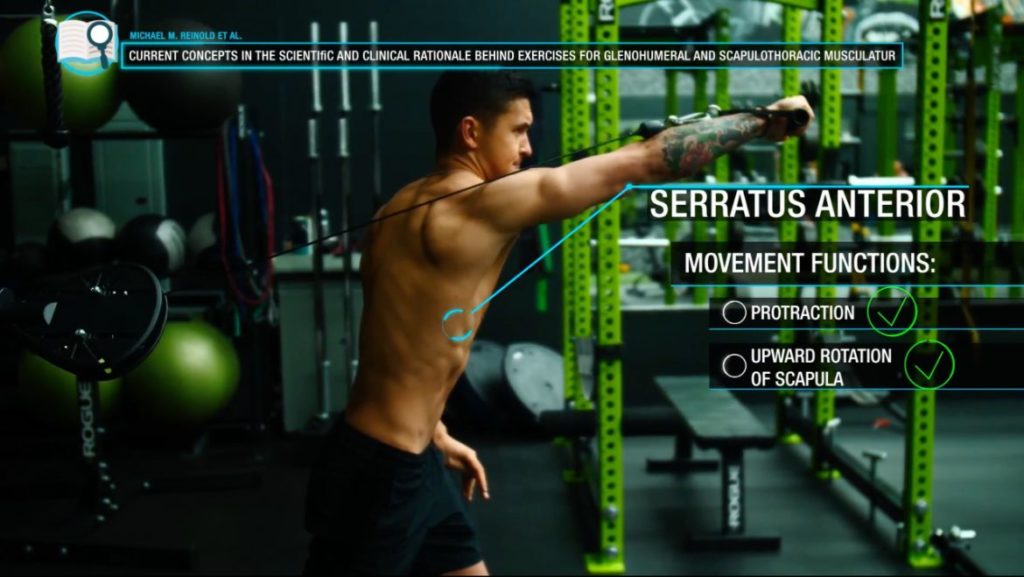
The last exercise of this abs workout will be something called serratus jabs. Which we know based on EMG analyses elicits very high activity of the serratus anterior since it effectively applies both of its main movement functions:
- Protraction and
- Upward rotation of the scapula
How To Perform Serratus Jabs
You can use a band or cable and set it up such that your arm travels upward during the jab. Then you want to simply perform an upward punching motion. And reach as far as you can at the end position to protract that scapula and fully activate the serratus anterior.
And we’ll again use a rep range of 10-15 reps per side for these and overload it overtime by increasing the resistance.
So to wrap this workout up for you, here’s how you’d want to construct it.
The Best Six Pack Abs Workout
Exercise 1:
Reverse Crunches: 2-3 sets of 15-20 reps (bodyweight)
BUILD UP TO:
2-3 sets of 10-15 reps (weighted/decline)
Exercise 2:
High To Low Cable Woodchoppers: 2-3 sets of 10-15 reps per side
OR
Bicycle Crunches: 2-3 sets to failure (bodyweight)
Exercise 3:
Weighted Crunches: 2-3 sets of 10-15 reps
Exercise 4:
Serratus Jabs: 2-3 sets of 10-15 reps
I’d recommend performing this workout 1-3 times per week, which can either quickly be done after your main workouts or on your rest days.
And for your convenience, I’ve compiled all of this information into an easy to a completely free, mobile-friendly PDF for you to download and use for reference while you’re at the gym performing this core workout. It’ll show you the full workout, rest times, step-by-step tutorials for each exercise, and more.
To get a copy of it:
Click the button below to download the six pack abs workout PDF:
↓
Conclusion
Now keep in mind though guys that this six pack abs workout, with the best ab exercises, is just one piece of the puzzle. If you truly want to attain a shredded, well-defined set of six pack abs then you need to pair your workouts with a nutrition plan that helps you both shred off fat effortlessly while providing your muscles with the fuel they need to recover and grow to the best of their ability after each workout.
If you are not sure how much fat you may need to lose before your abs become more visible, use the Built With Science body fat calculator to estimate your current starting point.
And for a step-by-step program that takes care of all the guesswork for you and shows you exactly how to train AND what to eat week after week in order lean down most effectively with science, just like several other members have been able to do with their Built With Science programs, then:
Click the button below to take my analysis quiz to discover the best program for you:
↓
I hope you enjoyed this article on the best science-based 6 pack abs workout! Don’t forget to give me a follow and connect with me on Instagram, Facebook, and Youtube as well, in order to stay up to date with my content.
Six Pack Abs Workout: FAQ
How often should I do this abs workout?
Jeremy recommends performing this workout 1–3 times per week, either after your main training sessions or on rest days. For most people, 2 sessions per week is a good starting point. Your abs recover relatively quickly compared to larger muscle groups, but they still need adequate rest between sessions to adapt and grow. Starting at twice per week gives you enough stimulus without overdoing it, and you can add a third session if you feel fully recovered and want to increase the training frequency.
Do I need to train abs every day to get a six pack?
No. Training your abs every day is not necessary and is likely counterproductive. Like any other muscle group, your abs need recovery time between sessions to repair and grow stronger. Daily ab training also tends to produce high volumes of low-effort work rather than the progressive, challenging sets that actually drive development. Two to three quality sessions per week with proper form and progressive overload will produce better results than daily ab circuits done without intensity or structure.
Why are my abs not showing even though I train them regularly?
Visible abs are primarily a function of body fat, not ab development alone. No matter how well trained your abs are, they will not be visible if there is a layer of fat covering them. For most men, abs become visible at around 10–12% body fat. For most women, the threshold is around 14–18% body fat. If your abs are not showing, the most effective thing you can do is focus on your nutrition and create a consistent calorie deficit. Use the Built With Science calorie calculator to find your daily calorie target for fat loss.
How long does it take to get a six pack?
The timeline depends almost entirely on how much body fat you are currently carrying and how consistently you maintain a calorie deficit. Someone who is already relatively lean may see visible abs within a few months of dieting. Someone starting at a higher body fat percentage may need six months to a year or more. Either ways, you should learn how to lose body fat in a sustainable way. Ab training accelerates the development of the underlying muscle, but the diet is what reveals it. Focus on both simultaneously rather than treating them as separate goals.
What body fat percentage do you need to see your abs?
For most men, abs become visible at around 10–12% body fat. For most women, the range is around 14–18% body fat. These are general thresholds and individual variation exists. Factors like how much muscle mass you carry, where you tend to store body fat and your overall ab development all influence exactly when your abs become visible. Building the underlying ab muscles through training while reducing body fat through a calorie deficit gives you the best combination of visible and well-developed abs.
Should I use progressive overload for ab training?
Yes. Your abs respond to the same principles of progressive overload as every other muscle in your body. Starting with bodyweight movements and gradually adding resistance over time is what drives actual ab muscle growth. This is why the workout progresses from bodyweight reverse crunches to weighted and decline variations, and why weighted crunches are included rather than endless bodyweight crunches. Once a movement becomes easy at your current rep range, increase the resistance rather than simply adding more reps indefinitely.
What is the serratus anterior and why does it matter for abs?
The serratus anterior is a muscle that sits on top of the ribs, along the sides of your torso. While it is not part of the abs directly, it contributes significantly to the overall appearance of a well-developed midsection by adding visible definition along the rib cage. It also plays an important role in shoulder health and scapular stability. Most people neglect it entirely in their ab training, which is why serratus jabs are included as the fourth exercise in this workout.
Can I get a six pack without doing any ab exercises?
Technically yes, in the sense that losing enough body fat will reveal whatever ab development you have built through compound lifting. Exercises like squats, deadlifts and overhead pressing do engage the core. However, direct ab training develops the rectus abdominis, obliques and serratus anterior more fully than compound movements alone. If you want well-developed, defined abs rather than just visible ones, direct ab work is worth including. The workout in this article is designed to be efficient and can be completed in under 20 minutes.
How does nutrition affect six pack abs development?
Nutrition is the primary driver of visible abs. Training builds and develops the muscle. Nutrition determines whether that muscle is visible. The most important nutritional factor is maintaining a consistent calorie deficit over time. Protein intake also matters significantly: eating enough protein while in a deficit helps preserve the muscle mass you have built, including your abs. Aim for 0.7–1 gram of protein per pound of body weight and use the Built With Science calorie calculator to set a calorie target that supports steady fat loss without excessive muscle loss.
How do I know how many calories to eat to lose body fat and reveal my abs?
Your calorie target for fat loss is based on your Total Daily Energy Expenditure (TDEE), which is the number of calories your body burns per day. Eating 300–500 calories below your TDEE creates a sustainable deficit that produces steady fat loss without excessive muscle loss. Learn how to calculate your calorie deficit for your particular goal. Use the Built With Science TDEE calculator to find your TDEE, then subtract your chosen deficit to get your daily calorie target. Track your weight over 2–3 weeks and adjust if needed.
By the way, here’s the article summed up into a YouTube video: