

You're Probably Wasting Time In The Gym: We Tested A 3 Days Vs 6 Days Split
TL;DR
- In our 3 days vs 6 days split experiment with 200+ lifters, doing twice the training didn’t produce a statistically significant advantage in muscle growth.
- A group that packed the six-day volume into three full-body workouts grew the most.
- More volume can still help, but only if it doesn’t come at the cost of effort and form.
Quick Answer: 3 Days Vs 6 Days Split — Which Builds More Muscle?
In our 10-week 3 days vs 6 days split experiment with 200+ lifters, a three-day push/pull/legs group grew about as much as a six-day group doing twice the training — the difference wasn’t statistically significant. A third group that fit the six-day volume into three full-body workouts grew the most. More volume can still add growth, but the extra sets only make sense if your effort and form hold up.
What if half the time and effort you’re spending in the gym isn’t actually doing anything?
I recently ran a 10-week experiment with over 200 lifters to compare a 3 days vs 6 days split. And the results went against what I expected.
The short answer: in our 3 days vs 6 days split, training twice as much didn’t produce a measurable advantage. The group training six days per week did around twice the weekly volume of our three-day push/pull/legs group, yet statistically, we couldn’t confidently distinguish their muscle growth. Meanwhile, a third group that fit the six-day group’s full weekly volume into three full-body workouts produced the most growth in our experiment.
That doesn’t mean more training is useless, or that three workouts will always beat six. But it does suggest that simply adding more sets and more days in the gym may not produce the results you expect, especially if all that extra work starts compromising how hard and how well you train.
Here’s what we found, why the results may differ from what controlled research would predict, and how to figure out how much training you actually need.
Can You Build As Much Muscle With A 3 Days Vs 6 Days Split?
Based on our 10-week 3 days vs 6 days split experiment, the three-day and six-day push/pull/legs groups experienced statistically similar muscle growth despite the six-day group doing roughly twice as much training. The six-day group recorded 0.85 inches of combined growth compared with 0.71 inches in the three-day group, but the difference was not statistically significant.
That wasn’t what I expected.
Ever since I got into lifting, I’ve always been someone who trains a lot — usually six hard workouts per week. And according to the latest research, doing more training volume should generally lead to more growth.
So why didn’t that happen here?
Why Should More Training Build More Muscle?
Research suggests that increasing weekly training volume can produce additional muscle growth, although the returns diminish as volume gets higher.
According to the latest research, going from around 10 sets per muscle per week to 20 should produce roughly 60% more gains. Increasing that again to 30 sets should provide another roughly 30% boost.
There was one problem.
Most studies investigating high training volumes only test that volume on one or two muscles at a time. In my own training, I was effectively doubling the volume across my entire body.
So was I actually getting more gains by training six times per week? Or could I have achieved similar results with half the training?
To find out, we recruited more than 200 people for a 3 days vs 6 days split experiment.

What Happened When We Tested A 3 Days Vs 6 Days Split?
We randomly assigned lifters to one of three workout programs and followed their progress for 10 weeks. The programs differed in training frequency, weekly volume, and — for the third group — how that volume was distributed throughout the week.
How The 3 Days Vs 6 Days Split Experiment Worked
The first group trained six days per week using a push/pull/legs split. It was almost exactly the routine I followed for years, with around 20 sets per muscle per week.
The second group followed the same general push/pull/legs structure, but trained only three days per week. They worked the same muscles but performed roughly half as many workouts and half as many sets.
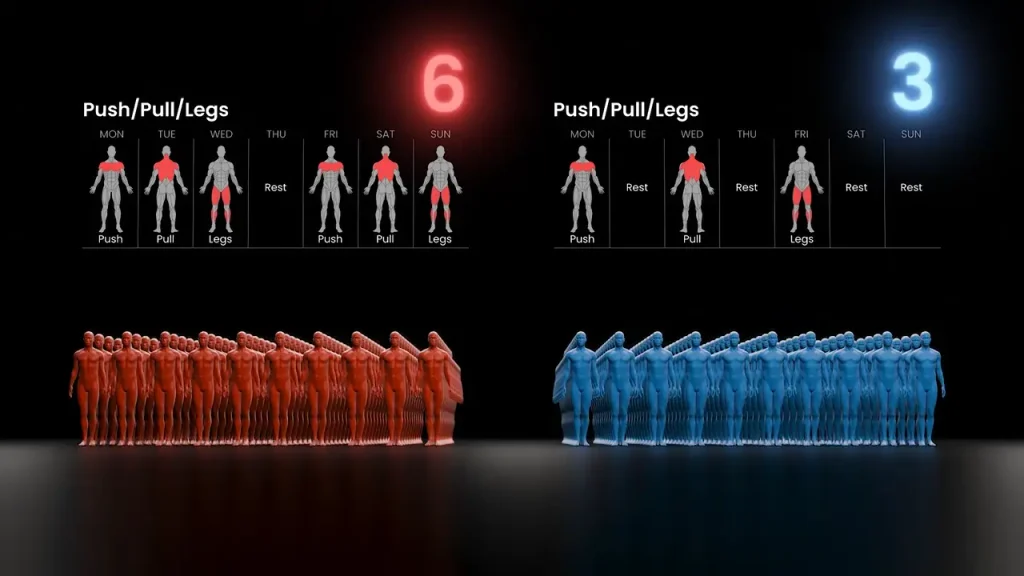
Then there was our third group: the Wild Card Group.
They also trained only three days per week, but instead of using the same push/pull/legs setup, they performed full-body workouts. We’ll come back to them because their results turned out to be the most interesting of the experiment.
To help control nutrition, every participant followed a small calorie surplus and had a minimum daily protein target. Everything was tracked in our app, and participants who weren’t sufficiently consistent were removed from the experiment.
We also balanced all three groups for gender and included equal numbers of beginner and intermediate lifters.
Why We Used Circumference Measurements
Muscle growth was assessed through weekly circumference measurements of participants’ flexed and unflexed muscles, along with their waists.
This obviously isn’t the same as bringing every participant into a laboratory for high-tech body-composition measurements.
But as statistician and muscle-growth researcher Dr. Eric Trexler explained, those sophisticated methods generally restrict researchers to much smaller groups. Using circumference measurements allowed us to expand the experiment to a larger and more representative sample.
Trexler helped us design the experiment and independently analyzed the results after the 10 weeks were complete.
Was Training 6 Days Per Week Harder To Sustain?
Yes. As the experiment progressed, the six-day group generally found its program increasingly difficult to sustain, while the three-day group tended to find its training easier to manage.
This became one of the clearest differences between the groups.
What Happened During The First 4 Weeks?
At the end of each week, we asked participants to rate how difficult their program felt.
During the first four weeks, the three-workout group consistently rated their workouts as feeling easier and easier. Several participants also reported feeling more rested than when they had previously trained five or six days per week.
One participant described how training only three days made him feel like he could give “110%” during each workout rather than cutting corners. Another said that, for the first time in a long time, he was actually enjoying working out, and that the three-day plan left him energized rather than drained like his past six-day routines.
The six-day group was moving in the opposite direction.
Participants increasingly reported soreness, scheduling difficulties, and trouble sticking to the plan.
Yet there was an interesting contradiction.
Both groups generally believed their workouts were working. And the six-day group repeatedly seemed more confident that their higher-volume approach was maximizing their growth.
For a while, that confidence appeared to help them push through the difficulty.
The picture wasn’t one-sided, though. Some members of the three-day group weren’t sure they were seeing results at all — one said he felt more rested but no stronger, and another worried his belly was growing more than the rest of him. And some six-day participants reported strong progress; one described hers as “explosive,” even while concluding that six days a week was too much for someone with a busy life.
At this point, the six-day group had both the research and the confidence on its side.
What Changed During The Final Weeks?
By the later weeks, a different pattern started appearing.
Members of the three-day group increasingly talked about feeling stronger and lifting heavier.
One participant who previously couldn’t perform more than one pull-up managed six with good form. Others described feeling noticeably stronger from one week to the next.
Meanwhile, some members of the six-day group sounded like they were trying to survive until the end.
Participants talked about needing a deload, questioning whether the workload was optimal, and struggling to balance six workouts with jobs and family responsibilities.
But feelings alone don’t tell us which program actually builds more muscle.
So after 10 weeks, we collected the data, sent it to Dr. Trexler, and let the numbers decide.

How Did The 3 Days Vs 6 Days Split Groups Compare?
The six-day push/pull/legs group recorded 0.85 inches of combined growth, while the three-day push/pull/legs group recorded 0.71 inches. Statistically, however, the difference between the two groups was not significant.
First, there was reassuring news about the experiment itself.
Trexler checked for unusual outliers and found that the distributions looked solid. Despite participants taking their own measurements, the changes were reasonably consistent and realistic across the sample.
More importantly, participants grew. The statistical analysis indicated significant growth across the board.
Then came the comparison we were waiting for.
The six-day group: 0.85 inches of combined growth.
The three-day PPL group: 0.71 inches.
At first glance, that might look like a meaningful advantage for six days.
But statistically, it wasn’t. As Trexler explained, a statistician looking at the data would conclude that the two groups essentially grew the same amount.
Our three-day group had therefore done roughly half the training, yet we couldn’t confidently distinguish their growth from the group doing twice as much.
My first thought was that we’d screwed something up.
Why Didn’t Twice The Training Produce More Muscle Growth?
One possible explanation is that additional sets only help if they continue producing a high-quality muscle-building stimulus. If higher volume causes effort, execution, or performance to decline, doing more work may not provide the expected return.
This distinction is crucial because the existing research gave us a reason to expect the six-day group to win the 3 days vs 6 days split comparison.
Based on the volume research mentioned earlier, doubling from roughly 10 to 20 weekly sets per muscle should have produced around 60% more gains. Applied to our results, that would have put the six-day group’s combined growth closer to 1.1 inches rather than 0.85.
So what happened?
More Sets Don’t Always Mean More Muscle Stimulus
Dr. Eric Helms — a muscle researcher and natural pro bodybuilder — offered one possible explanation.

Your muscles don’t know how many sets are written in your workout program. What matters is the actual muscle-building stimulus those sets create.
That means training effectiveness depends not only on how many sets you perform, but also on how hard you push those sets and how well you execute them.
Helms has seen cases in his coaching where people reduced their volume from more than 20 sets into the teens and then started growing better or broke through a plateau.
The explanation wasn’t necessarily that lower volume is inherently superior. Rather, after reducing their workload, they performed everything else better. Their actual effective training dose may therefore have increased even though their number of sets decreased.
Knowing You Have More Work May Make You Pace Yourself
People may subconsciously reduce their effort when they know they have substantially more work ahead of them.
A 2014 experiment provides an interesting example.
Researchers had participants perform 12 maximal isometric biceps contractions while trying to produce as much force as possible on every set.
Half were told how many contractions they would perform. The other half were falsely told they would only have to do six.
Despite everyone being instructed to push as hard as possible, the participants who knew they had 12 contractions ahead of them paced themselves and consistently produced less power than those who believed they only had six.
Something similar may have happened in our six-workout group.
Even though our app prompted participants to train close to failure, knowing they had twice as much training to complete could have caused them to subconsciously hold back. As fatigue accumulated, their form could also have deteriorated.
That doesn’t prove this was the reason for our result. But it provides one plausible explanation for why doubling the scheduled training didn’t produce the extra growth the research predicted.
Why Research Studies May Get Different Results
Controlled studies can maintain training effort and execution as volume increases in ways that may be difficult to reproduce in everyday training.
Research studies are designed to isolate variables.
When researchers increase volume, participants can be supervised to ensure they’re still pushing equally hard and maintaining consistent form. In the real world, unless somebody is watching every rep and pushing you, you’re responsible for maintaining that standard yourself.
That’s where the practical problem emerges.
If adding more training causes the quality of those sets to fall, some of the extra time you’re spending in the gym may not be producing the return you expect.
How Can You Tell If Your Workouts Are Being Wasted?
Three useful signs are rep speed, rep drop-off between sets, and long-term progression. Together, they can help indicate whether you’re actually training hard enough for your current volume to be productive.
Test 1: Check Your Rep Speed
If you’re pushing hard enough, your last few reps should generally move noticeably slower than your first few.
If your rep speed barely changes as the set progresses, you may be stopping too soon.
Test 2: Check Your Rep Drop-Off
Suppose you’re performing three sets of an exercise with the same weight.
If your reps remain almost perfectly flat from set to set — or somehow increase on your final set — that can be a sign that you didn’t push hard enough during your earlier sets.
Hard sets should take something out of you.
For example, 12 reps might fall to 10 or 11 on the next set, followed by eight or nine on the final set.
Test 3: Check Your Progress
The most important test is whether your lifts are actually progressing over time.
Look back over the past two or three months.
Are you consistently adding reps or weight to your main lifts?
If yes, your program is probably doing its job.
But if you’re training five or six days per week and your lifts haven’t moved in months, it may be worth experimenting with less training rather than automatically adding more.
Should You Try Doing Less Training Volume?
If you’re doing a lot of training without progressing, reducing your volume for a training block or two may help you determine whether some of your sets are low quality.
Trexler suggested treating it as an experiment.
Cut back your volume, deliberately push the remaining sets hard, bring more focus into each session, and then monitor your progress.
Practically, that could mean performing two hard, high-quality sets per exercise instead of the usual three or four.
If you discover that you’re pushing those sets much harder, concentrating better, and continuing to progress despite the lower volume, you may realize that some of your previous sets weren’t contributing much.
But there’s an important counterargument.
What if you already know how to train hard?
What if your form is dialed in and, whether you’re doing five sets or 20, you can maintain the quality of your training?
Surely much more volume should then build much more muscle.
The answer is where things get interesting.
Does Higher Training Volume Still Build More Muscle?
Higher training volumes can still provide additional muscle growth, but the extra gains may become increasingly small as more sets are added.
Shortly after our experiment, researchers conducted a similar study involving more than 100 trained lifters.
They compared roughly 36 weekly sets for the arms and thighs against just nine sets — around four times the training volume.
Unlike our experiment, however, every workout was supervised. This was designed to ensure that the high-volume group didn’t start slacking as more sets were added.
If very high volume was going to completely blow lower volume out of the water, this was a strong setup for it to happen.
Yet according to Helms, although the data slightly favored higher volumes, the difference was probably not meaningful to most people.
His broader point was that as you keep adding sets — particularly once you get into the teens and 20s — each additional set offers an increasingly marginal return on your investment.
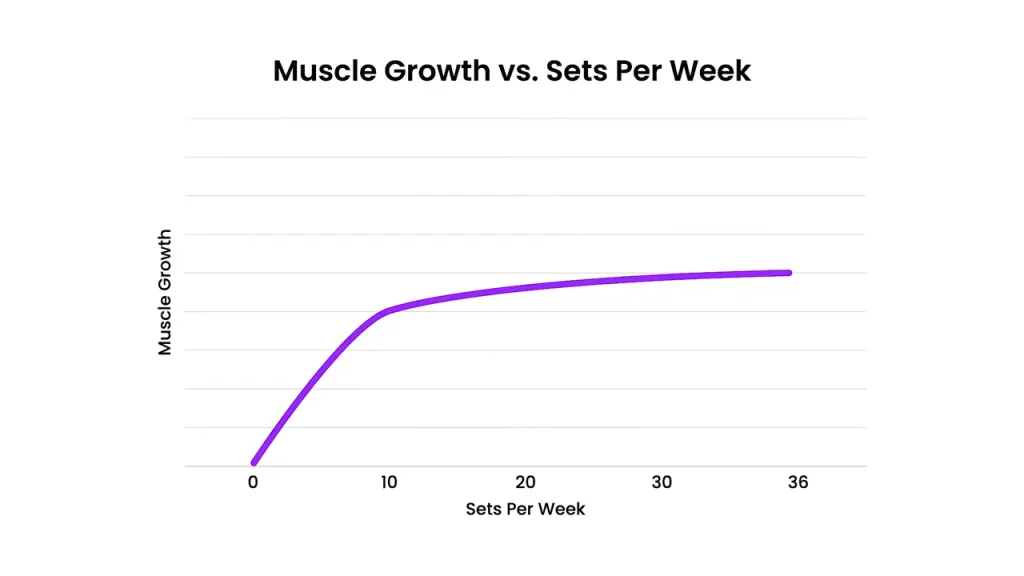
That doesn’t make the extra work useless.
For someone trying to squeeze out every possible bit of muscle, even a small additional return can matter.
Helms gave his own bodybuilding as an example. From 2023 to 2025, his stage weight increased from 79.5 kg to 81.5 kg — meaningful progress within competitive natural bodybuilding.
But achieving marginal additional gains can demand a lot of training.
At one point, he described spending 10–11 hours training in a week while acknowledging he could potentially have achieved almost the same outcome with around a third of that time.
So the real question isn’t simply whether more training can build more muscle.
It’s whether the extra muscle is worth the extra time to you.
What Was The Best-Performing Workout Split?
The highest measured growth in our 3 days vs 6 days split experiment came from the three-day full-body group, which performed the high-volume workload across three full-body workouts using supersets to save time.
If you’re willing to make that tradeoff to squeeze out every last bit of muscle, our Wild Card group may have revealed the best way to do it.
We took all the volume from the six-day split and packed it into three full-body sessions.
Their result?
1.2 inches of combined growth — the largest increase of the three groups.
Interestingly, the Wild Card group’s growth was much more in line with what the volume research had predicted from the higher weekly volume.
Importantly, we can’t say exactly why this program performed so well.
Trexler offered a couple of possibilities.
One is training frequency per muscle.
The full-body group performed the same overall volume as the six-day PPL group, but distributed each muscle’s work across more sessions. That may have reduced the performance drop-off that occurs when you perform set after set for the same muscle in a single workout.
Another possibility is psychological.
When you only have three workouts each week, there may be more of a sense that every session has to count.
One participant in the full-body group described exactly that mindset: because she only had three days, she felt she pushed herself harder than she would have on a six-day plan.
Again, these are possible explanations — not proof of what caused the result.
Interestingly, this general idea resembles how Helms structures his own very high-volume training. Instead of performing only three full-body sessions, he trains six days per week, with each workout divided into separate morning and evening sessions.
The goal is to maximize volume while keeping the quality of each individual session as high as possible.
How Much Should You Train To Build Muscle?
The right amount of training and whether a 3 days vs 6 days split suits you depends on whether your priority is maximizing total muscle growth or getting most of the available gains with substantially less time in the gym.
The experiment and supporting research point toward two different approaches.
If You Want To Maximize Muscle Growth
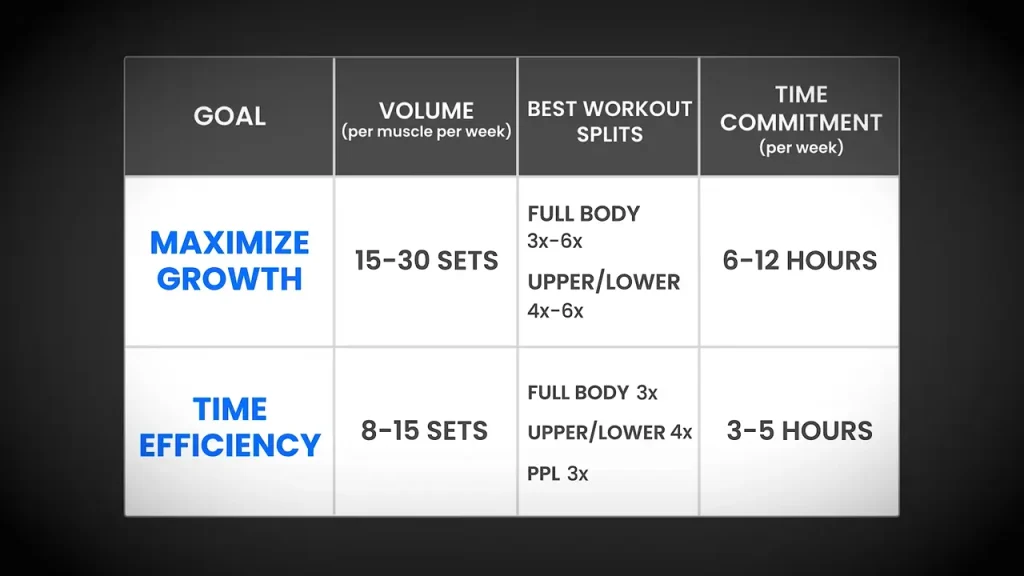
If you’re willing to invest considerably more time to squeeze out additional growth and can maintain your effort and form as volume rises, a rough target is:
| Goal | Weekly Volume | Workout Splits | Estimated Time |
| Maximize Muscle Growth | 15–30 Sets/Muscle/Week | Full Body 3–6x, Upper/Lower 4–6x, PPL 6x | 6–12 Hours/Week |
The key qualification is that the extra volume only makes sense if it isn’t compromising the quality of your training.
If You Want To Maximize Gains Per Hour
If you want solid muscle growth without spending a huge amount of time in the gym or you’re currently training a lot without seeing great results, the recommendation changes:
| Goal | Weekly Volume | Workout Splits | Estimated Time |
| Maximize Gains Per Hour | 8–15 Sets/Muscle/Week | Full Body 3x, Upper/Lower 4x, PPL 3x | 3–5 Hours/Week |
These are the rough volume, split, and time recommendations presented at the end of the experiment.
Personally, I’m not willing to go as far as Helms does to maximize every possible bit of growth.
I train hard around four to five times per week, which I estimate probably gets me about 60–70% of the way there.
That’s a tradeoff I’m willing to make.
And ultimately, our 3 days vs 6 days split experiment showed that very different plans can produce results if you’re able to stick with them and support your training with good nutrition.
If you want the guesswork taken care of for you, the Built With Science Plus app provides a personalized workout and nutrition plan that adjusts weekly based on how your body is responding. You can try it free for two weeks through Built With Science.
Frequently Asked Questions
Is Training 3 Days A Week Enough To Build Muscle?
Yes. In our 3 days vs 6 days split experiment, participants training three days per week experienced significant muscle growth. The three-day PPL group’s growth was statistically indistinguishable from the six-day PPL group, despite doing roughly half the training.
Is Training 6 Days A Week Better For Muscle Growth?
Not necessarily. In our 3 days vs 6 days split experiment, the six-day PPL group recorded slightly more combined growth than the three-day PPL group, but the difference wasn’t statistically significant. Higher volumes may still produce additional growth when training quality is maintained, but the returns become increasingly marginal as more sets are added.
How Many Sets Per Muscle Per Week Should You Do?
For maximizing gains per hour, a rough recommendation is 8–15 sets per muscle per week. If your goal is maximizing total muscle growth and you’re willing to spend considerably more time training, the recommendation increases to roughly 15–30 sets per muscle per week, provided the additional volume doesn’t compromise effort or form.
How Do You Know If You’re Doing Too Much Training Volume?
Start with your progress. If you’re training five or six days a week but haven’t added reps or weight to your main lifts in two or three months, it may be worth trying less volume for a training block or two. Rep speed and rep drop-off can also show whether you’re pushing your current sets hard enough to be productive.
Is A Full-Body Workout 3 Days Per Week Effective?
It was in this experiment. The three-day full-body group — which fit the six-day group’s full weekly volume into three workouts using supersets — recorded 1.2 inches of combined growth, the largest measured increase of the three groups. However, we can’t say exactly why: higher per-muscle frequency and the mental advantage of fewer training days were proposed as possible explanations, not proven causes.