What Happens If You Train Forearms Every Day? (One Forearm, 30 Days — Gym vs Rice Bucket vs Hand Gripper)
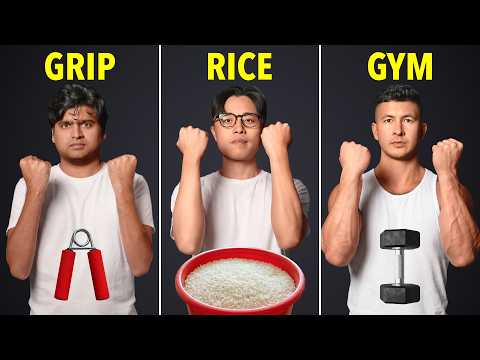
What happens if you train forearms every day? We trained only one forearm every day for 30 days — pitting a gym plan vs rice bucket training vs a hand gripper — to find the fastest way to grow forearms and build real grip strength.
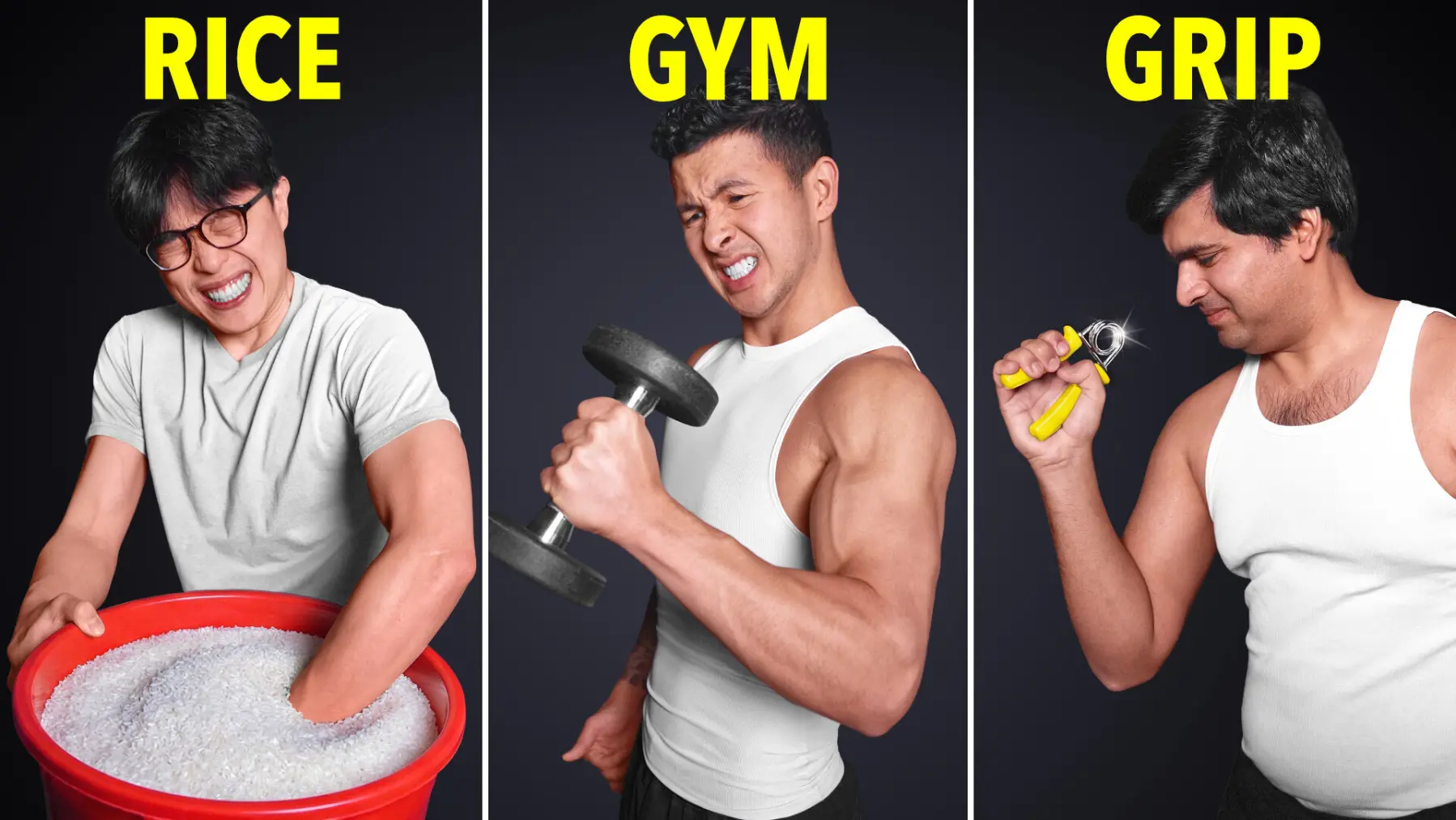
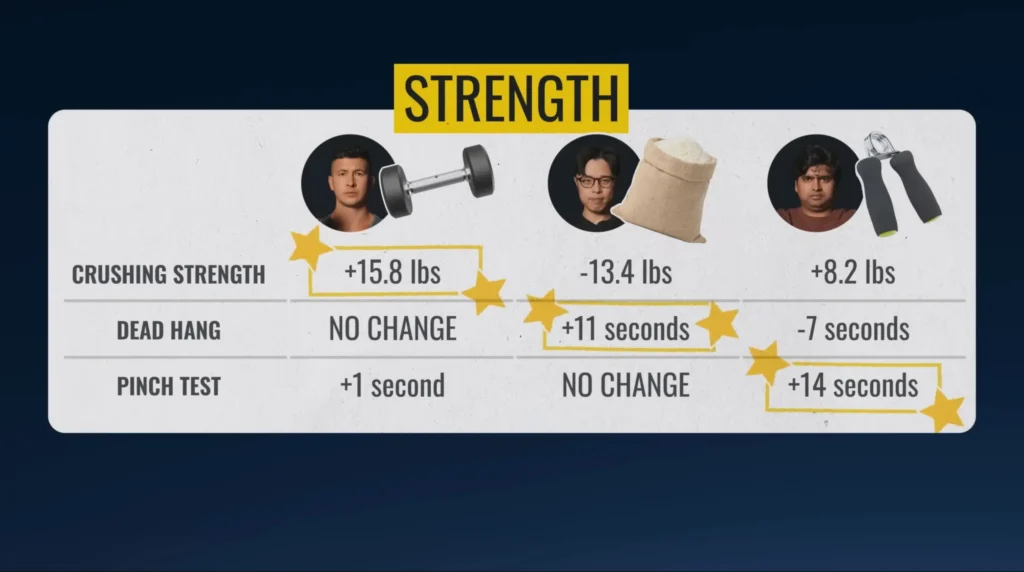
Three of us trained only our left forearms for 30 days using three popular methods: a gym plan, a rice bucket routine, and 100 reps/day on a hand gripper. After retesting forearm size and 3 types of grip strength, each method “won” something: the gym plan improved crush grip the most, the rice bucket improved support-grip endurance the most, and the hand gripper improved pinch grip + lower-forearm growth the most.
TL;DR
- Gym plan: biggest crush grip increase (+15.8) + strong upper/mid forearm growth
- Rice bucket: biggest dead hang (support grip) improvement (+11 seconds)
- Hand gripper: biggest pinch improvement (+14 seconds) + biggest mid/lower forearm growth
- Training forearms daily can work, but joint discomfort is real, and exercise swaps matter.
Why I Did This Experiment
For 30 days, I trained the one muscle almost everyone ignores — the forearms — because while I always assumed my forearms would grow from normal weight training, I’ve realized my forearms have become the weakest part of my entire physique.
And other people have noticed.
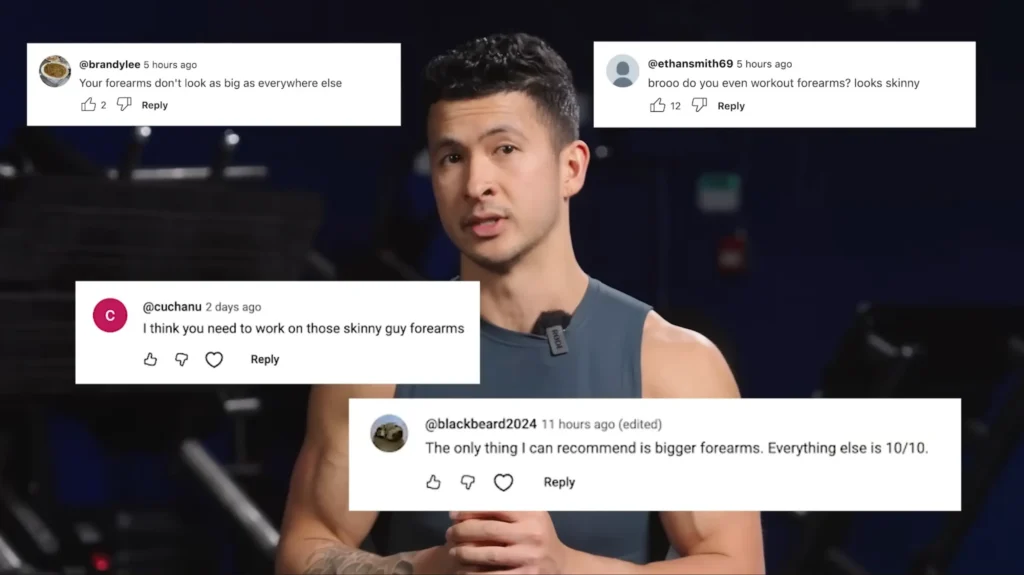
To find the fastest way to grow my forearms, I trained my left arm only using a science-backed plan. And to put it to the test, I recruited two friends who trained the most popular forearm protocols I’ve seen online.
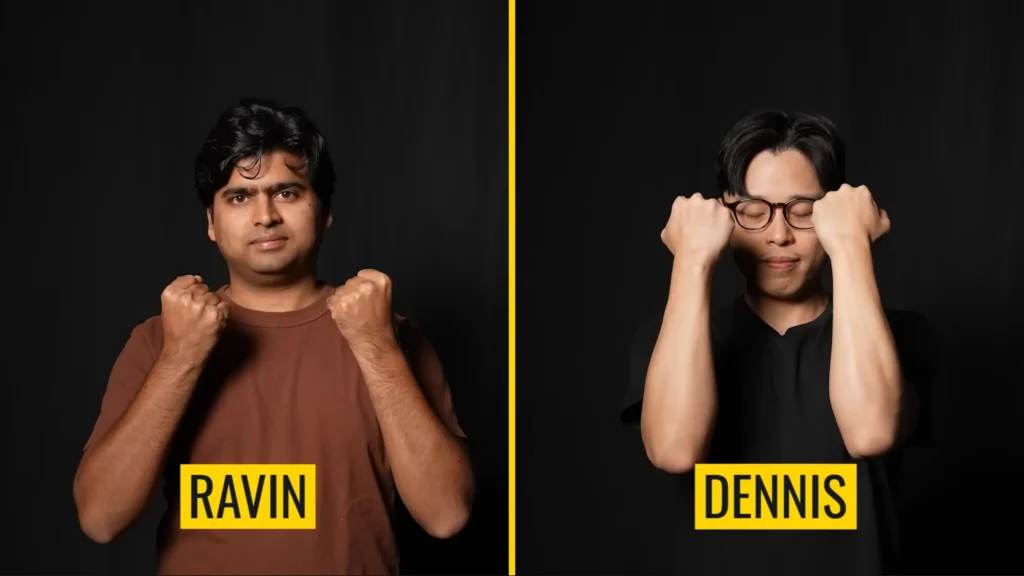
After 30 days, we wouldn’t just see whose forearms grew the most, but also which method actually builds the strongest grip.
Experiment Setup
- 3 participants
- All right-handed
- We trained left forearm only
- Right arm served as a control
- We measured forearm size at three points:
- P1 = Upper forearm
- P2 = Mid forearm
- P3 = Lower forearm/near wrist
- We tested 3 types of grip strength (explained below)
Baseline Forearm Measurements (Day 1)
Circumference measurements (cm)
| Person | Arm | P1 Upper | P2 Mid | P3 Lower/Wrist |
|---|---|---|---|---|
| Jeremy | Right | 29.2 | 25.6 | 17.8 |
| Jeremy | Left | 28.6 | 24.3 | 17.8 |
| Dennis | Right | 26.2 | 22.6 | 15.6 |
| Dennis | Left | 26.1 | 23.9 | 16.0 |
| Ravin | Right | 27.6 | 23.9 | 17.7 |
| Ravin | Left | 27.1 | 23.3 | 17.2 |
The 3 Types Of Grip Strength (And How We Tested Them)
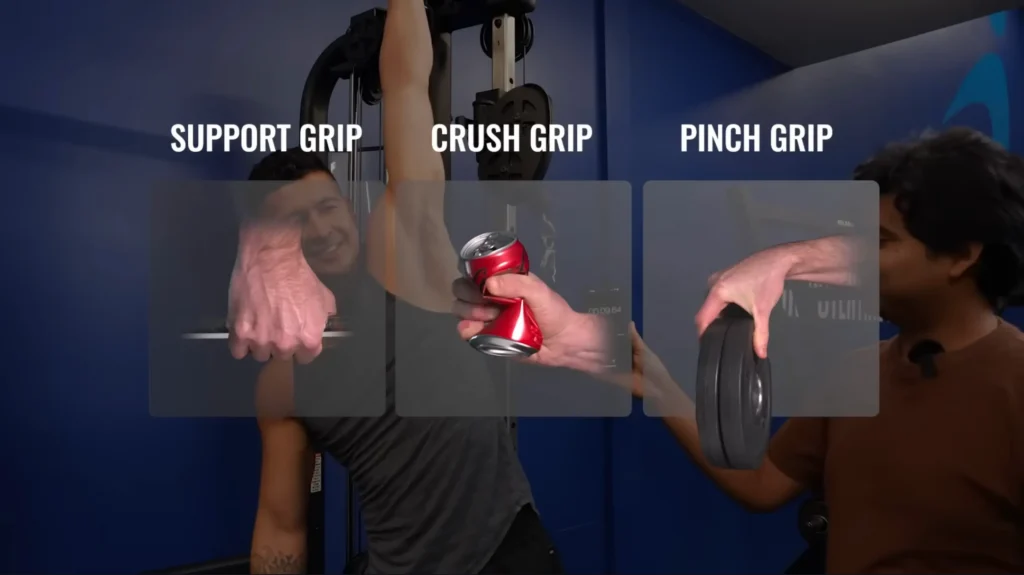
1) Support Grip (Endurance)
What it is: Holding onto something for time (dead hangs, farmer carries).
How we tested: Single-arm dead hang.
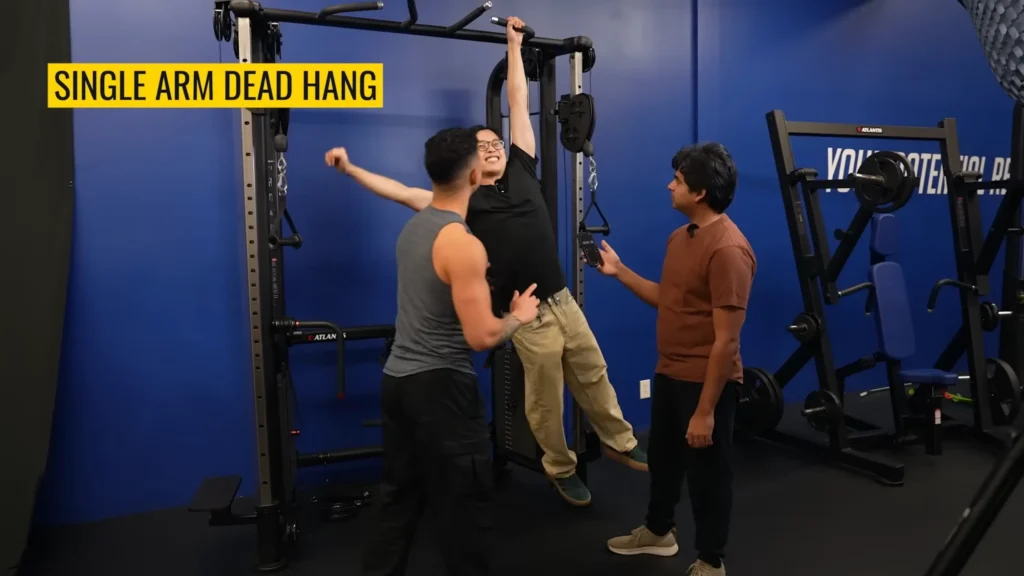
This simple test measures your support grip, which is essential for rock climbing, deadlifting, and even bringing in your groceries. Most beginners should be able to hang for 10–20 seconds, with 90+ seconds being elite.
- Dennis lasted under 10 seconds. “You couldn’t last 10 seconds.” He said it didn’t count. It counted.
- Ravin went limp … like he just dies. He lasted 17 seconds.
- I dropped at 1:14.
2) Crush Grip (Closing Strength)
What it is: Squeezing hard (firm handshake, crushing something in your hand).
How we tested: Grip dynamometer (Handexter).
- Me 121.4
- Dennis 81.2, then 99.8 (after: “I’ve felt your handshake. It’s like a little girl’s.”)
- Ravin 103.2
We even had a handshake competition. Dennis lost.
To make Dennis feel better after his first attempt, we also called out something important: multiple studies have found the average person’s grip strength today is far weaker than it was even just 20 years ago. Which is problematic, because a strong grip is one of the best predictors of your overall strength and even your life expectancy.
3) Pinch Grip (Thumb + Fingers)
What it is: Holding something between fingers and thumb (plate pinches).
How we tested: Holding three 10-lb plates for time.
- I got 5 seconds.
- Dennis couldn’t pick it up: “This is so embarrassing. There’s no way — I’m a fitness guy.”
- Ravin hit 6+ seconds.
The 3 Forearms Training Plans (Gym vs Rice vs Gripper)
Plan A: Jeremy (Gym-Based “Science-Backed” Plan)
Goal: hit all major forearm regions directly, daily.
Forearm anatomy focus:
- Flexors: wrist curls (dumbbells + cable variations)
- Extensors: wrist extensions (dumbbells + cable version)
- These sit on top of your forearm, create crazy striations when developed, and may also help with elbow pain.
- Brachioradialis (big chunk near elbow crease)
- Unlike the other two, it doesn’t cross the wrist, so wrist movements won’t train it.
- To target it more: neutral/hammer-style curling + incline/preacher-style setups + reverse-grip curls.
Protocol:
- I trained each area with 3 sets to failure every day.
- And after 30 days of experimenting, I’d share what I think is the #1 exercise for each area, plus a fully optimized forearms workout based on what I found.
Plan B: Dennis (Rice Bucket Training)
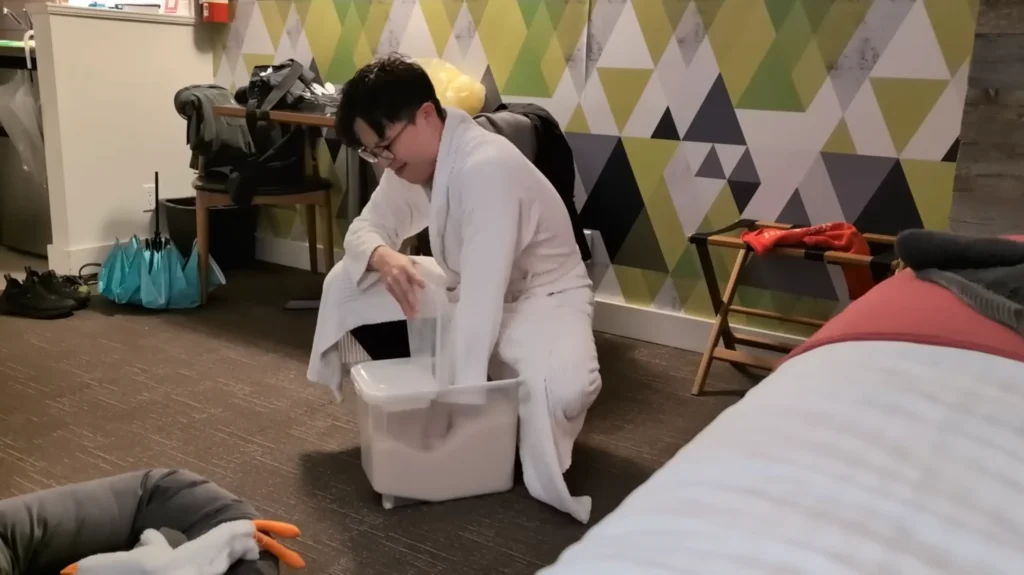
Dennis followed a popular rice training plan:
- Grab rice: 20–30 reps
- Extend in rice: 20–30 reps
- Grab + twist: 20–25 reps
- Rice squeeze: 20–25 reps
- Wrist rotation: 15s each side
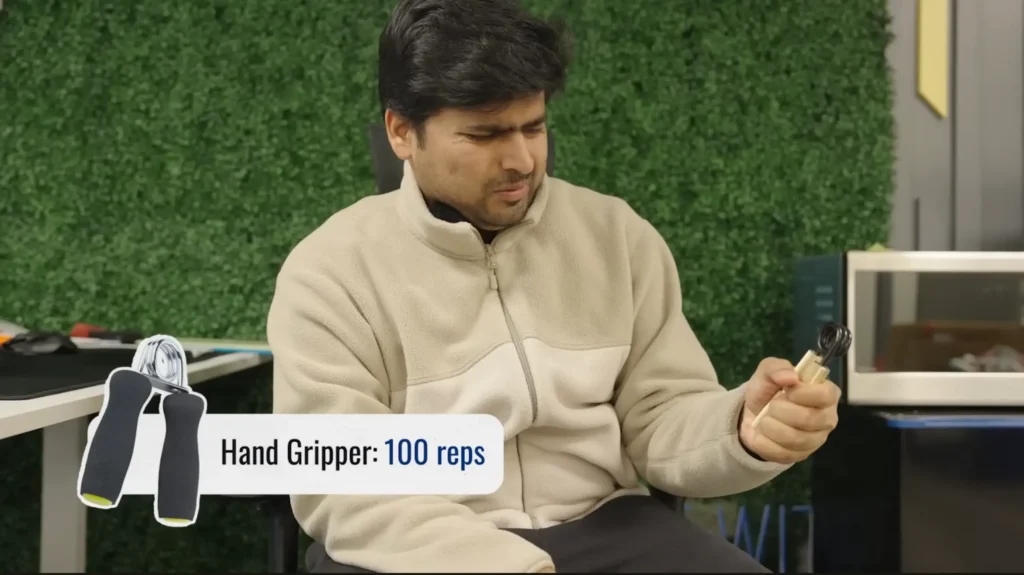
Plan C: Ravin (Hand Gripper Only)
Ravin did:
- 100 reps every day
- Hand gripper only
Weeks 1–2: Soreness, Wrist Pain, And The Lesson Nobody Wants To Hear
By the time I finished just my second workout, I was already wondering if my forearms were going to make it the full 30 days.
By day three, I was feeling discomfort not just in my forearms — but in my actual wrist joint.
And when I checked in with Ravin, he was having a similar struggle trying to hit 100 reps each day (at one point stopping early because his wrists hurt too much).
In fact, the only person who wasn’t struggling so far seemed to be Dennis. At first, the rice bucket “felt kind of nice”… and then five seconds later it was “this is so ridiculous.”
Meanwhile, I noticed something about a bunch of forearm exercises, especially brachioradialis-focused ones: with dumbbells, it’s hard to lock in form without aggravating wrists and elbows. So I started experimenting with cables — and instantly the movement felt smoother and more comfortable.
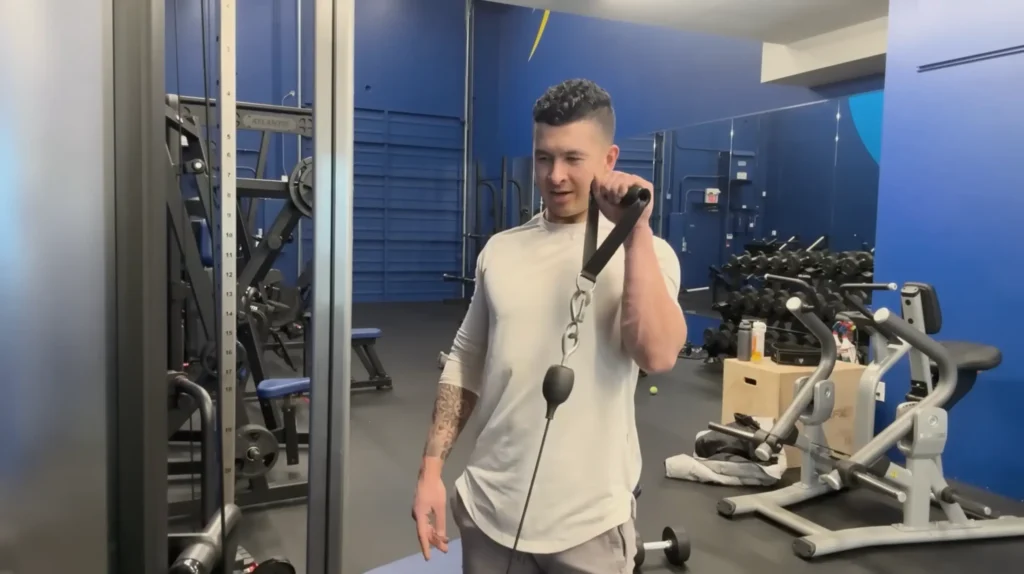
My joint pain was no longer an issue, and I’d even found some home-friendly exercises I could swap in when I didn’t have a dumbbell.
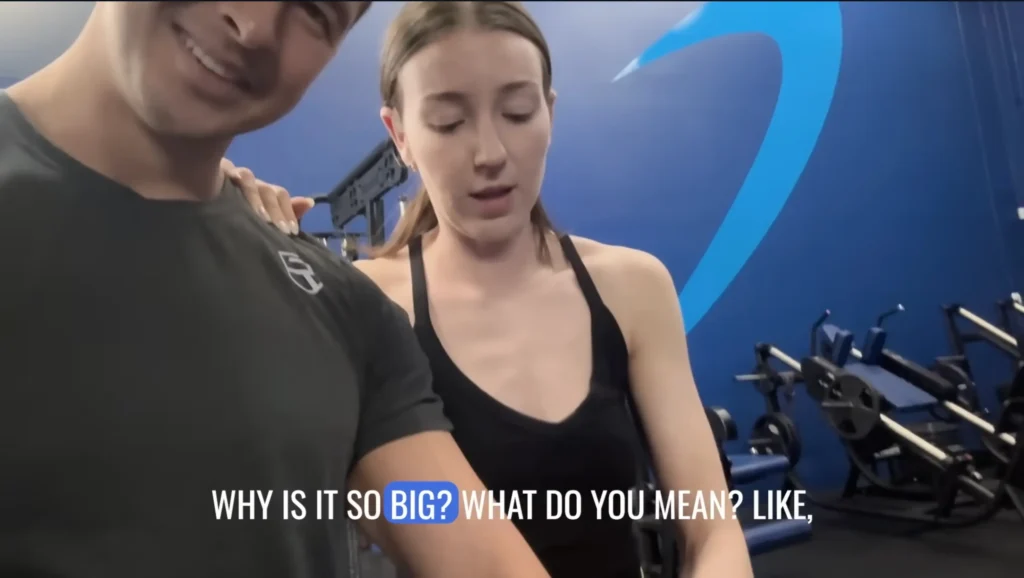
But the craziest improvement by far was the visual change I was already noticing. Even my wife seemed shocked by my progress. Asking me the one question every guy wants to hear. "Why is it so big?"
Why I Trained Forearms Every Day
I always thought training a muscle every day wouldn’t allow it to recover and grow bigger and stronger. But some new research made me rethink that.
In a recent study, strong, well-trained lifters bench pressed every single day for 34 consecutive days. Each day they did:
- 1 heavy set where they tried to lift as much as they could for 1 rep
- then 5 lighter sets for volume
You’d expect training like this every day would burn most lifters out. But by the end, the lifters made insane strength gains — adding an average of 40 lbs to their 1 rep max.
Now, while a study focused on bench press isn’t the perfect model for how to grow your forearms, my hypothesis was that short, daily training shouldn’t be anything to worry about — and if anything, might get me the fastest gains of my life.
The Straps Problem (Why My Forearms Stopped Being Challenged)
If I’m being honest, I think relying too much on lifting straps is a major reason my forearms became underdeveloped.
Once I found a study showing that using lifting straps increased the subjects’ deadlifts from a max of 350 lbs to 390 lbs, I started using straps on deadlifts, rows, and lat pulldowns.
But by completely taking my grip out of the equation on so many exercises, my forearms simply stopped getting challenged. So in this experiment, I started relying less on straps and more on my grip to get bigger forearms.
Day 15 Check-In: The Farmer Carry Grip Test
Remember what my wife asked me? Well, after 15 days, size didn’t mean much without functional strength. So we ran a simple grip test:
Usually the test is carrying 100% of your bodyweight for 30 seconds — but since we were doing one arm, we used 50%.
- Ravin and I were close to 160, so we carried 80 lbs
- Dennis carried 65 lbs
If you can make the full 30 seconds, your grip strength is performing as it should.
If you fail… you’ve got some work to do.
Dennis and I finished. Ravin dropped out (“he doesn’t get a high five — he didn’t pass.”).
Weeks 3–4: Overload, Plateaus, And Staying The Course
By week 3, regular rice wasn’t challenging Dennis anymore — so he increased resistance by adding metal balls, and we even gave him a wooden spoon to make it “like 5 times more difficult.”
And after 30 days, Ravin was getting stronger and stronger with his hand gripping, and he’d even made it to the hardest setting. Though I’m not sure the parking lot was the best place for this…
As for me, everything was going good… until week 3. My forearms started feeling exhausted, and I had to drop the weight I was using on my flexor/extensor work.
That was concerning — but when I looked closer at the daily bench press study we talked about earlier, some days the lifters got stronger, some days weaker, and some days stayed the same. But by the end, all of them were significantly stronger than when they started.
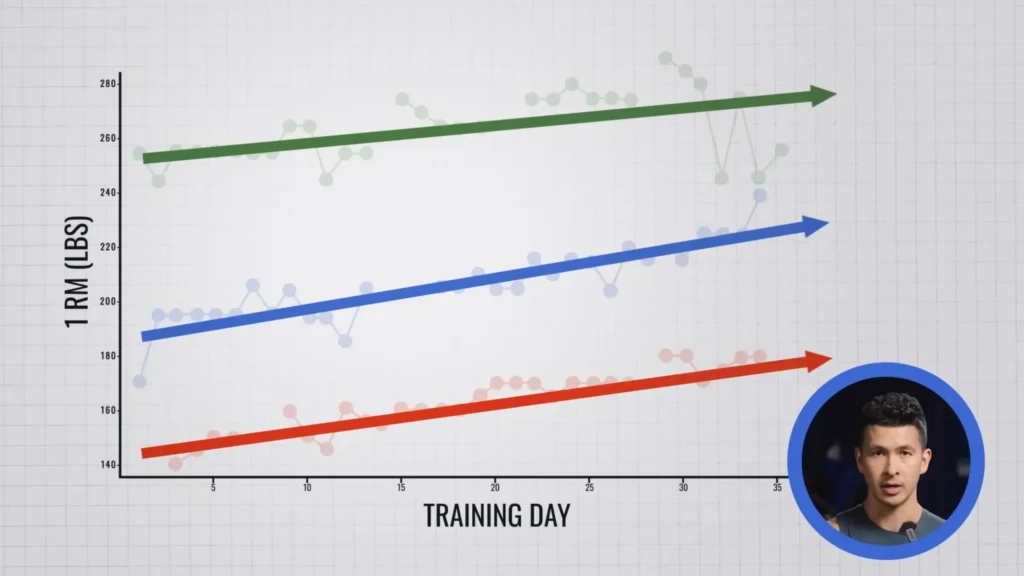
So I stayed the course heading into the final tests.
Final Results After 30 Days
Grip Strength Changes (4 Tests)
| Test | Gym plan | Rice bucket | Hand gripper |
|---|---|---|---|
| Dead hang (support grip) | No change | +11 sec | -7 sec |
| Pinch test | +1 sec | 0.0 | +14 sec |
| Crushing strength | +15.8 | -13.4 | +8.2 |
| Incline biceps curls | +1 | +3 | No change |
Interpretation:
- Want crush grip? Gym plan won.
- Want endurance/support grip? Rice bucket won.
- Want pinch/lower forearm strength? Grippers won.
Forearm Growth Results
| Measurement point | Gym plan | Rice bucket | Hand gripper |
|---|---|---|---|
| Upper forearm (P1) | +1.2 cm | +1.0 cm | +0.3 cm |
| Mid forearm (P2) | +1.2 cm | -0.8 cm | +1.6 cm |
| Lower forearm/wrist (P3) | 0.0 cm | +0.2 cm | +1.2 cm |
Full Trained-Arm Measurements (Day 1 To Day 30)
| Name | P1 Upper | P2 Mid | P3 Lower/Wrist |
|---|---|---|---|
| Ravin | 27.1 → 27.4 (+0.3) | 23.3 → 24.9 (+1.6) | 17.2 → 18.4 (+1.2) |
| Dennis | 26.1 → 27.1 (+1.0) | 23.9 → 23.1 (-0.8) | 16.0 → 16.2 (+0.2) |
| Jeremy | 28.6 → 29.8 (+1.2) | 24.3 → 25.5 (+1.2) | 17.8 → 17.8 (No change) |
While my forearms experienced a ton of growth through the upper and middle, the lower part around my wrist stayed exactly the same.
Ravin, on the other hand, had barely any change in his upper forearm, but the highest growth was around his middle and lower forearm. So similar to when we tested his pinch grip, these lower forearm muscles seemed to respond well to his hand-grip training. However, because of his training experience, he probably experienced the biggest “newbie gains” of all of us.
So… Which Forearms Training Method Is “Best”?
Across the four tests, each method improved different areas of grip strength:
- Gym plan: best for crush grip
- Rice bucket: best for support grip endurance
- Hand gripper: best for pinch grip + lower-forearm growth
My Top 3 Forearms Exercises
Based on my 30-day experiment, here are my picks:
- Flexors: dumbbell wrist curls
- Extensors: dumbbell wrist extensions, but arm out to the side (way more comfortable than how people normally do them)
- Brachioradialis: reverse curls — but with cables (instead of dumbbells)
Bonus: if you want to improve grip endurance, farmer carries at the end of workouts are a good idea (especially for beginners). And as we saw with Ravin, a hand gripper is a low-barrier way to get started and might even grow the lower forearm a bit more.
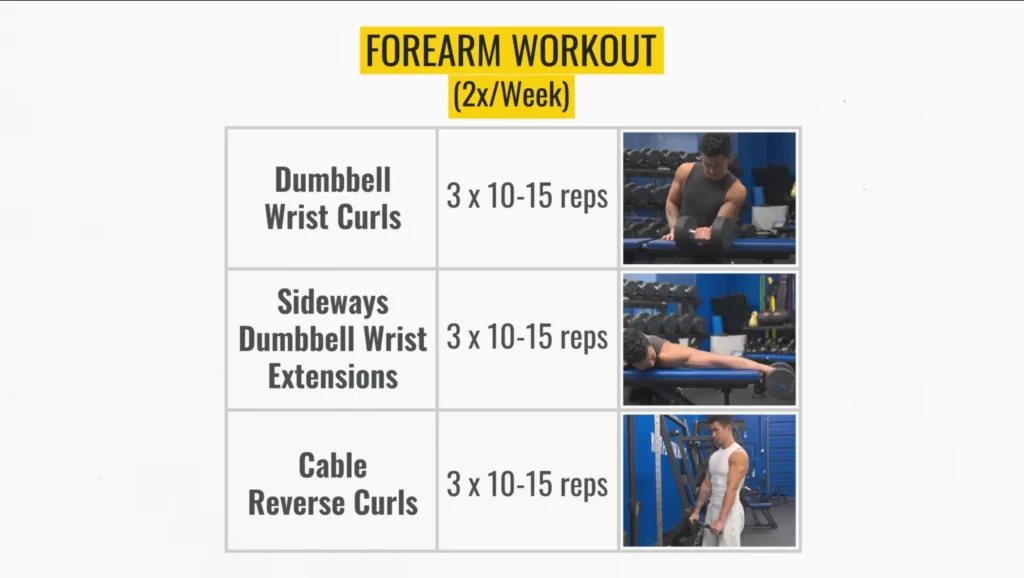
The Forearms Workout I’m Sticking With (2×/Week)
Here are the forearm exercises I’m personally going to be sticking with going forward, doing it twice a week on my leg days or rest days:
Dumbbell Wrist Curls: 3 x 10-15 reps
Sideways Dumbbell Wrist Extensions: 3 x 10-15 reps
Cable Reverse Curls: 3 x 10-15 reps
FAQ
Do hand grippers build forearms?
They can be a low-barrier way to start and seemed to help pinch grip and the lower forearm most in our experiment.
Is rice bucket training effective?
It improved support grip endurance the most (dead hang win) and had to be overloaded by week 3 because regular rice stopped being challenging.
What improved crush grip the most?
The gym plan improved crush grip the most (+15.8).
If You Want The Full Plan (Built With Science+)
I like experiments like this because online fitness is full of “try this one weird trick” content, and it’s hard to tell what’s worth doing or just a waste of time.
That’s exactly why I worked for years with scientists, coaches, and nutrition experts to create the Built With Science+ app, helping people like Dennis get into the best shape of their lives. Inside the app, you’ll get science-backed workouts customized to your body and goals, so you always know what to do every time you train.
And the same with your diet. All you have to do is follow your plan and enjoy the results. And the best part? You can try it free for 2 weeks here:
Click the button below to try the BWS+ app for 2 weeks, for free, no strings attached:
↓
And if you want to pair your forearm training with a full body workout plan that hits every muscle group, then you should check out this article next. Thanks for sticking to the end, and I’ll see you next time.
By the way, here’s the article summed up into a YouTube video: