

How To Strengthen Weak Tendons In Your Knees, Elbows, And Shoulders
Quick Answer
To strengthen weak or painful tendons, manage increases in your training carefully and load the affected tendon with isometric exercises rather than relying on complete rest. Choose an isometric that closely matches the movement causing your pain, hold it for at least 30 seconds, and complete three sets, twice a day to start. Keep any discomfort at roughly 3–4 out of 10 or below, and ease off if the tendon feels worse the next day.
Key Takeaways
- Tendons adapt more slowly than muscles, so training that outpaces them can leave you with pain.
- Complete rest may ease pain temporarily, but it does not rebuild a tendon’s capacity to handle load.
- The two most common training mistakes are increasing load too quickly and using too much momentum.
- Isometric holds load the tendon without moving the joint and may help the healing signal reach damaged tissue.
- Match the isometric to the movement that aggravates you, then hold for at least 30 seconds, three sets, twice a day to start.
- Keep discomfort at roughly 3–4 out of 10 or below, and ease off if the tendon feels worse the next day. Some relief is possible within one to two weeks, with longer-term rehab over four to eight weeks.
What Are Tendons And What Do They Do?
Tendons are strong connective tissues that attach muscles to bones. Muscles have a tendon at each end, allowing muscular force to move a joint.
You can think of tendons as the cables that make movement possible. They help lift your forearm during a curl, pull your arm across your body during a bench press, and move your elbow when you swing at a tennis ball.
But transferring force is not their only job.
Physiotherapist Coach Q Wiley explains that tendons also help protect muscles when your body experiences a sudden impact. Imagine jumping down a few steps and landing on both feet. You would not want your muscles to absorb the entire load.

A tendon can stretch rapidly for a short period, reducing how quickly the attached muscle has to lengthen. This helps the muscle manage the impact.
That protective role means your tendons need to be extremely strong. The problem is that lifting weights does not necessarily strengthen tendons in exactly the same way or at the same rate as it strengthens muscles.
Why Do Tendons Become Weak Or Painful?
Tendons may become painful when the demands placed on them increase faster than their ability to adapt. Muscles and tendons respond differently to training, so improving muscular strength does not automatically mean that tendon capacity is keeping pace.
Dr. Keith Baar, a professor at UC Davis whose laboratory has produced widely cited research on tendon healing and strength, explains that tendons do not necessarily respond best to the same types of loading used to build muscle or improve cardiovascular fitness.
This can create a gap: your muscles become capable of producing more force, but your tendons are not yet prepared to tolerate it.
According to Baar, tendon issues are a leading cause of pain in general, and they account for a large share of the injuries he sees working with professional athletes. He describes many of these injuries as a mismatch between the strength of the muscle and the capacity of the tendon associated with it.
This is also one reason people using anabolic steroids may face a greater risk of tendon injuries. Their muscular strength and size can increase rapidly, potentially outpacing the tendons supporting those muscles.
But you do not need to use performance-enhancing drugs for this mismatch to occur. It can also happen when a regular training program becomes more demanding too quickly.
What Does Tendon Clicking Mean?
Clicking alone does not necessarily mean that a tendon is weak or damaged. It becomes more concerning when the clicking is accompanied by pain.
Coach Q explains that a sensitive tendon can become slightly thicker. In an area such as the shoulder, the tendon must move through relatively narrow joint spaces. Even a small change in its size may make it feel as though it is popping or rolling during movement.
That does not make every click a sign of injury. However, clicking combined with pain is the more meaningful warning sign.
Why Can Complete Rest Make Tendon Problems Worse?
Complete rest may temporarily reduce tendon pain, but it does not necessarily rebuild the tendon’s ability to tolerate load. Because tendons depend on loading to maintain and regain strength, removing all stress may leave the underlying problem unresolved.
As Baar puts it, “a tendon isn’t a tendon without load.”
When you completely rest a painful tendon, the discomfort may fade because nothing is currently stressing it. But according to Baar, the damaged portion never properly rebuilds, while the healthy areas grow weaker.
Once you return to normal activity, the pain may come back because the tendon still has not regained the capacity required for that activity.
This can become increasingly noticeable with age. Baar explains that small injuries accumulated during years of hard training do not necessarily disappear unless they are addressed. That may help explain why highly active people sometimes reach their 40s with persistent musculoskeletal pain.
Complete rest alone may not be enough to rebuild the tendon’s capacity.
What Training Mistakes Can Hurt Your Tendons?
Two common training mistakes can expose tendons to more stress than they are prepared to handle. They sit alongside other common gym habits that lead to joint pain, but these two matter most for your tendons:
- Increasing training volume or intensity too quickly
- Using momentum that produces rapid, demanding loads
Mistake One: Increasing Your Training Too Quickly
Poor load management occurs when your activity increases faster than your tendons can adapt. This might mean suddenly doing more bench pressing, running much farther, lifting much heavier weights, or starting a demanding new sport.
The first few sessions may feel fine. The pain often appears only after the higher workload has accumulated for several weeks.
Coach Q describes many tendon problems as “underprepared” injuries rather than simple overuse injuries. The body can often adapt to more work, but tendons generally need longer than muscles to make that adaptation.
This happened to me during a 60-day training experiment. I trained one half of my body with heavy weights and low repetitions, while the other half used lighter weights and higher repetitions. By the end of the experiment, I had developed elbow and knee tendinitis on the heavily trained side. The lesson was not that heavy weights are inherently bad. The problem was that my body was not accustomed to that particular loading pattern. Mixing heavier and lighter training days is one common way to vary that load if you program your own training.
Increases of more than roughly 30% are commonly discussed in the research as a potential injury risk. This figure should be treated as a practical guideline rather than a guaranteed cutoff.
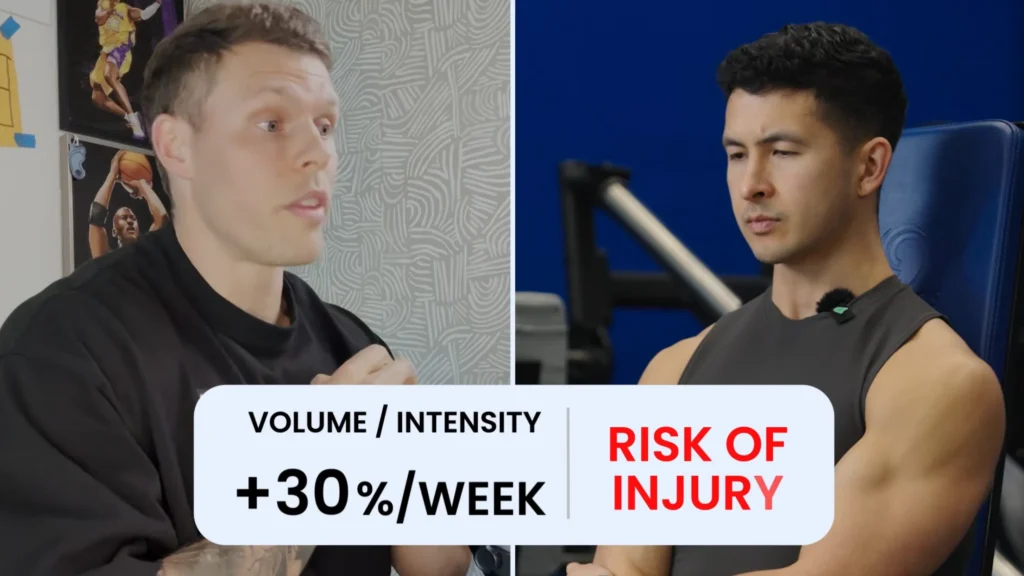
For example, suppose you normally perform four weekly sets of the bench press. Jumping immediately to 10 sets represents a major increase. Adding one or two sets would keep the change much closer to that guideline.
The same principle applies to weight. If you are returning after time away and 100 pounds feels easy, immediately jumping to 150 pounds may be more than your tendons are prepared for. Moving closer to 130 pounds and building gradually would be a more controlled increase.
This principle also applies outside the gym. Running, racket sports, golf, and other repetitive or explosive activities all place demands on tendons.
Mistake Two: Using More Momentum Than Your Tendons Can Handle
Momentum can expose tendons to rapid loading that may be difficult for unprepared connective tissue to handle. This includes bouncing a bar off your chest, rebounding aggressively from the bottom of a squat, hitting a tennis ball, or swinging a golf club.
Momentum becomes especially common when lifters try to increase the amount of weight they are using.
These fast loading patterns are the type of load that is hardest on your tendons.
That does not mean momentum is always harmful. Olympic weightlifters use it extensively, but their tendons have adapted to those forces over time.
As a general rule in the gym, control the bottom portion of each repetition unless you have a specific power or strength goal requiring a faster movement. This may be easier on your tendons. Research also suggests that greater control can support faster muscle growth.
What Type Of Exercise Can Help Strengthen Tendons?
Isometric exercises can help load painful or weakened tendons without requiring repeated joint movement. An isometric involves contracting a muscle while holding the joint in a fixed position.
A simple example would be flexing your biceps while keeping your elbow fixed at a 90-degree angle.
Baar’s work suggests that isometrics can distribute a loading signal throughout a tendon, including the scarred area.
Why Are Longer Isometric Holds Used?
A sufficiently long isometric hold may allow tension to spread progressively through the tendon. Baar describes this process using the concept of tendon “creep.”
When you pull and hold, the healthiest and strongest parts of the tendon initially take much of the load. As those areas gradually lengthen, the load reaches the next strongest areas and eventually the weaker portion.
Baar explains that holding the contraction for about 30 seconds can help the whole tendon receive a signal. That signal can then stimulate collagen synthesis and support stronger tissue.
In simpler terms, holding an isometric for long enough may help the “signal to heal” reach the damaged part of the tendon rather than remaining concentrated only in its strongest areas.
How Do You Choose The Right Tendon Exercise?
The most relevant isometric is usually one that closely matches the movement causing discomfort. Find a way to load that movement hard while keeping the joint in a fixed position.
Coach Q gives the example of pain during the bench press. Because that is the motion producing the symptoms, a suitable starting point may be an isometric that resembles a bench press.
The same reasoning applies elsewhere:
- If a curl bothers your elbow, use a curl-based hold.
- If a pushdown bothers your triceps, use a pushdown-based hold.
- If a knee extension bothers your knee, use a knee-extension-based hold.
The goal is not to select a random isometric. It is to load the motion that appears to place the greatest demand on the sensitive tendon.
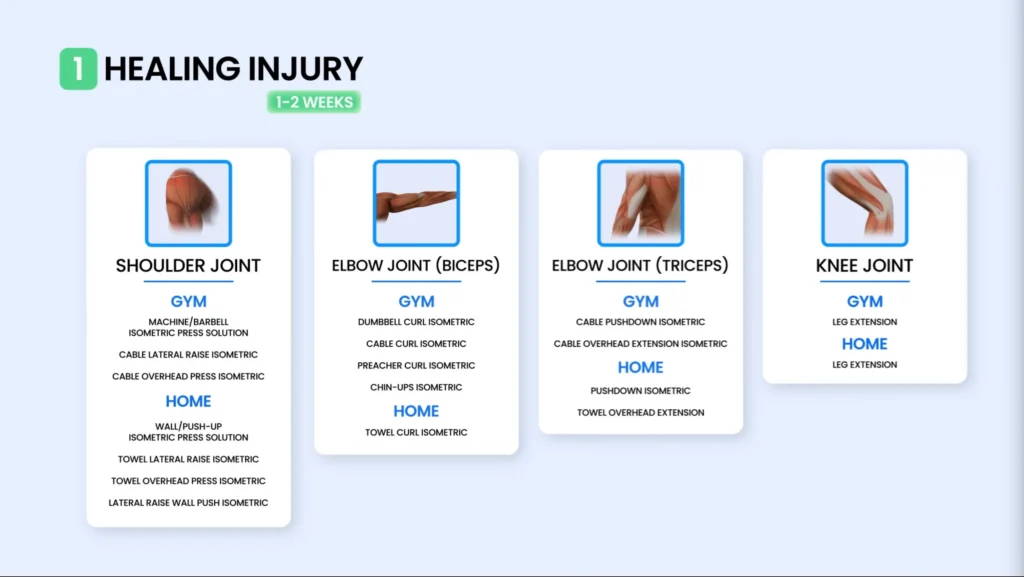
What Are The Best Isometric Exercises For Your Shoulders?
Shoulder isometrics should match the pressing or raising pattern that causes discomfort. There are different options depending on whether symptoms appear during chest pressing, overhead pressing, or lateral raises. Building balanced shoulder strength over time can also help protect the joint.
Isometrics For Pain During Chest Pressing
If chest pressing bothers your shoulder, set up one of the following:
- A bench press
- A Smith machine press
- A chest press machine
- A push-up hold
- A wall press
With a bench press, Smith machine, or chest press machine, you can use enough resistance to push hard without allowing the weight to move. Another option is to use a lighter weight and hold it halfway through the repetition. At home, hold the middle of a push-up or push firmly against a wall without moving your body. Choose one variation, hold the position for at least 30 seconds, and complete three sets.
Isometrics For Overhead Pressing Or Lateral Raises
For overhead-press or lateral-raise pain, apply the same rule: hold a fixed position that loads that movement hard, matched to the action that aggravates you, while keeping the joint still.
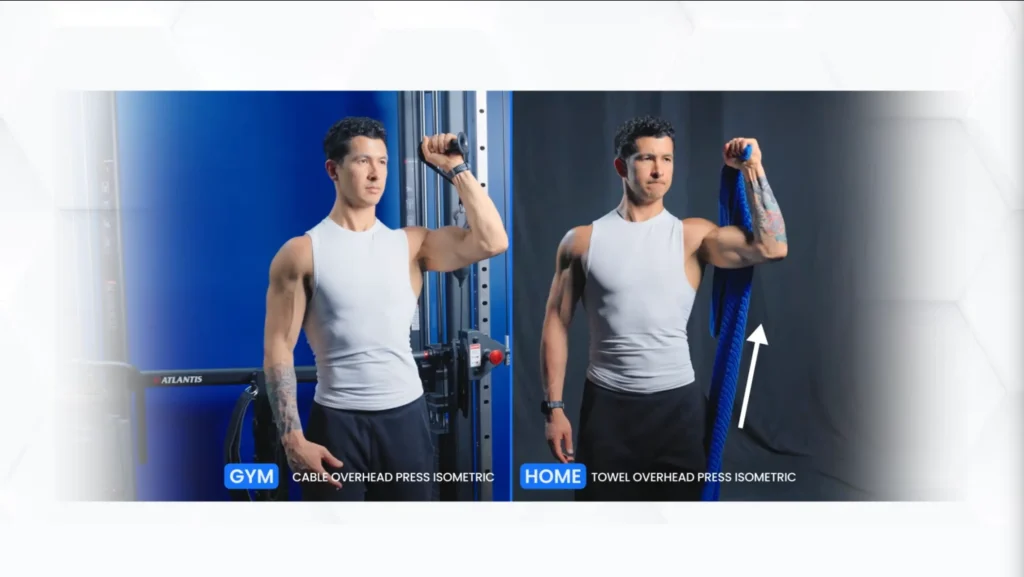
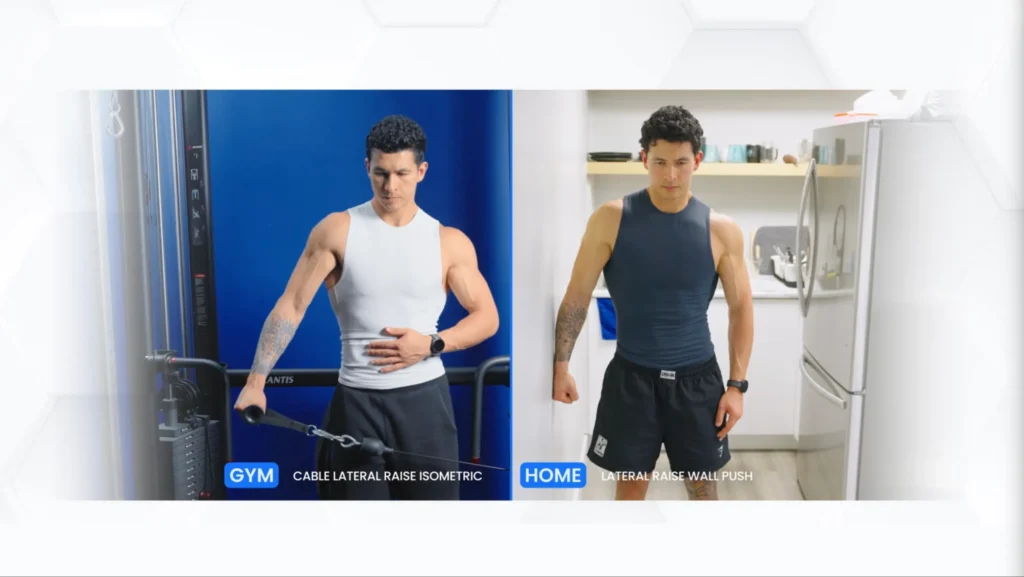
There is no single mandatory variation; the central rule is to match the isometric to the movement producing your symptoms.
What Are The Best Isometric Exercises For Your Elbows?
Elbow isometrics should reflect whether the discomfort appears during biceps work, pulling movements, triceps pushdowns, or overhead triceps extensions.
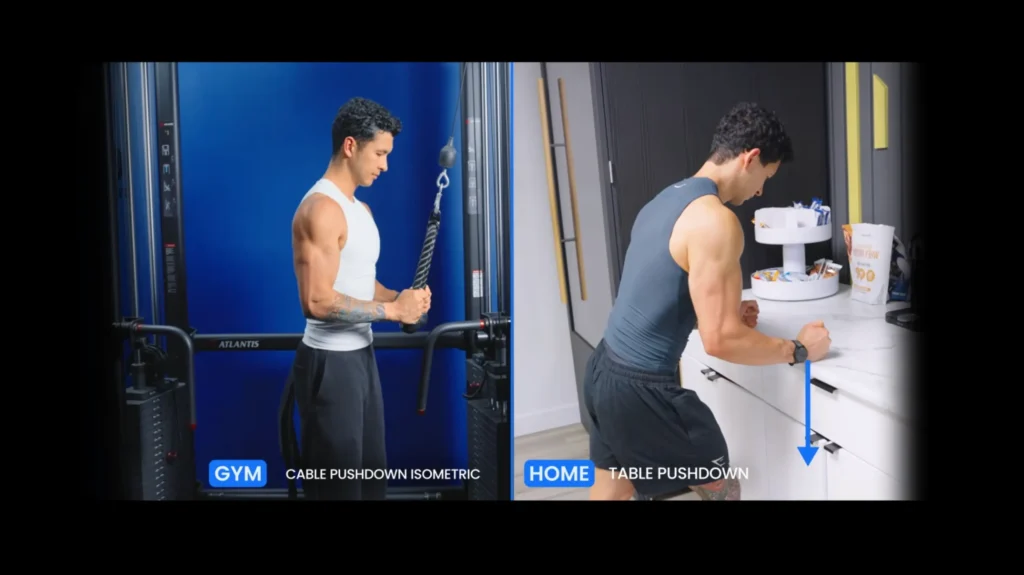
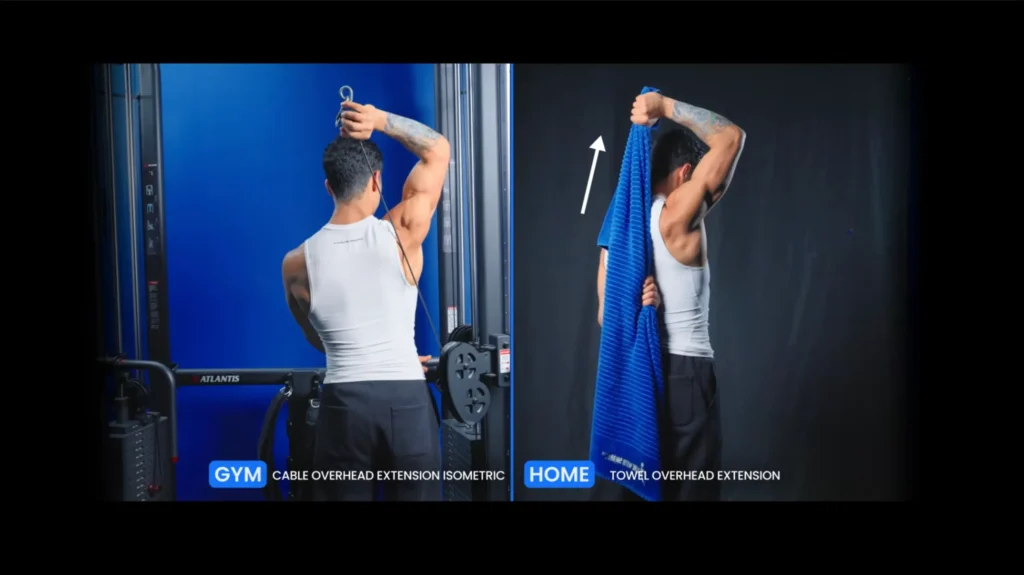
Keep in mind that recurring elbow pain can also stem from weaknesses further up the arm and shoulder.
Isometrics For The Biceps And Pulling Movements
If your elbow mainly hurts during a particular type of curl, use a lighter weight and hold the middle position of that curl.
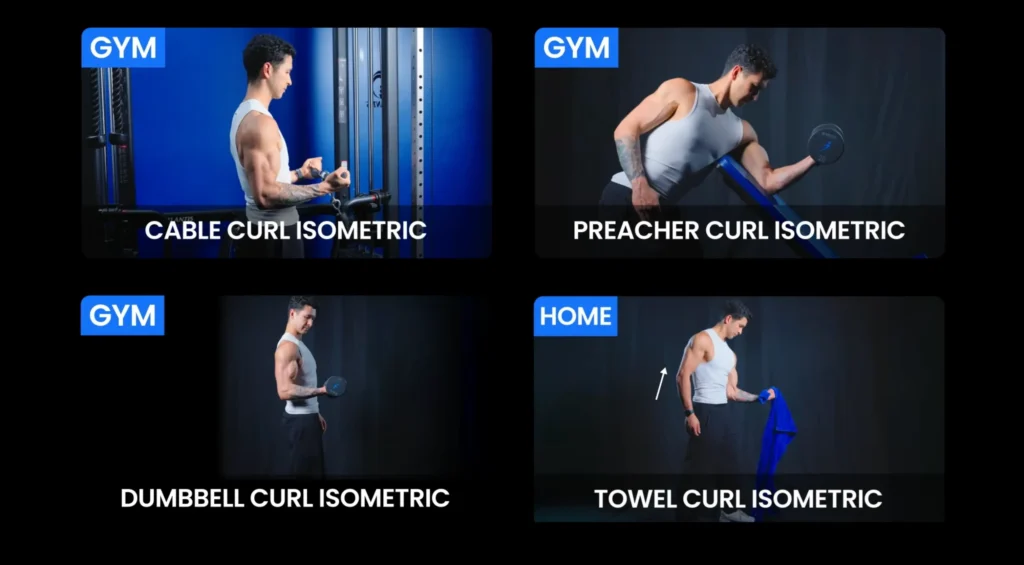
The same principle applies if the pain appears during pulldowns or chin-ups.
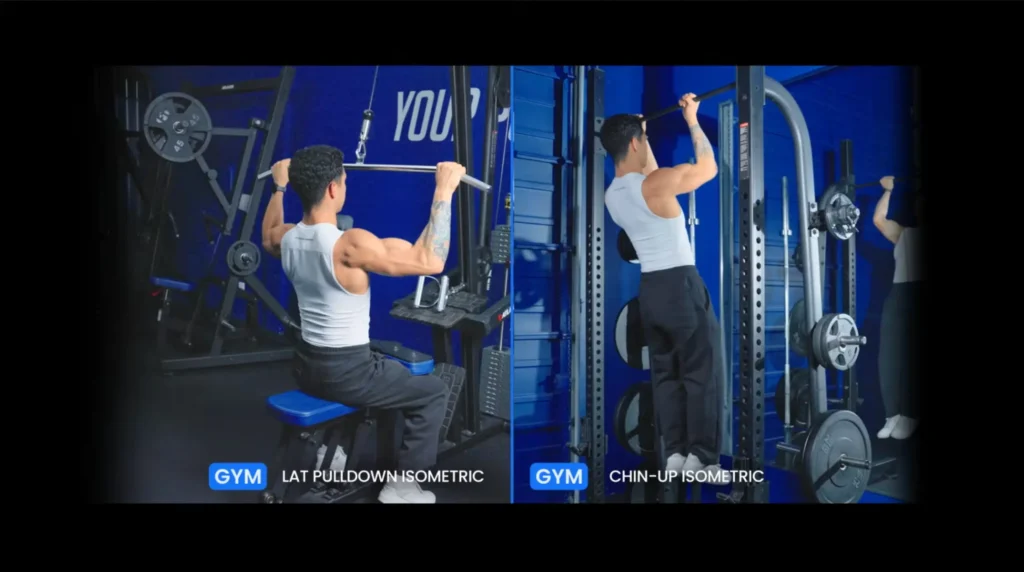
Choose a fixed pulling position that resembles the aggravating movement and hold it without allowing the joint to move.
Isometrics For The Triceps
If the pain appears during triceps pushdowns, use a pushdown-based isometric. If it appears during overhead extensions, use an overhead-extension-based isometric instead.
Matching the exercise to the sensitive movement helps load the tendon in the position where it appears to need more capacity.
What Are The Best Isometric Exercises For Your Knees?
The knee extension machine is one of the simplest and most accessible ways to perform a knee-focused isometric. Hold the knee-extension position without allowing the weight to move.
If you do not have access to a knee-extension machine, Coach Q also demonstrates a wall-based variation in which your back and hips stay against the wall, your heels are raised so only your toes contact the floor, and your knees move forward as you slide down.
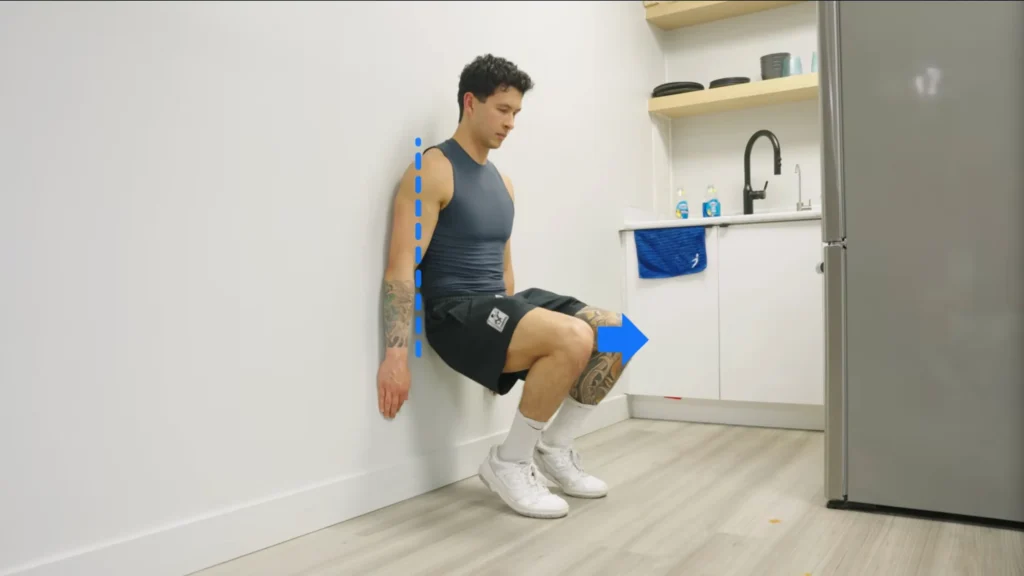
This recreates a loading pattern similar to a knee extension.
How Much Pain Is Acceptable During Tendon Exercises?
Some discomfort during a tendon isometric may be acceptable, but it should remain manageable and should not make the area feel worse the following day. There are two practical limits:
- Pain during the exercise should not rise above roughly 3–4 out of 10.
- The tendon should not feel worse the next day.
If either occurs, reduce the difficulty. You can use less weight or push with less force.
You may also notice temporary pain relief immediately after performing the exercise. However, short-term relief should not be confused with complete healing. Restoring tendon capacity requires consistent loading over a longer period.
How Often Should You Train Your Tendons?
The starting plan is to choose one isometric based on the joint and movement bothering you, perform three sets, and repeat the session twice a day. The proposed schedule is:
- Three sets in the morning
- Three sets in the evening
- At least 30 seconds per hold
Baar reports that some people begin feeling substantially better within the first week, while many notice significant improvement after roughly two weeks. These are possible responses rather than guaranteed recovery times.
For longer-term rehabilitation, he recommends continuing the exercises three to four times per week for at least four to eight weeks.
After that period, spending five to 10 minutes on tendon exercises after each workout may help maintain tendon health and reduce the risk of future problems. Pairing this with regular mobility work can also help keep the surrounding joints moving well.
The Bottom Line
Weak or painful tendons generally need appropriately managed loading, not indefinite complete rest. Because muscles can adapt faster than tendons, sudden increases in weight, volume, speed, or activity can create a gap between the force your muscles produce and the force your tendons can tolerate.
Isometric exercises offer one way to close that gap. Choose an exercise that closely matches the motion causing discomfort, hold it for at least 30 seconds, and complete three sets. The protocol described here begins with two daily sessions, followed by three to four weekly sessions for at least four to eight weeks.
Keep any discomfort within roughly 3–4 out of 10 and reduce the effort if the tendon feels worse the next day.
By the way, here’s the article summed up into a YouTube video:

For a program that incorporates these tendon rehabilitation exercises, along with joint-friendly alternatives for movements that bother you, the Built With Science app provides guided training and nutrition support. You can try it free for two weeks here:
Click the button below to try the BWS+ app for 2 weeks, for free, no strings attached:
↓
Frequently Asked Questions
Can Rest Heal A Tendon Injury?
Complete rest may temporarily reduce pain, but it does not necessarily rebuild the tendon’s ability to tolerate load. A tendon generally needs an appropriate loading stimulus to regain strength.
Are Isometric Exercises Good For Tendon Pain?
Isometrics are one of the most useful ways to load and strengthen a painful tendon. They allow you to produce substantial muscular force while keeping the joint in a fixed position.
How Long Should You Hold A Tendon Isometric?
The experts recommend holding the position for at least 30 seconds. Baar explains that this duration may help distribute the loading signal throughout the tendon, including its weaker areas.
How Quickly Can Tendon Pain Improve?
Some people may notice improvement within one or two weeks, according to Baar. Longer-term rehabilitation should generally continue for at least four to eight weeks.
Is Clicking A Sign Of Tendon Damage?
Clicking alone does not necessarily mean a tendon is damaged or weak. Clicking accompanied by pain is more concerning and may indicate that the tendon or surrounding area is sensitive.
Can Heavy Lifting Damage Your Tendons?
Heavy lifting is not automatically bad for your tendons. Problems are more likely when the load or volume increases faster than your tendons can adapt.
Should Tendon Exercises Hurt?
Mild discomfort may be acceptable, but keep pain no higher than roughly 3–4 out of 10. The area also should not feel worse the next day.
How Can You Keep Your Tendons Healthy?
Manage increases in training volume and intensity, avoid uncontrolled momentum unless you have adapted to it, and continue appropriate tendon-loading exercises consistently. Spending five to 10 minutes on these exercises after workouts, once the initial rehabilitation period is complete, can help.